Reality Fracture Chase: Scarcity Lessons from Black Lotus
Magic’s Reality Fracture chase is already the loudest story of the week: prerelease wraps around October 1, 2026, and tabletop street date is October 2. The headliner everyone screenshots is the serialized double-rainbow-foil Bloodline Recollector. Before you treat that chase like a guaranteed trophy, pair it with Magic’s oldest scarcity lesson—Black Lotus print culture—and ask what is actually known about supply versus what is only marketed.
This sits in Card Core’s Collector Guides cluster: liquidity first, hype second. For the week’s confirmed calendar context, see our TCG Drop Radar for the week of September 28, 2026.
What Wizards actually published for the Reality Fracture chase
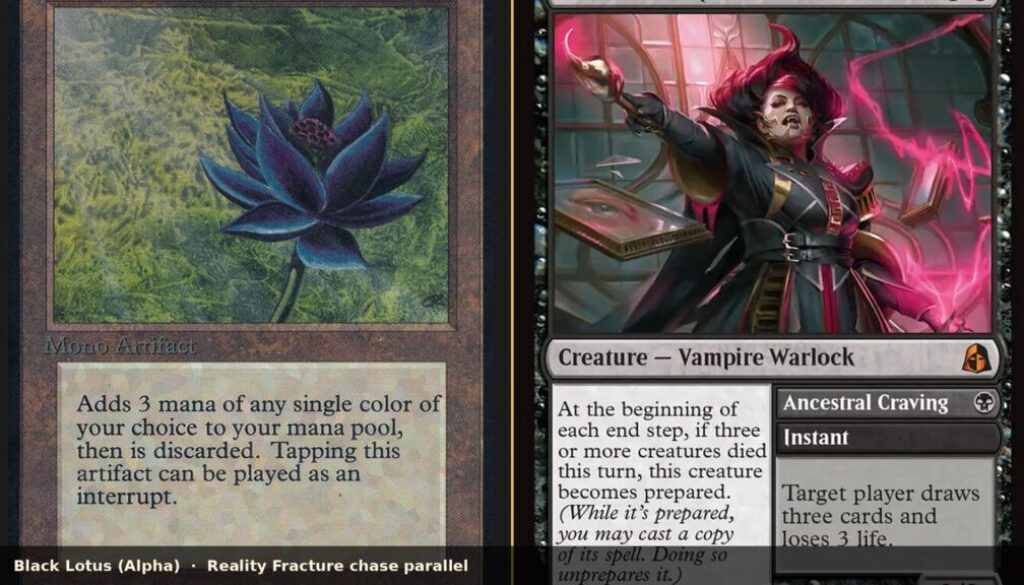
Wizards’ Collecting Reality Fracture article is the primary source. The set’s headliner is a serialized, double rainbow foil, throwback full-art Bloodline Recollector illustrated by Mark Poole (also the artist on Ancestral Recall). Key published facts:
- There are 500 serialized copies.
- They appear only in Reality Fracture Collector Boosters.
- They can show up in Collector Boosters of any language, but the card is always English.
- Wizards states a serialized copy appears in less than 1% of Collector Boosters.
- The non-serialized Bloodline Recollector is mechanically identical.
Collector Booster MSRP is listed at $26.99 on the same collecting guide and buyer’s materials. That MSRP is a list price for sealed product—not a forecast for singles or serialized clears.
Other Booster Fun treatments (shattered mirrors, Japan Showcase, Special Guests panorama, and so on) matter for sealed EV conversations, but they are not the same scarcity claim as a published 500-copy serialized headliner. When a print figure is not officially stated, omit it. Facet-foil shattered mirrors do carry approximate production language from Wizards in the same article; treat those as separate products with their own pull math, not as substitutes for the serialized chase.
Lottery math is not a buy thesis
A Reality Fracture chase with a published ceiling of 500 copies across worldwide Collector product is, by design, lottery-shaped. Most Collector Boosters will not contain it. Most sealed buyers will not open it. That is not a moral judgment; it is how serialized chase design works.
Liquidity questions for collectors buying sealed or singles around Reality Fracture:
- Are you paying for playable cardboard, for a specific Booster Fun treatment, or for a lottery ticket toward the serialized headliner?
- If the serialized card is the only “reason,” what is your exit plan if you open everything else?
- Completed sales for the exact printing and treatment beat ask screenshots—especially in the first weeks after street, when asks and social posts outrun clears.
We are not inventing comps, “EV,” or projected secondary prices here. Those move hourly and belong on completed-sale evidence for the exact SKU.
Historic parallel: Black Lotus scarcity myths vs verified supply
Black Lotus is Magic’s default scarcity metaphor. Older collector articles often repeated rough estimates on the order of about 1,100 Alpha copies and about 3,200–3,300 Beta copies. Those figures circulated for years as folk knowledge.
Better production anchors arrived in 2021, when former Wizards CEO Peter Adkison shared Carta Mundi purchase-order totals for Alpha and Beta that hobby researchers then applied to known pack collation and 121-card rare sheets. Reputable reconstructions of that math put each Alpha rare—including Black Lotus—around 1,008 copies produced, and each Beta rare around 3,025 copies produced. Detailed walkthroughs live at MTG Information’s print-run calculations and MTG Print Run’s methodology.
Important caveats—say them out loud:
- Those numbers are production estimates from product totals and sheet math, not a census of surviving Near Mint or graded copies.
- Losses, damage, counterfeits, and ungraded binders mean liquid supply is a different (and harder) problem than “cards printed.”
- Unlimited and later non-tournament printings are separate supply stories; do not collapse every Black Lotus into one scarcity number.
The lesson for a modern Reality Fracture chase is not “Lotus was fake scarce.” It is that scarcity narratives travel faster than verified supply data, and collectors who price the myth instead of the production math get surprised when deeper evidence lands.
For a related Reserved List liquidity classroom—play demand stacked on frozen supply—see our MTG dual lands liquidity lesson.
What translates from 1993 print culture to a 2026 serialized chase
| Question | Black Lotus (early printings) | Reality Fracture serialized headliner |
|---|---|---|
| Published official print run at launch? | No modern-style “500 copies” marketing at the time; production clarity came decades later via printer/Wizards testimony | Yes: Wizards published 500 serialized copies |
| Scarcity type | Early-run cardboard + Reserved List policy later | Intentional serialized lottery inside Collector Boosters |
| Liquid supply | Production ≠ surviving graded population | 500 printed still ≠ 500 sitting in liquid listings at once |
| Collector failure mode | Treating folk estimates as census truth | Treating “one of 500” as if every sealed purchase is close to the pull |
Serialized modern chase cards and early Power Nine cardboard are not the same asset class. One is a known-run specialty treatment inside a living Standard-era set. The other is foundational Reserved List history with decades of condition attrition. The parallel that does hold is behavioral: collectors overpay when they confuse marketing scarcity with exit liquidity.
Liquidity takeaways for Reality Fracture sealed and singles
- Separate products in your head. Play Boosters, Collector Boosters, Bundles, and Secret Lair Bundles are different SKUs with different chase densities. The serialized Bloodline Recollector is Collector-only per Wizards.
- Cite or omit. Use the official 500 figure for the serialized headliner. Do not invent pull rates beyond Wizards’ “less than 1% of Collector Boosters,” and do not invent secondary prices.
- Mechanically identical exists. If you want the card for play or for a non-serialized collectible look, the regular Bloodline Recollector is a different market than the serialized foil.
- Condition and venue still dominate exits. Even with a hard print cap, grade, centering, authenticity, fees, and buyer pool decide how fast a chase card clears—same pattern we track in card grading consolidation.
- Week-one noise is not structure. Prerelease hype and day-one asks are not completed-sale history. Wait for clears when the dollar risk is real.
- Lotus lesson applied: Prefer verified supply statements over folklore. When Wizards publishes a number, use it. When the hobby only has estimates, label them as estimates—or skip the number.
Bottom line
The Reality Fracture chase is real scarcity by design: Wizards published a 500-copy serialized Bloodline Recollector headliner inside Collector Boosters, with street date October 2, 2026. Black Lotus still teaches the complementary lesson—scarcity stories outrun supply evidence until someone does the production math. Buy sealed or singles for the product you actually want (play, non-serialized collects, or an explicit lottery), not for a screenshot of “one of 500” that assumes liquidity you have not verified.
Image sources: Black Lotus (Alpha) and Bloodline Recollector card scans via Scryfall; set facts from Collecting Reality Fracture on magic.wizards.com.