Short answer: the MTG Star Trek signed cards are seven hand-autographed headliner cards with fewer than 250 copies each, found only in Collector Boosters ($37.99 MSRP) when the set hits stores on November 13, 2026, per Wizards of the Coast. Early eBay asks sit near $30,000 for Kirk and Picard, but as of November 10 none had sold, and one Picard auction ended without meeting its reserve. The best guide to what happens next is the last capped Magic chase with years of data: The Brothers’ War serialized schematics, 500 copies of each card, still log only about three to five recorded sales per card per year on PriceCharting four years later.
Wizards’ Collecting Star Trek article lays out the rules. There are 7 different signed headliner cards. Each was printed, hand-signed by the actor who played the character, and randomly inserted into a Collector Booster. There are fewer than 250 copies of each. They can turn up in Collector Boosters of any language, but the card itself is always English. Wizards has not published pack counts or pull odds, so nobody can honestly tell you the chance per pack.
Captain James T. Kirk (#1701), signed by William Shatner
Captain Jean-Luc Picard (#1701D), signed by Patrick Stewart
Mr. Spock, Science Officer (#1702), signed by Ethan Peck
Lieutenant Commander Data (#1703), signed by Brent Spiner
Captain Kathryn Janeway (#1704), signed by Kate Mulgrew
Seven of Nine, Unassimilated (#1705), signed by Jeri Ryan
Lt. Cmdr. Geordi La Forge (#1706), signed by LeVar Burton
Card names come from Wizards; collector numbers and actor pairings are as listed by Cardsphere and NerdSnack. Seven cards at fewer than 250 each means fewer than 1,750 signed cards in the whole print run. The first one surfaced early: Game Rant reported on November 8 that a game store had already pulled a signed Picard, days before street date. Patrick Stewart died on October 28, 2026, which has put that card at the center of early attention.
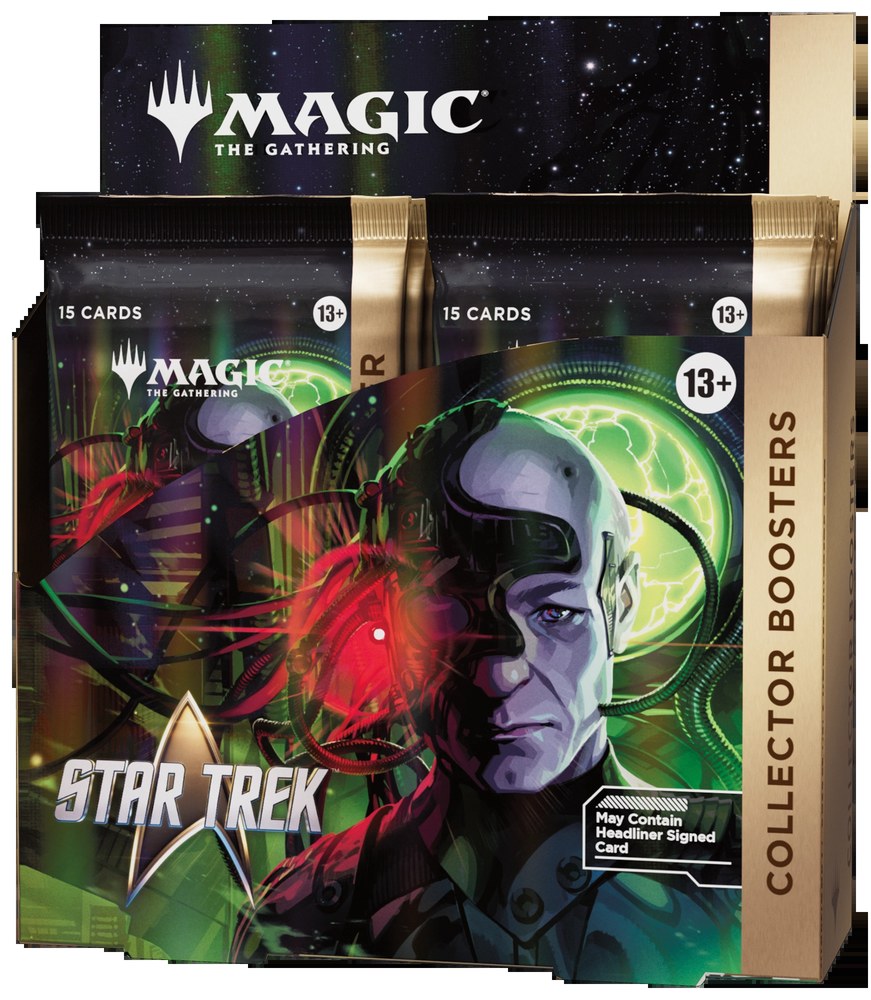
Star Trek Collector Boosters are the only place the signed headliners appear. Image source: Wizards of the Coast
Asks are not prices yet
Draftsim logged the first eBay listings on November 10. Every number below is an asking price, not a sale:
Signed headliner
Early eBay ask (Nov 10)
Sold?
Captain James T. Kirk
About $30,000
No
Captain Jean-Luc Picard
About $30,000
No (auction ended below reserve)
Captain Kathryn Janeway
$20,000
No
Lt. Cmdr. Geordi La Forge
$15,165
No
Lieutenant Commander Data
$9,500
No
Source: Draftsim, updated November 10, 2026. NerdSnack found no TCGplayer listing or sale for any of the seven as of November 10.
Two things stand out. First, the spread between asks for cards with the same cap (Data at $9,500, Kirk at about $30,000) tells you that sellers are guessing. Second, a failed Picard auction is real information: at least one seller set a floor higher than any bidder would pay. Until a few copies actually change hands, there is no price. There is only a range of hopes.
Compare that with the same characters in unsigned form. UnboxTCG logged TCGplayer prices on November 10 of $299.98 for the showcase surge foil Mr. Spock and $297.99 for the surge foil Picard. Those versions already have enough copies moving to form a price. The signed versions do not.
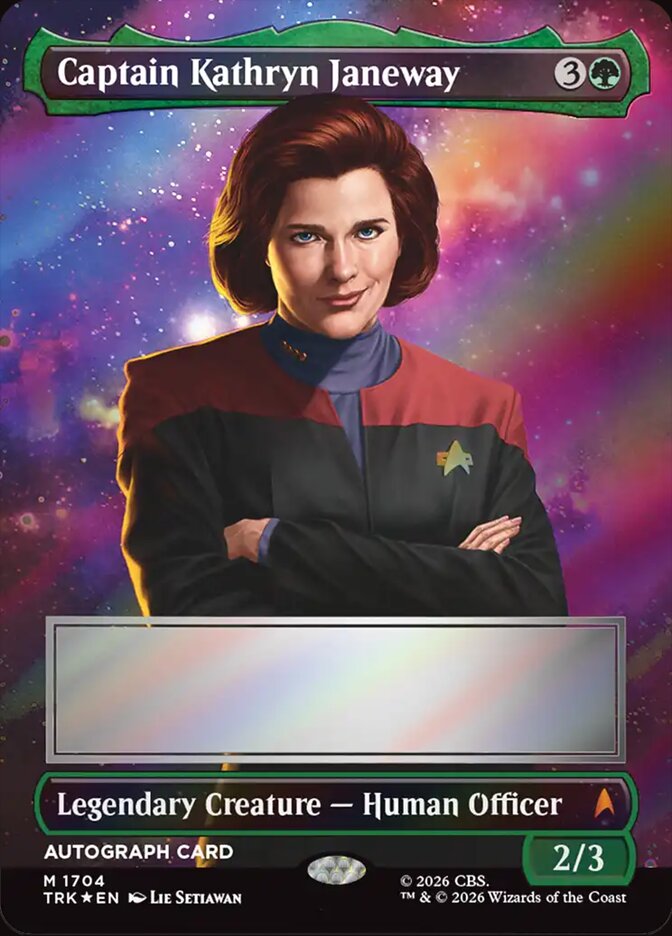
Captain Kathryn Janeway #1704, shown as Wizards’ digital rendering. Real copies carry Kate Mulgrew’s signature in the blank panel. Image source: Scryfall (Wizards of the Coast)
The historic lesson: Brothers’ War serialized schematics
The Brothers’ War (November 18, 2022) brought what Wizards called a first for any Magic set: serial-numbered cards. Per Wizards’ booster breakdown, each of the 63 schematic retro artifacts got 500 serialized copies, numbered 1 to 500 in double rainbow foil. They appeared in fewer than 1% of Collector Boosters. That is 31,500 numbered cards spread across 63 names.
Launch week looked like a gold rush. MTG Rocks tracked a serialized Wurmcoil Engine #217/500 selling for $1,000 on a single bid, and #159 for $710. Soon after, the TCGplayer buyer’s guide noted that most early eBay sales landed between $250 and $600, with only Chromatic Star 001/500 clearing $1,000. Here is what four of those cards have done since, using only PriceCharting sale rows whose titles show a serialized copy:
$497.99 and $498 (Sep to Oct 2025), $449.99 (Jan 2026), $799.99 (411/500, Oct 13, 2026)
Source: PriceCharting completed-sale logs and volume ratings (eBay and TCGplayer), checked November 12, 2026. Duplicate rows for the same copy counted once.
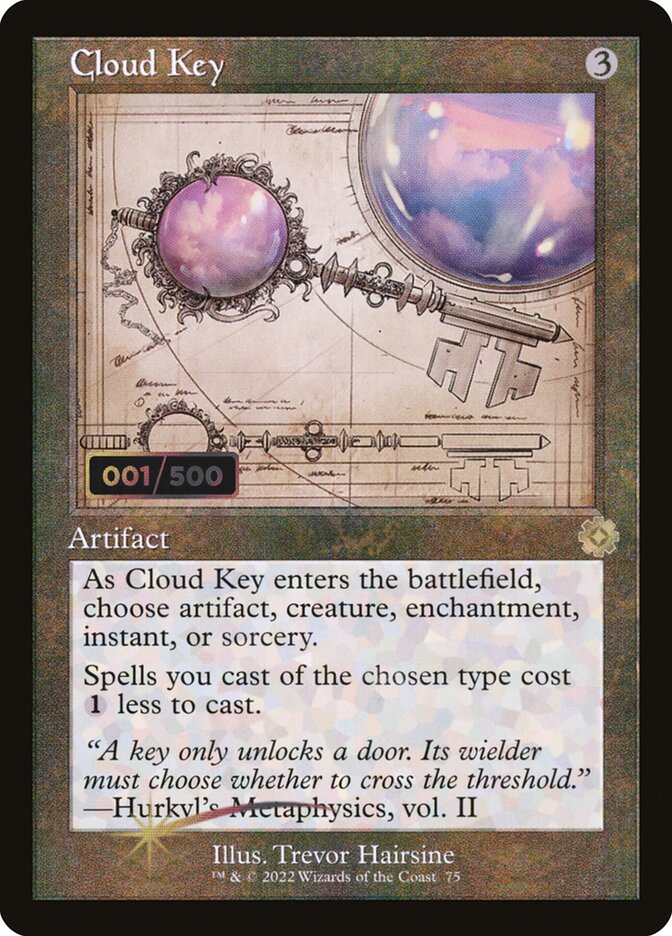
Serialized Cloud Key: $150 to $200 in late 2024, about $500 in 2026. Image source: Scryfall (Wizards of the Coast)
Read that table as a liquidity record, not a price forecast. With 500 copies of each card, these chases still trade a handful of times a year. Prices moved in both directions: Wurmcoil Engine never got back to its launch-week $1,000, while Cloud Key more than doubled from its 2024 sales. A fixed print run did not set the direction. Demand for the specific card did, and with so few sales, a single trade can move the “price” by hundreds of dollars.
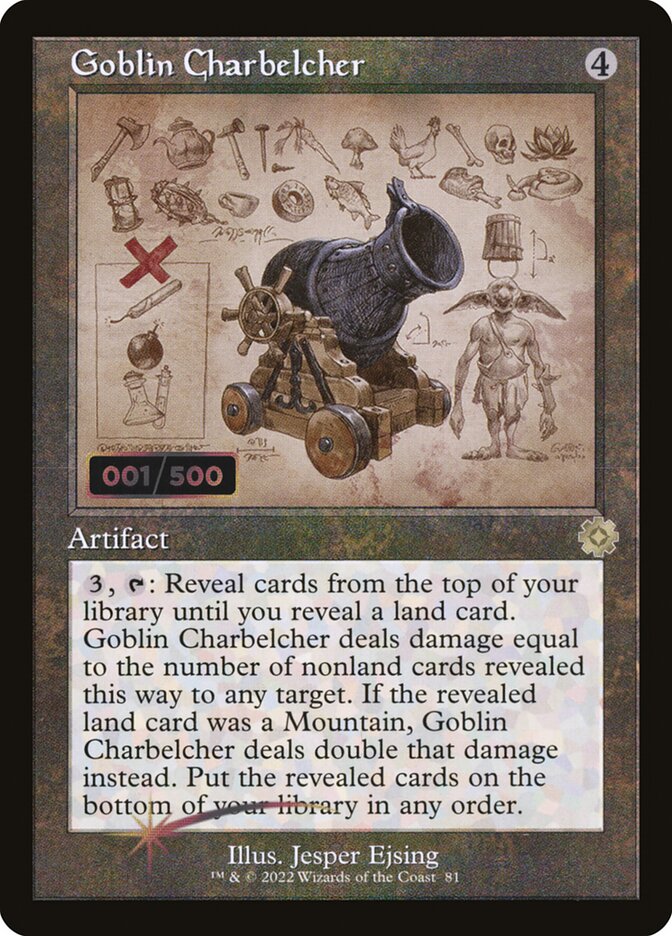
Serialized Goblin Charbelcher: one $799.99 sale in October 2026 after three trades near $450 to $500. Image source: Scryfall (Wizards of the Coast)
What the lesson means for the signed headliners
Expect even thinner trading. Each signed card has fewer than half the copies of a Brothers’ War serialized card, and only seven names exist. If a 500-copy card logs three to five sales a year, a sub-250 card can go months between public sales.
No two copies are identical. A serial number is the only difference between two Brothers’ War serialized copies. A hand signature adds placement, boldness, and smudge risk, so comparable sales will be harder to match.
Launch prices are the noisiest. The Wurmcoil record shows how a first-week sale can become an anchor that later sales don’t reach. The first few signed sales will say more about who was bidding that week than about long-run value.
Demand beyond Magic matters. These cards will also draw Star Trek autograph collectors, which no serialized schematic ever had. That can support prices, but it does not make the cards trade more often.
How to act on Star Trek release weekend
If you pull one: sleeve and top-load it right away and handle it by the edges, because the signature is the value. Don’t price it off the asks above. Wait for real completed sales of that exact character, or run an auction with a reserve you would honestly accept. If the reserve isn’t met, that tells you something about the market too.
If you want to buy one: price against sold listings only, compare the signature itself, and expect early sellers to test the ceiling. A three-to-one spread in asks between cards with the same cap tells you there is no shared anchor yet.
If you are buying sealed: a $37.99 Collector Booster is a bet on the rest of its contents, with an unpublished chance at a signed card. Buy it for what you know you get. Our Nov 13 radar breaks down the Beam Me Up Bundle’s $99.99 against its boosters at MSRP. Full product details are on Wizards’ Star Trek product page.
Quick answers
How many MTG Star Trek signed cards are there? Seven different cards, each with fewer than 250 copies, per Wizards. That puts the total under 1,750.
Are the signed cards serialized? Wizards does not describe them as serial-numbered. It says only that there are fewer than 250 of each.
What are they worth? No sale had been recorded as of November 10, 2026. Early eBay asks ranged from $9,500 (Data) to about $30,000 (Kirk and Picard). An ask is not a value.
What are the odds of pulling one? Wizards has not published odds or Collector Booster print totals, so any per-pack figure you see is an estimate.
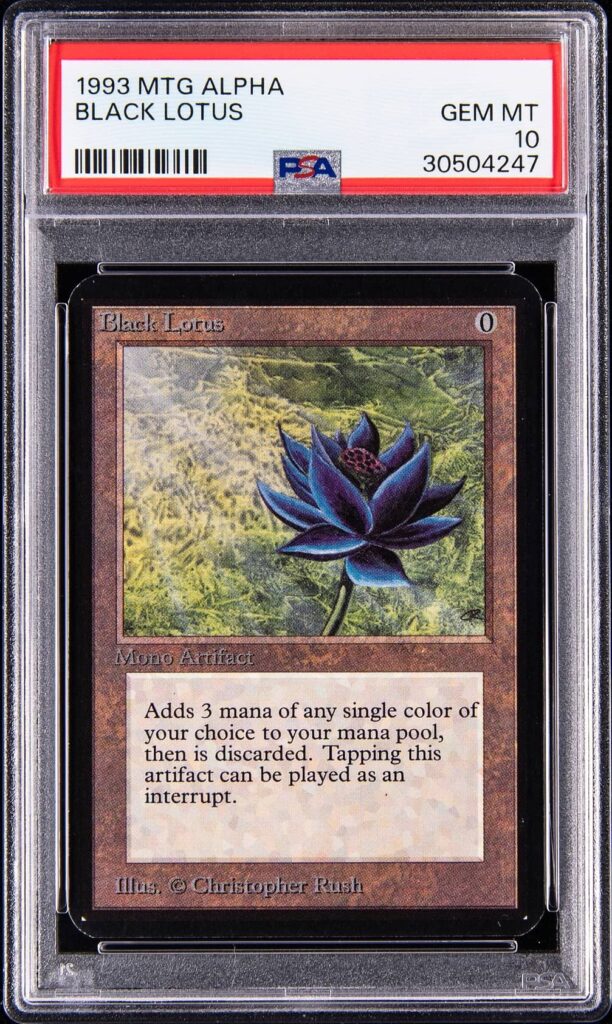
Black Lotus does not have one price. It has a ladder. The public auction record is $2.208 million, including buyer’s premium, for a PSA Gem Mint 10 Limited Edition Alpha copy that Goldin sold in its 2026 Summer Goldin 100 auction (ICv2, September 20, 2026). That card is one of only three Alpha Black Lotus copies at PSA 10. PSA’s CardFacts population table, checked October 20, 2026, lists 21 at PSA 9 and 41 at PSA 8. Edition (Alpha, Beta, or Unlimited) and grade decide which Black Lotus market you are actually in, and nearly every headline comes from the thinnest rung of that ladder.
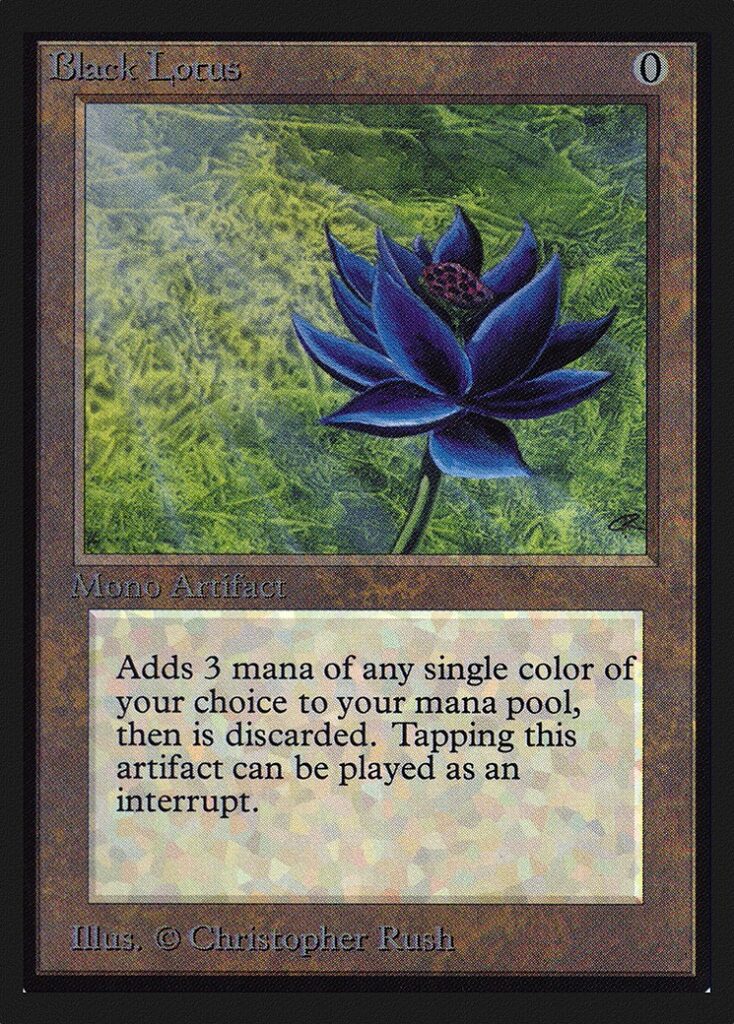
Black Lotus, illustrated by Christopher Rush, was printed for regular play in three 1993 core-set runs: Limited Edition Alpha (August 5), Limited Edition Beta (October 4), and Unlimited Edition (December 1), per Scryfall’s printing records. Wizards of the Coast lists it on the Reserved List in its Official Reprint Policy, which says reserved cards “will never be printed again in a functionally identical form.”
What gets talked about less is how little the card is played. Wizards’ Banned and Restricted list restricts Black Lotus in Vintage, so a deck can run only one copy, and bans it in Legacy and Commander. The original dual lands still get Legacy and Commander play, which gives them buyers who just want to use them. Black Lotus has very little of that. Its demand leans heavily on collectors, so its liquidity depends on collector money and on the condition of each copy.
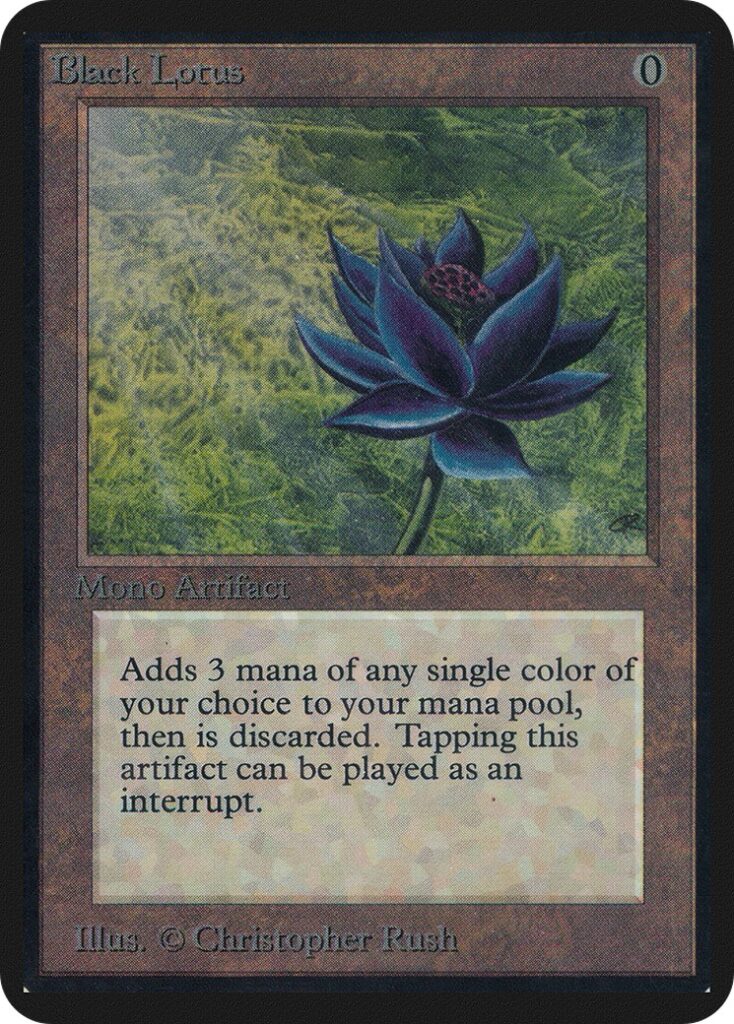
Limited Edition Alpha Black Lotus (#232). Alpha’s rounded corners are the quickest way to tell it apart from Beta. Image source: Scryfall
Edition is the first liquidity split
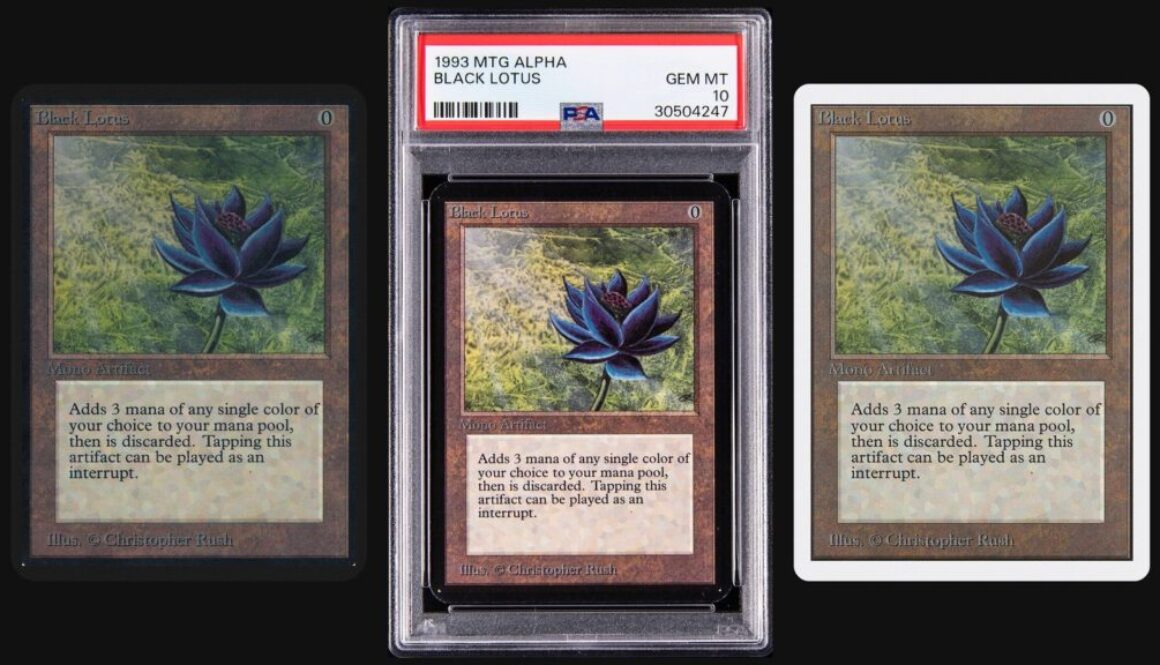
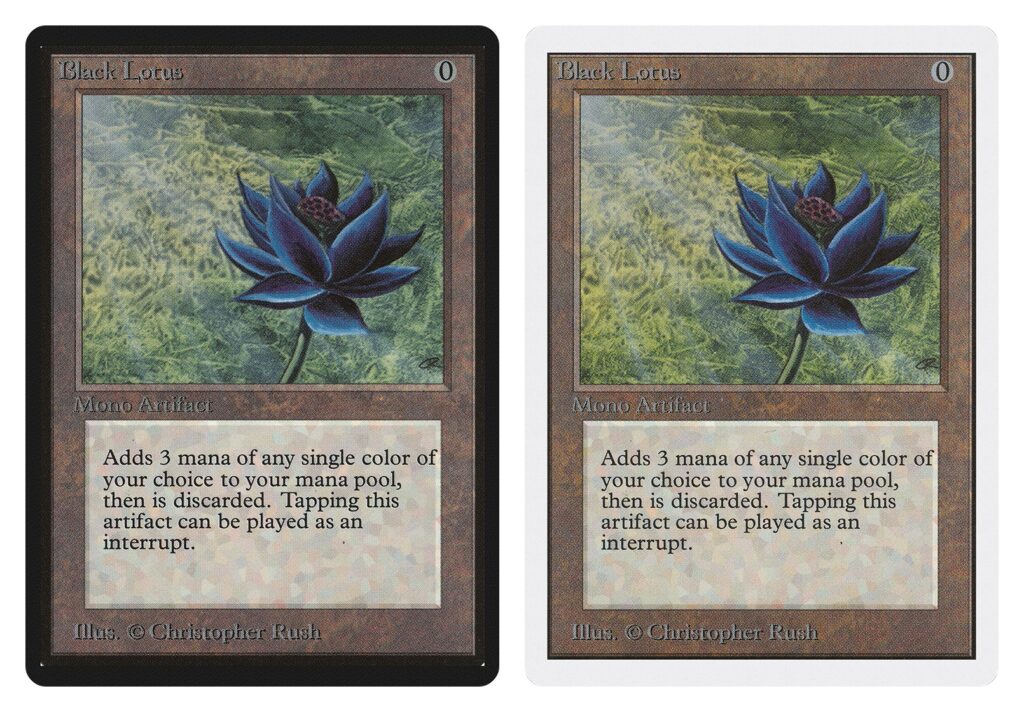
The three playable printings share the same art and text. You tell them apart by their physical features. According to Misprint’s Alpha vs Beta vs Unlimited guide, Alpha has noticeably rounded corners and a black border. Beta keeps the black border but has squarer corners. Unlimited switched to a white border. The same guide gives commonly cited whole-set print runs of roughly 2.6 million Alpha cards, 7.3 million Beta cards, and 40 million Unlimited cards. Those are totals for every card in each set, not counts of Black Lotus. Estimates for Lotus alone vary by source, so we leave them out here.
For a buyer, that splits the card into three different markets:
Alpha: the trophy tier. It has the smallest supply, the most fragile corners, and the sales that make headlines.
Beta: the black-border look without the Alpha premium. Misprint calls Beta “the usual target” for players who want an authentic 1993 card without paying the Alpha premium.
Unlimited: the largest supply and the most realistic first Black Lotus for most collectors. The white border makes it easy to identify, and it has the deepest pool of copies to compare.
Black Lotus in Limited Edition Beta (left) and Unlimited Edition (right). Same card, different supply, different market. Image source: Scryfall (Beta) and Scryfall (Unlimited)
The grade cliff: what the population reports show
PSA’s CardFacts page for the Alpha Black Lotus shows how few copies reach the top. These are the counts we saw on October 20, 2026. Population reports change as cards are submitted, crossed over, or resubmitted, so check the live page before you rely on them.
CGC’s numbers are just as steep. When Goldin sold a CGC 9 Alpha Black Lotus for $138,402 in August 2025, CGC reported 51 Alpha Lotus copies in its population report, with only 9 graded higher than that one (CGC). Here is how sourced public results line up by tier:
The PSA 10 and the CGC 9 above sold a year apart and were graded by different companies, so you can’t read a clean ratio from them. Still, the 2026 PSA 10 brought more than fifteen times the 2025 CGC 9. At the top of the ladder, a one-grade difference isn’t a small adjustment. It puts the card in a different market with a different set of buyers.
The PSA Gem Mint 10 Alpha Black Lotus (cert 30504247) that set the public auction record at Goldin in 2026. Image source: ICv2, imaged by Goldin
Three reasons a headline price is not a market price
Bids are not clearing prices. In the January 2021 PWCC auction of an Alpha PSA 10, early bidding pushed the price past $700,000. Some of those bids were then disallowed because the bidders couldn’t be verified. The final winning bid was $511,100 (ICv2). A screenshot taken mid-auction would have overstated the price by a wide margin.
The same grade can still look different. ICv2 reported that observers noticed more white printer cut marks on the corners of the 2026 Goldin PSA 10 than on other PSA 10 copies, such as the one sold in 2021, and suggested this may have held bidding back a little. The same article notes that PSA Gem Mint cards tend to sell for more at auction than similar cards graded by other services. The label on the slab and the card inside both affect the price.
Private sales can’t be checked. The $3 million CGC Pristine 10 sale was private, and ICv2 pointed out the large gap it opened between private-sale and auction prices for Black Lotus. Outsiders can’t verify the terms. Treat it as a data point about one unique card, not a price for anyone else’s copy. Even public auction prices like the $2.208 million include the buyer’s premium, so the seller received less after fees. Check the auction house’s terms before you compare a headline with what a seller actually keeps.
Collectors’ Edition, 30th Anniversary, and the Reserved List fine print
Wizards’ reprint policy says its rules “apply only to tournament-legal Magic cards” and allows special-purpose versions “not meant for regular game play.” That is why Black Lotus exists in other forms. The December 1993 Collectors’ Edition reused Beta card faces with square-cut corners and gold-bordered backs. Wizards originally announced 10,000 sets for the U.S. and Canada and added about 5,000 International Edition sets, according to Peter Adkison’s newsgroup post as quoted by the MTG Wiki. Under Magic Tournament Rules section 3.3, cards with gold borders on the front or back are not Authorized Game Cards (Magic Judges rules resources).
In 2022, Wizards sold 30th Anniversary Edition for $999 per display. It was a non-tournament-legal product with its own card back, and its retro-frame rare slot could include Black Lotus. The Reserved List protects the supply of tournament-legal copies. It does not stop non-playable reprints of the card. A listing titled just “Black Lotus” could be any of these, so always confirm the edition, corners, border, and card back before comparing prices.
Collectors’ Edition Black Lotus (1993). The front copies Beta, but the corners are square and the gold-bordered back makes it non-tournament-legal. It is a separate market from Alpha, Beta, and Unlimited. Image source: Scryfall
A practical Black Lotus framework
Pick your market first. High-grade Alpha is a trophy market. Beta is the black-border collector’s market. Unlimited in mid grades is the first-Lotus market. Collectors’ Edition, International Edition, and 30th Anniversary are non-playable collectibles. Each has its own buyers and its own sales history.
Compare like with like. Match the edition, grading company, and grade, and use completed public sales such as auction-house archives and PSA’s Auction Prices Realized. Asking prices and estimated values are not sales.
Look up the cert. Check every slab’s certification number on the grader’s own site. Misprint notes that Alpha and Beta cards are among the most faked in the hobby, so buy raw copies only from sellers who let you inspect the corners and borders closely.
Run the grading math before you submit. Grading pays off only if the likely grade’s real completed-sale price, minus the raw card’s value, is more than the grader’s fee for that declared value plus insured shipping both ways. For Alpha, the population ladder shows that most copies land well below Gem Mint, so plan around a mid-grade result.
Price the net, not the headline. Buyer’s premiums, seller fees, insurance, and time on market all come out of the result. A record price shows the most one buyer was willing to pay for one copy. It does not tell you what you’ll net when you sell yours.
The bottom line
Black Lotus clearly shows how one famous name can hide several separate markets. The $2.208 million record is real, but it came from one of three PSA 10 Alphas. For most collectors, the realistic choice is a mid-grade Unlimited or Beta copy, and each of those has its own buyer pool and its own completed sales. Pick your edition and grade first, then compare like with like. The headline price tells you what one copy brought, not what yours is worth.
MTG God Packs are coming back. On October 5, 2026, Wizards of the Coast announced a booster overhaul that starts with Nauctis: The Sunken Realm, the first Magic set of 2027, due February 5, 2027. Roughly 1 in every 1,000 Booster Packs and 1 in every 300 Collector Boosters will be a God Pack stuffed with rares and mythics. The same announcement removes foil commons and uncommons from Booster Packs and takes three cards out of every Collector Booster. The God Pack gets the headlines. The rest of the changes are what will actually show up in most of the packs you open.
This is a structure story, not a price call. Below: what changes, what the odds mean for a real buyer, and how to adjust before Nauctis preorders open. No comps, no print runs, nothing Wizards hasn’t published. For more pieces like this, see Market News, the Collector Guides hub, and our Magic: The Gathering coverage.
Play Boosters are renamed Booster Packs. WPN calls this “a name change, not a new product.” They are still the packs used for Prerelease, Draft, and Sealed.
God Packs show up in every Magic Multiverse set starting with Nauctis. Universes Beyond sets are expected to get them in 2028.
Booster Packs drop foil commons and uncommons, and a foil is no longer guaranteed in every pack. Any foil you do open in a Booster Pack will be a rare or mythic rare.
Foil rare and mythic rates go up in Booster Packs, and traditional-foil Japan Showcase cards can now appear in the Booster Pack wildcard slot. Until now they were Collector Booster–only.
Collector Boosters lose two foil commons and one foil uncommon. Those three cards are not replaced.
No MSRP change. Wizards wrote that “none of these changes come with any adjustments to prices.”
Wizards explains the trade directly. Pulling the low-interest foils frees up printing capacity for God Packs and for Japan Showcase cards in Booster Packs. Magic communications director Blake Rasmussen gave Polygon a similar explanation: removing those cards “reduces our overall printing complexity to a noticeable degree.”
What’s inside MTG God Packs
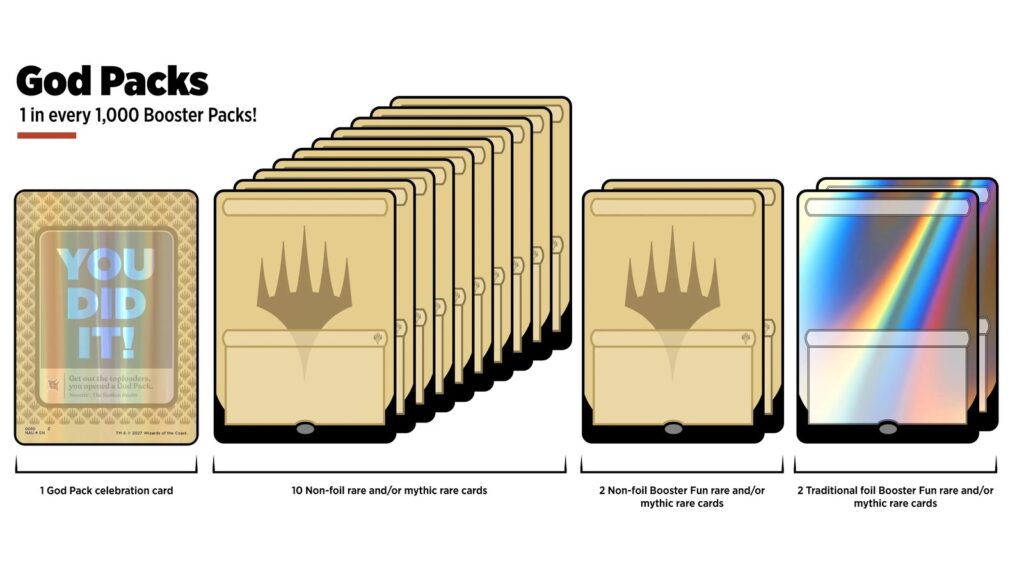
From the outside, a God Pack looks like any other pack. WPN says it is “not a separate product to order.” It is mixed in at random with the Booster Packs and Collector Boosters a store already stocks. In a Booster Pack, about 1 in 1,000 will contain:
1 “You did it!” God Pack celebration card
10 non-foil rare and/or mythic rare cards
2 non-foil Booster Fun rare and/or mythic rare cards
2 traditional foil Booster Fun rare and/or mythic rare cards
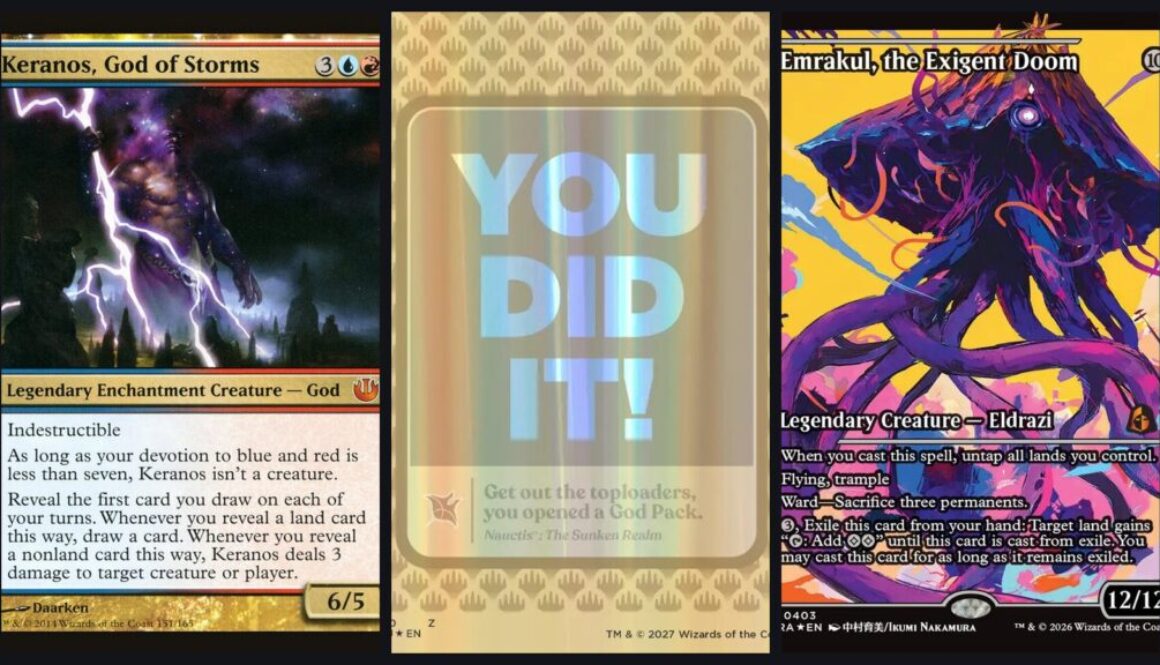
That makes 14 rares or mythics and a keepsake card, with no commons or uncommons. Polygon reports Rasmussen’s description of the celebration card as both a reference card and something to display. On the sample shown by Wizards, it reads “Get out the toploaders, you opened a God Pack.”
Booster Pack God Pack layout: one celebration card plus 14 rares and mythics, about 1 in 1,000 packs. Image source: Wizards of the Coast
Collector Booster God Packs, and the three missing cards
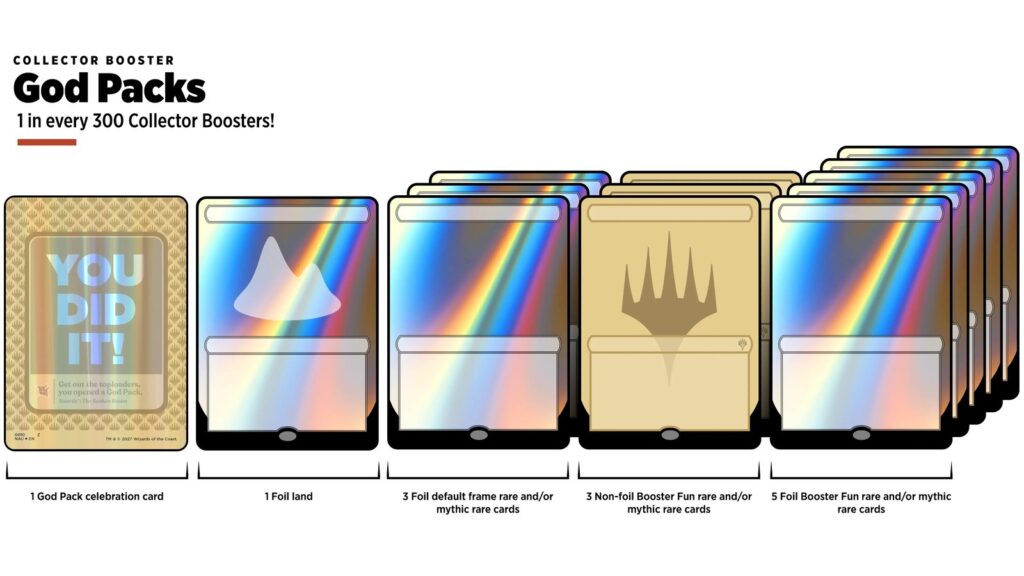
Collector Boosters get better God Pack odds, about 1 in 300, and a more premium layout: a celebration card, one foil land, three foil default-frame rares or mythics, three non-foil Booster Fun rares or mythics, and five foil Booster Fun rares or mythics. Wizards says that last group, the “foil fancy slot” five times over, could in theory hold more than one headliner card, but calls that “pretty improbable.”
The bigger change for anyone who buys Collector Boosters regularly is the other one. Starting with Nauctis, every regular Collector Booster has three fewer cards: two foil commons and one foil uncommon, not replaced. GameSpot reports that this takes the pack from 15 cards to 12. Wizards is open about it: “How does removing cards make opening Collector Boosters more exciting? We’ll be honest here—it doesn’t.” The stated reason is that most openers skip those cards anyway.
For collectors, the useful takeaway is this: same MSRP, fewer cards, and value even more concentrated at the top of the pack. If you already think about Collector Boosters as a few slots that matter plus filler, that’s now closer to literally true. If you liked those foil commons for a cube, a Pauper deck, or a foil set, there are fewer of them per pack, and from Nauctis on, Collector Boosters are the only booster that still has them.
Collector Booster God Pack layout, about 1 in 300 packs. Regular Collector Boosters lose three foil commons and uncommons. Image source: Wizards of the Coast
God Packs aren’t new: the Journey into Nyx precedent
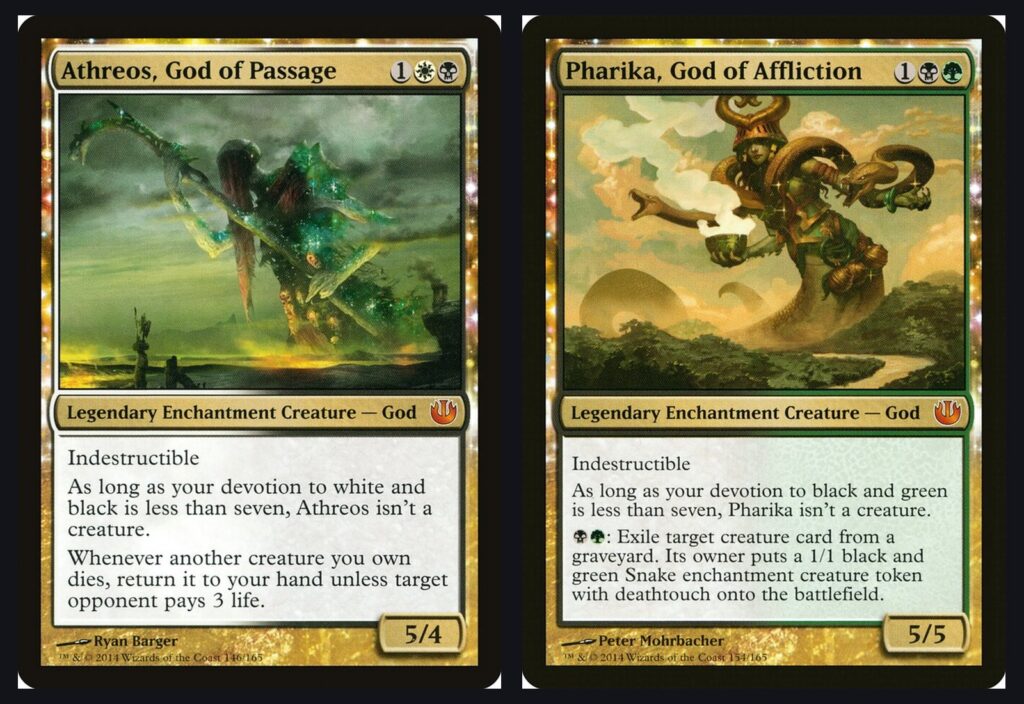
Magic has done this before. As Polygon recounts, Journey into Nyx boosters in 2014 had a very slim chance of being a pack made entirely of Theros-block gods. Back then it was a one-time surprise. In 2027 it becomes a standing feature of every Magic Multiverse set, with published contents and published odds. Rasmussen told Polygon that bringing God Packs back as a regular feature “has long been at the top of our list of wants.”
That difference matters for collectors. A one-off God Pack was a story. A recurring God Pack with known odds is a probability you can reason about. In practice, it’s a lottery ticket attached to every pack, and lottery tickets are easy to overpay for.
Journey into Nyx (2014) gods Athreos, God of Passage and Pharika, God of Affliction. That set’s god-only packs are the precedent for the 2027 God Packs. Image source: Scryfall
Japan Showcase cards and better foil odds in Booster Packs
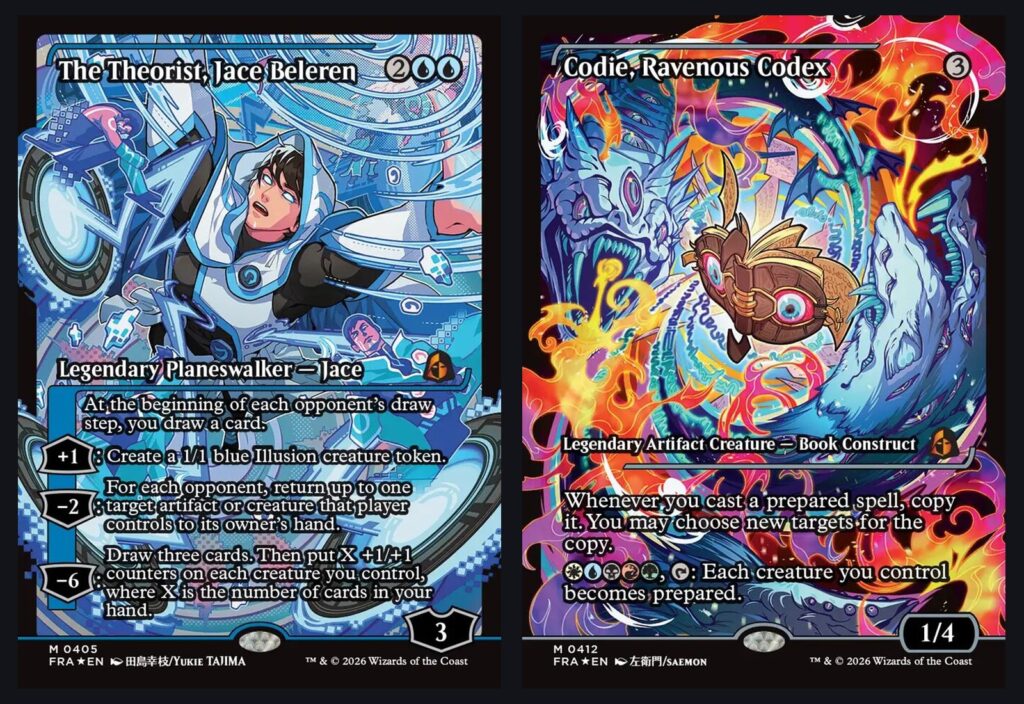
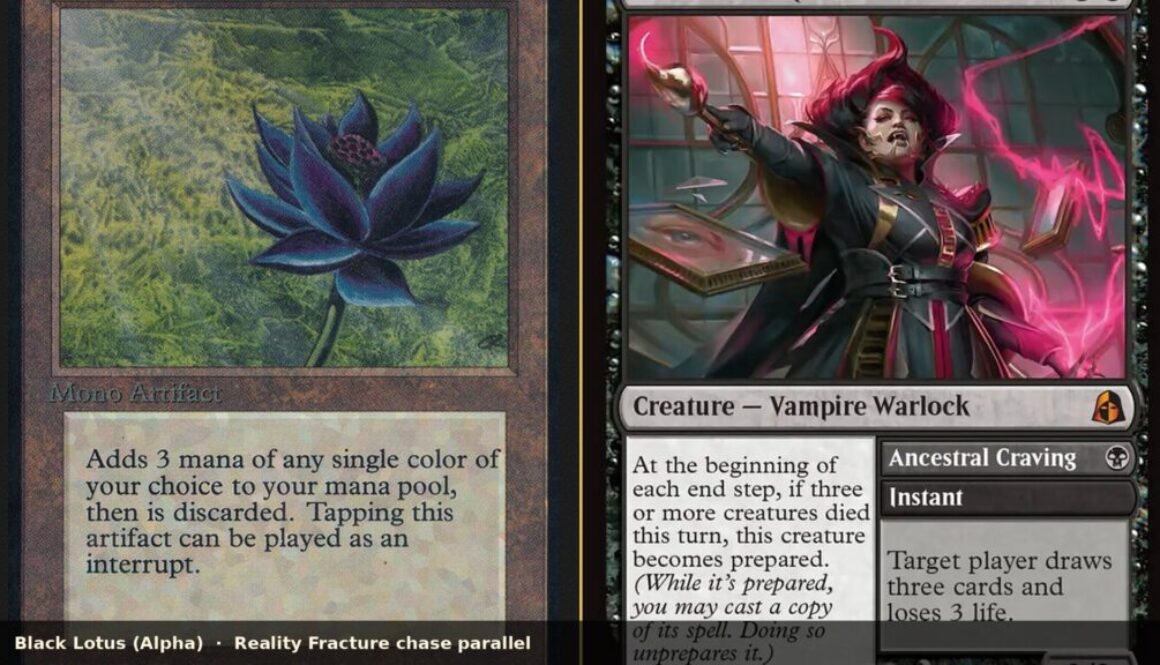
The change that affects the most packs is the least flashy one. With foil commons and uncommons gone from Booster Packs, the foils that remain are all rares and mythics. Rasmussen told Polygon that the chance of a foil rare or mythic in a Booster Pack rises from roughly 7% to 10%. Traditional-foil Japan Showcase cards, which recent sets limited to Collector Boosters (Reality Fracture’s run includes cards like Emrakul, the Exigent Doom), will appear in the Booster Pack wildcard slot at about 1%, per the same report.
Two things follow from that. First, a treatment that used to come only from Collector Boosters will now also come from the cheaper pack. Over time, that can change how scarce a Japan Showcase card in traditional foil really is, compared with the specialty-foil versions that remain Collector Booster chases. Second, if you used foil commons as cheap upgrades, Booster Packs will no longer supply them at all. We covered how treatment rarity differs from real scarcity in our Reality Fracture chase breakdown. The same lesson applies here: a published drop rate tells you how often a card appears, not how much buyer demand there will be for it.
Reality Fracture Japan Showcase cards: The Theorist, Jace Beleren and Codie, Ravenous Codex. Starting in 2027, traditional-foil versions of this treatment can come from Booster Packs. Image source: Scryfall
What 1 in 1,000 actually means
Published odds are averages, not a schedule. Polygon reports that God Packs are inserted completely at random, with no guarantee that one appears in any particular display, case, pallet, or region. If you treat each pack as an independent shot at the stated rates, the math works out like this:
Booster Packs (1 in 1,000): about a 9.5% chance of at least one God Pack in 100 packs, 39% in 500 packs, and 63% in 1,000 packs.
Collector Boosters (1 in 300): about a 3.9% chance in 12 packs, 28% in 100 packs, and 63% in 300 packs.
Even opening the full “1 in” count leaves roughly a one-in-three chance of getting none. For a collector buying a box or two, a God Pack is a bonus you might get, not something to plan a purchase around. Pricing sealed product as if a God Pack were likely is how a fun feature turns into an expensive mistake.
A collector playbook for the 2027 booster changes
Don’t pay a God Pack premium. Wizards held MSRP flat, but what you pay at the counter is set by the market. If a listing or a break sells “God Pack odds” as the reason for a higher price, run the numbers above first. At these rates, the God Pack chance shouldn’t add much to what a single pack is worth to you.
Re-check Collector Booster math, not just the headline. Three fewer cards per pack at the same MSRP means more of your expected value sits in the top slots. Before Nauctis preorders, compare the cost of a Collector Booster with simply buying the singles you want. Our sealed vs singles guide covers that comparison step by step.
Buy loose packs from sellers you trust. A rare pack worth searching for gives people a reason to search. Sealed displays from authorized retailers are still the safest way to get untouched odds. Be careful with loose packs from unknown sellers, the same as you would with any high-variance product.
Know the event rule. If you open a God Pack at Prerelease or Draft, stop and call a judge. WPN strongly recommends that stores let you keep the God Pack and replace it with a fresh Booster Pack at no charge. At competitive events where Wizards supplies the product, such as Regional Championships and the Pro Tour, removing and replacing it is required. Casual events can choose to leave it in the pool.
Track Universes Beyond separately. God Packs come to Multiverse sets in 2027 and are expected for Universes Beyond in 2028. Rasmussen told Polygon the delay comes from the longer production timelines for partner sets. Don’t assume a crossover set in 2027 has God Packs unless Wizards says it does.
Value cards for demand, not for how they were pulled. A rare from a God Pack is the same card as that rare from a normal pack. The celebration card is new, and it’s too early to say how collectors will value it, so don’t assume it holds a premium. Lasting demand comes from cards people want to play and keep, a point our MTG dual lands liquidity lesson makes with three decades of history.
Bottom line
MTG God Packs arrive with Nauctis: The Sunken Realm on February 5, 2027. They appear in about 1 in 1,000 Booster Packs and 1 in 300 Collector Boosters, inserted at random, and Universes Beyond sets are expected to follow in 2028. To make room, Booster Packs lose foil commons and uncommons and gain better foil rare odds and Japan Showcase chances, while Collector Boosters drop three cards at the same MSRP. Treat the God Pack as a fun bonus, recheck your Collector Booster math, and judge every card by the demand behind it, not by the pack it came from. Check the Wizards announcement for updates as Nauctis previews begin.
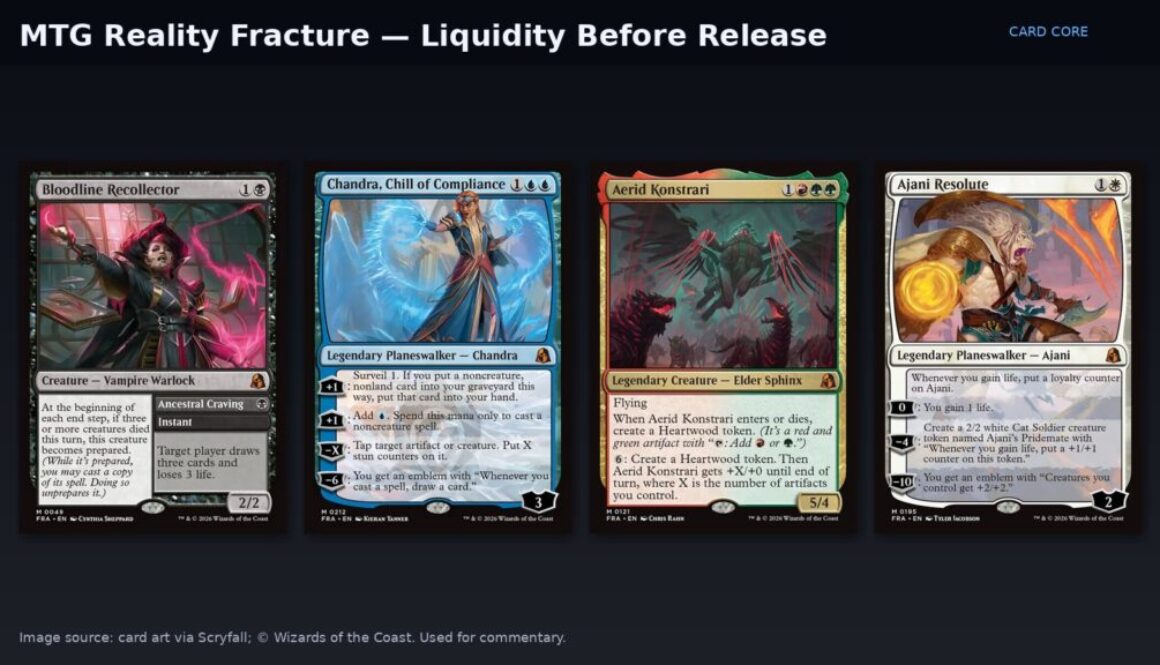
Magic’s Reality Fracture chase is already the loudest story of the week: prerelease wraps around October 1, 2026, and tabletop street date is October 2. The headliner everyone screenshots is the serialized double-rainbow-foil Bloodline Recollector. Before you treat that chase like a guaranteed trophy, pair it with Magic’s oldest scarcity lesson—Black Lotus print culture—and ask what is actually known about supply versus what is only marketed.
What Wizards actually published for the Reality Fracture chase
Wizards’ Collecting Reality Fracture article is the primary source. The set’s headliner is a serialized, double rainbow foil, throwback full-art Bloodline Recollector illustrated by Mark Poole (also the artist on Ancestral Recall). Key published facts:
There are 500 serialized copies.
They appear only in Reality Fracture Collector Boosters.
They can show up in Collector Boosters of any language, but the card is always English.
Wizards states a serialized copy appears in less than 1% of Collector Boosters.
The non-serialized Bloodline Recollector is mechanically identical.
Collector Booster MSRP is listed at $26.99 on the same collecting guide and buyer’s materials. That MSRP is a list price for sealed product—not a forecast for singles or serialized clears.
Other Booster Fun treatments (shattered mirrors, Japan Showcase, Special Guests panorama, and so on) matter for sealed EV conversations, but they are not the same scarcity claim as a published 500-copy serialized headliner. When a print figure is not officially stated, omit it. Facet-foil shattered mirrors do carry approximate production language from Wizards in the same article; treat those as separate products with their own pull math, not as substitutes for the serialized chase.
Lottery math is not a buy thesis
A Reality Fracture chase with a published ceiling of 500 copies across worldwide Collector product is, by design, lottery-shaped. Most Collector Boosters will not contain it. Most sealed buyers will not open it. That is not a moral judgment; it is how serialized chase design works.
Liquidity questions for collectors buying sealed or singles around Reality Fracture:
Are you paying for playable cardboard, for a specific Booster Fun treatment, or for a lottery ticket toward the serialized headliner?
If the serialized card is the only “reason,” what is your exit plan if you open everything else?
Completed sales for the exact printing and treatment beat ask screenshots—especially in the first weeks after street, when asks and social posts outrun clears.
We are not inventing comps, “EV,” or projected secondary prices here. Those move hourly and belong on completed-sale evidence for the exact SKU.
Historic parallel: Black Lotus scarcity myths vs verified supply
Black Lotus is Magic’s default scarcity metaphor. Older collector articles often repeated rough estimates on the order of about 1,100 Alpha copies and about 3,200–3,300 Beta copies. Those figures circulated for years as folk knowledge.
Better production anchors arrived in 2021, when former Wizards CEO Peter Adkison shared Carta Mundi purchase-order totals for Alpha and Beta that hobby researchers then applied to known pack collation and 121-card rare sheets. Reputable reconstructions of that math put each Alpha rare—including Black Lotus—around 1,008 copies produced, and each Beta rare around 3,025 copies produced. Detailed walkthroughs live at MTG Information’s print-run calculations and MTG Print Run’s methodology.
Important caveats—say them out loud:
Those numbers are production estimates from product totals and sheet math, not a census of surviving Near Mint or graded copies.
Losses, damage, counterfeits, and ungraded binders mean liquid supply is a different (and harder) problem than “cards printed.”
Unlimited and later non-tournament printings are separate supply stories; do not collapse every Black Lotus into one scarcity number.
The lesson for a modern Reality Fracture chase is not “Lotus was fake scarce.” It is that scarcity narratives travel faster than verified supply data, and collectors who price the myth instead of the production math get surprised when deeper evidence lands.
For a related Reserved List liquidity classroom—play demand stacked on frozen supply—see our MTG dual lands liquidity lesson.
What translates from 1993 print culture to a 2026 serialized chase
Question
Black Lotus (early printings)
Reality Fracture serialized headliner
Published official print run at launch?
No modern-style “500 copies” marketing at the time; production clarity came decades later via printer/Wizards testimony
500 printed still ≠ 500 sitting in liquid listings at once
Collector failure mode
Treating folk estimates as census truth
Treating “one of 500” as if every sealed purchase is close to the pull
Serialized modern chase cards and early Power Nine cardboard are not the same asset class. One is a known-run specialty treatment inside a living Standard-era set. The other is foundational Reserved List history with decades of condition attrition. The parallel that does hold is behavioral: collectors overpay when they confuse marketing scarcity with exit liquidity.
Liquidity takeaways for Reality Fracture sealed and singles
Separate products in your head. Play Boosters, Collector Boosters, Bundles, and Secret Lair Bundles are different SKUs with different chase densities. The serialized Bloodline Recollector is Collector-only per Wizards.
Cite or omit. Use the official 500 figure for the serialized headliner. Do not invent pull rates beyond Wizards’ “less than 1% of Collector Boosters,” and do not invent secondary prices.
Mechanically identical exists. If you want the card for play or for a non-serialized collectible look, the regular Bloodline Recollector is a different market than the serialized foil.
Condition and venue still dominate exits. Even with a hard print cap, grade, centering, authenticity, fees, and buyer pool decide how fast a chase card clears—same pattern we track in card grading consolidation.
Week-one noise is not structure. Prerelease hype and day-one asks are not completed-sale history. Wait for clears when the dollar risk is real.
Lotus lesson applied: Prefer verified supply statements over folklore. When Wizards publishes a number, use it. When the hobby only has estimates, label them as estimates—or skip the number.
Bottom line
The Reality Fracture chase is real scarcity by design: Wizards published a 500-copy serialized Bloodline Recollector headliner inside Collector Boosters, with street date October 2, 2026. Black Lotus still teaches the complementary lesson—scarcity stories outrun supply evidence until someone does the production math. Buy sealed or singles for the product you actually want (play, non-serialized collects, or an explicit lottery), not for a screenshot of “one of 500” that assumes liquidity you have not verified.
Image sources: Black Lotus (Alpha) and Bloodline Recollector card scans via Scryfall; set facts from Collecting Reality Fracture on magic.wizards.com.
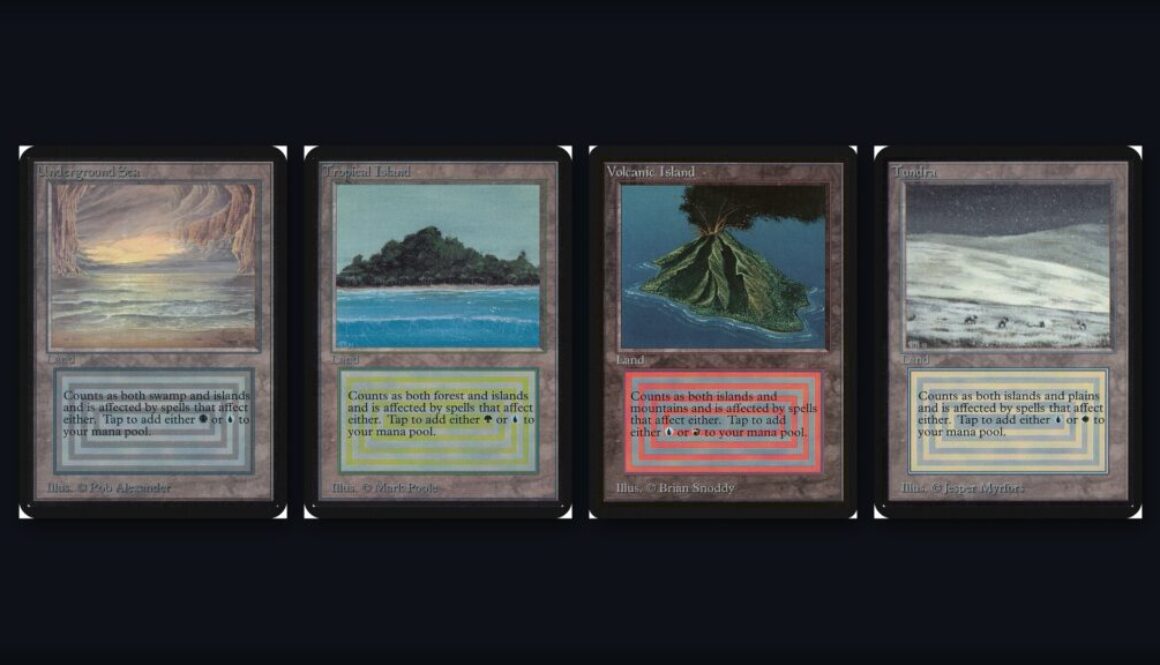
Original MTG dual lands still sit at the intersection of play demand and collectible scarcity. The ten Alpha/Beta/Unlimited/Revised duals (Underground Sea, Volcanic Island, Tropical Island, Tundra, and the rest of the cycle) remain format staples in Legacy, Vintage, and Commander while also trading as high-visibility collectibles. That stack is exactly why they belong in Card Core’s Iconic Cards lane: not as nostalgia props, but as a live case study in liquidity, condition sensitivity, and bubble risk.
Most modern dual-color lands ask you to pay something: life, tempo, or a condition. The original duals do not. Each taps for either of two colors, enters untapped, and carries two basic land types, so fetch lands can find them. That combination still defines competitive mana bases in eternal formats where the cards are legal.
For collectors, the other half of the story is supply policy. Wizards of the Coast’s Official Reprint Policy places these duals on the Reserved List, meaning they will not be printed again in a functionally identical form. Play demand does not have a fresh booster valve. That freezes paper supply at whatever survived from the early 1990s printings, while player and collector interest keeps churning.
If you only remember duals as “expensive old lands,” you miss the useful lesson: they are simultaneously tools and trophies. Pricing pressure behaves differently when both engines run at once.
Print context: Alpha, Beta, Unlimited, Revised (and what came later)
Be precise about editions. The ten duals appeared across Limited Edition Alpha, Limited Edition Beta, Unlimited, and Revised (3rd Edition). Collectors often shorthand that as ABUR. Volcanic Island is the famous exception: it was not in Alpha (art timing), and debuted in Beta. Hobby guides covering Alpha versus Beta versus Unlimited walk through corner shape, border, and palette tells that separate those printings.
Revised is not a “modern” reprint cycle. It is an early core set that did print the duals, usually with a white border and a larger surviving population than Alpha/Beta. Later land cycles (shock lands, fetch lands, pain lands, check lands, and so on) are functional substitutes with drawbacks or different constraints. They cool play pressure for some decks without reprinting the Reserved List duals themselves. Do not conflate “I can play shocks and fetches” with “the original duals got a new print run.”
Early Magic cardboard is unforgiving. Centering, corner wear, edge whitening, and surface scratches move duals across wide value bands even within the same named edition. Alpha’s rounded corners are a known identifier, while later printings use square corners. White-border Unlimited and Revised copies are easier to find than black-border Alpha/Beta, but clean Near Mint examples still separate sharply from played binders.
High-end graded copies are thin by design: population reports and auction visibility make gem grades scarce relative to mid grades. Mid-grade raw or mid-slab copies often have deeper transactional liquidity because more buyers can clear the check without needing a trophy outcome. That is the same liquidity pattern we track across grading decisions in Grading in 2026 and PSA Standard tier backlog math.
Counterfeit risk is also material on duals. For higher dollar purchases, trusted sellers, strong return policies, and professional grading are risk tools, not status symbols.
Liquidity: completed sales beat ask prices
Treat duals like other iconic cardboard. Ask prices on marketplaces are invitations, not comps. Completed sales (auction results, verified private sales you can document, recent clear transactions) are the structure that matters. Auction visibility can look “hot” while private deals clear differently after fees, shipping, and authentication friction.
Fees matter. Platform take rates, payment processing, grading costs, and time-to-cash change whether a dual is liquid for you. A card that “has a market” can still be a slow exit if your copy sits in a thin grade band or an edition buyers treat as second-tier.
Also separate play copies from collectible copies. A Revised dual bought to finish a Legacy mana base has a different buyer pool than an Alpha Underground Sea chased as a display piece. Same oracle text. Different exit paths. Our broader collector liquidity framework is built for that distinction.
Bubble risk when play demand and collector demand stack
Duals are a clean bubble-risk classroom. Speculation heats up when:
Eternal formats keep the cards heavily played, so “need” demand stays real.
Collector narratives amplify Reserved List scarcity.
Ask boards and social posts outrun completed-sale evidence.
Buyers treat every dual as interchangeable prestige instead of edition-, condition-, and color-pair-specific inventory.
Cooling does not require Wizards to break the Reserved List. Format shifts, weaker tournament share for a color pair, wider adoption of functional substitutes in casual and Commander tables, or a general risk-off mood in the hobby can slow dual velocity. When play demand and collector FOMO stop reinforcing each other, mid-grade and lower-visibility copies usually feel it first.
That is the anti-hype point. Scarcity policy is not a guarantee of forever-rising liquidity. It is a supply ceiling. Demand still has to show up with cash and completed sales. For the wider hobby frame, see Card Core’s 2026 trading card bubble risk report.
Honest caveats
We are not publishing invented print runs or sale prices here. Edition tiers and relative scarcity are well documented by Wizards policy pages and reputable hobby press; dollar comps move constantly and should be verified against recent completed sales for the exact printing and condition.
Aggregator “market” numbers often sit above what cards actually clear for.
Proxies and non-tournament printings (where applicable) are a different product conversation than tournament-legal ABUR duals.
Reserved List policy can be discussed and debated in the community; collectors should price the world as it exists, not the rumor of a policy change.
What to look for: a practical checklist
Print / edition: Confirm Alpha, Beta, Unlimited, or Revised (plus language/border variants if relevant). Volcanic Island has no Alpha copy.
Condition and population: Grade honestly. Check centering and edges before you pay a high-end premium. Mid grades often have more buyers.
Market depth: Prefer completed sales over asks. Note how many similar copies actually moved recently.
Venue and fees: Auction, dealer, private sale, and platform fees change net proceeds. Model exit cost before entry.
Authenticity: Duals are heavily counterfeited. Trust chain of custody; use grading when the dollar risk justifies it.
Use case: Playing Legacy/Commander versus holding as a collectible changes which edition and condition make sense.
Not vibes: Skip nostalgia narratives that skip edition, condition, and sale evidence.
Closing: Iconic Cards, not museum labels
Original MTG dual lands earn Iconic Cards coverage because they still clear a collector test in 2026: identifiable supply rules, ongoing play demand, condition-sensitive pricing, and enough market activity to study liquidity without inventing folklore. They are not immune to cooling. They are simply one of the clearest places to watch play demand and collectible demand either reinforce each other or pull apart.
Card Core will keep using this lane for landmark cards that teach structure. Duals belong beside other liquidity anchors, not above evidence.
Magic: The Gathering — Reality Fracture is in the middle of its launch window: prerelease events run September 25–October 1, 2026, MTG Arena drops September 29, and tabletop street date is October 2 per Wizards’ Collecting Reality Fracture feature.
Card Core’s job this week is not to rank every Booster Fun treatment. It is to map which SKUs create durable liquidity versus which are preview-season theater — using only numbers Wizards published.
Official MSRPs (Wizards)
Play Booster: $5.49
Collector Booster: $26.99
Multiverse Reforged Commander Deck: $49.99
Foundations Commander Deck: $29.99
Bundle: $57.99
Secret Lair Bundle: $89.99
Draft Night: $89.99
Those are manufacturer list prices, not secondary comps. Do not treat MSRP as a floor or a ceiling on the open market.
Chase layers Wizards actually quantified
Serialized Bloodline Recollector (double rainbow foil, throwback full-art): 500 serialized copies, Collector Boosters only, always English even in other-language boxes (Wizards).
Facet foil shattered mirror cards: Wizards cites approximately 6,000 copies per rare facet foil and approximately 3,000 per mythic rare facet foil (Collector Boosters; English card text).
Echoed pairs, braintwister, sculptor’s stronghold, Japan Showcase, Special Guests panorama, Secret Lair Bundle promos — all documented in the collecting article with pack-slot notes. Use that article; do not invent odds beyond it.
Liquidity checklist for prerelease week
Play Boosters first if you draft/sealed. Event demand creates the cleanest near-term exit for sealed Play product and commons/uncommons players need.
Collector Boosters are a variance product. Serialized and facet-foil EV is not a retail guarantee. Size CB exposure to what you can hold through post-release dump weeks.
Secret Lair Bundle is a hybrid SKU. Two CBs + six Plays + exclusive promos at $89.99 MSRP — compare the promo set’s actual completed sales after release before stacking inventory.
Commander decks are format liquidity, not chase liquidity. Multiverse Reforged vs Foundations serve different buyers; do not conflate them in one “Commander is hot” bucket.
Capital collision. Radiance Pre-Rift/preview spend and Pokémon sealed restocks compete for the same wallet. Rank exits before you rank FOMO.
Reality Fracture’s collectible map is unusually well documented by Wizards — including the 500 serialized Bloodline Recollectors and approximate facet-foil counts. Use those official figures; refuse invented secondary prices until completed sales exist after October 2.
Magic: The Gathering has teamed up with FINAL FANTASY™, and the result is nothing short of legendary. As part of the Summer Superdrop 2025, Wizards of the Coast is releasing three exclusive Secret Lair drops packed with stunning art, iconic references, and collector-worthy reprints. Whether you’re a diehard FF fan, a devoted Planeswalker, or both, this crossover delivers flavor, nostalgia, and bling in equal measure.
Let’s break down what you get, what it costs, and whether it’s worth the gil.
🎮 What Is Secret Lair x Final Fantasy?
These three drops are part of Magic’s Universes Beyond initiative, where the MTG multiverse merges with beloved franchises. This isn’t a new mechanic-heavy set—it’s a love letter to FINAL FANTASY fans with reimagined versions of existing Magic cards, showcasing characters, spells, and weapons from across the franchise’s 16 mainline titles.
🔥 The Three Drops
1. Game Over
Dramatic finishers get a Final Fantasy facelift.
Day of Judgment → Spira’s Punishment
Temporal Extortion → Absorb into Time
Toxic Deluge → Merciless Poisoning
Praetor’s Grasp → Unseat the Usurper
Star of Extinction → Meteorfall
💰 $29.99 non-foil / $39.99 rainbow foil
2. Grimoire
Powerful magic channeled by iconic FF heroes.
Prismatic Ending → Yuna’s Holy Magic
Cyclonic Rift → Hope’s Aero Magic
Damn → Noctis’s Death Magic
Lightning Bolt → Vivi’s Thunder Magic
Heroic Intervention → Aerith’s Curaga Magic
💰 $29.99 non-foil / $39.99 rainbow foil
3. Weapons
Legendary gear takes center stage.
Staff of the Storyteller → Yuna’s Sending Staff
Blade of Selves → Clive’s Invictus Blade
Umezawa’s Jitte → Cloud’s Buster Sword
Colossus Hammer → Gaia’s Dark Hammer
Sword of Truth and Justice → Tidus’s Brotherhood Sword
💰 $29.99 non-foil / $39.99 rainbow foil
💎 Exclusive Bundles (With Promo!)
For collectors who want it all—and a little extra:
English Bundle: All 3 drops in both non-foil and foil + Rainbow Foil Gilded Lotus Promo 🔖 $199.99
Japanese Bundle: Same as above, entirely in Japanese 🔖 $199.99
Superdrop Bundle: English + Japanese versions of everything 🔖 $399.99
These go on sale June 9, 2025 at 9 a.m. PT, exclusively on MagicSecretLair.com. Limited quantities. Expect them to sell out faster than you can say Zanarkand.
🧠 Is It Worth It?
If you’re in it for the:
🎨 Art? Absolutely. The treatments are stunning, and the weapon/effect pairings are fan service at its finest.
💵 Value? The reprints are powerful staples—Cyclonic Rift, Umezawa’s Jitte, and Lightning Bolt all have legacy play and collector value.
🕹️ Nostalgia? This hits hard. These are the cards you’ll want framed, sleeved, and maybe even graded.
But if you’re strictly a player on a budget, buying singles post-drop may be the smarter route.
Final Thoughts: Game Over or Game Changer?
This is more than just a Secret Lair—it’s a celebration of gaming’s two biggest fantasy franchises. Magic fans get iconic spells with new skin, and FF fans get a chance to immortalize their favorite characters in cardboard. Whether you grab a foil drop or just pick up Cloud’s Buster Sword as a single, there’s something here for every kind of fan.
Introduction: Defining Historical Significance in Magic: The Gathering
In the vast and intricate history of Magic: The Gathering, spanning over three decades, numerous sets have been released, each contributing to the game’s evolution in its own way. Determining the “top” sets from a historical standpoint requires a nuanced understanding of what constitutes significance beyond mere card power or popularity at the time of release. Historical significance in this context encompasses a set’s lasting impact on the game’s mechanics, its influence on design philosophy, its role in shaping competitive formats, its cultural resonance within the player community, and its introduction of enduringly iconic elements.1
Several criteria can be employed to evaluate a set’s historical importance. One key aspect is the introduction of groundbreaking mechanics or entirely new card types that fundamentally altered how the game is played.1 Another crucial factor is a set’s influence on competitive formats, either through the introduction of powerful cards that defined metagames or through the establishment of entirely new archetypes.2 Furthermore, a set’s impact on the game’s design philosophy, including changes to set structure, release strategies, or core design principles, contributes to its historical weight.1 Cultural relevance, encompassing a set’s thematic strength, its connection to memorable storylines, and its overall reception by the player community over time, also plays a significant role.4 Finally, the introduction of iconic cards or characters that have become synonymous with Magic: The Gathering and continue to hold significance across various formats solidifies a set’s place in history.3 It is important to acknowledge that any attempt to rank sets based on these criteria will inherently involve a degree of subjectivity, as different players will weigh these factors based on their own experiences and perspectives within the game.
The Genesis: Foundational Sets that Shaped the Game
Alpha/Limited Edition (1993): The Blueprint of Magic Alpha, released in 1993, holds an unparalleled position in the history of Magic: The Gathering as the very first set, effectively laying the foundation for the entire game.3 This initial offering established the fundamental rules, the five colors of mana, the core card types (creature, spell, artifact, land, enchantment), and the very concept of a trading card game with customizable decks.3 Beyond these foundational elements, Alpha introduced some of the most powerful and iconic cards in the game’s history, including the legendary Power Nine – Black Lotus, Ancestral Recall, Time Walk, Mox Pearl, Mox Sapphire, Mox Jet, Mox Ruby, Mox Emerald – and the original dual lands, such as Tropical Island and Underground Sea.3 These cards, renowned for their immense power and format-defining capabilities, continue to shape high-level competitive play in formats like Vintage.3 The impact of Alpha extends beyond just powerful individual cards. It set the initial standards for card effects, establishing precedents for what players could expect from various types of spells and abilities.3 The very structure of the game, from mana costs to card interactions, was first codified in this set.7 Considering that Alpha was the first attempt at creating a game of this nature, its comprehensive design and the breadth of ideas it tackled are remarkably impressive.1 The set’s contribution to gaming history as a whole, through the invention of the collectible card game genre, ensures its eternal significance.7 Its foundational nature is so profound that all subsequent sets are, in essence, built upon the framework it established.
Arabian Nights (1993): The First Expansion and Thematic Identity Released shortly after Alpha in 1993, Arabian Nights holds the distinction of being the very first expansion set for Magic: The Gathering.3 This marked a pivotal moment in the game’s history, signaling its intent to grow and evolve beyond the initial release.3 Arabian Nights was groundbreaking not only for being the first expansion but also for introducing the concept of flavor themes to Magic.3 Heavily inspired by the tales from “One Thousand and One Nights,” the set brought a distinct Arabian aesthetic and narrative to its cards, enriching the game’s world and demonstrating the potential for thematic depth in future expansions.3 This thematic approach became a crucial aspect of Magic set design, allowing for immersive and flavorful gameplay experiences that would resonate with players.8 Beyond its thematic contributions, Arabian Nights also introduced several powerful and highly sought-after cards that had a significant impact on early Magic.3 Cards like Bazaar of Baghdad and Library of Alexandria, both incredibly potent lands offering unique card advantage, became staples in competitive play and remain highly valuable collector’s items today.3 Even in formats like Pauper, the set’s inclusion of the removal spell Oubliette had a notable effect.3 As the first step in Magic’s expansion, Arabian Nights established a precedent for continuous growth and demonstrated the power of thematic design, solidifying its place as a historically significant set.
The Explosive Growth: Sets That Redefined Power and Mechanics
Version 1.0.0
Urza’s Saga (1998): The Era of Unparalleled Power Urza’s Saga, released in 1998, is often remembered as a period of unparalleled power in Magic: The Gathering, leading to an era colloquially known as “Combo Winter”.3 This set pushed the boundaries of card strength to such an extent that it caused significant upheaval in the competitive landscape, with fast and powerful combo decks dominating tournaments.9 The sheer density of overpowered cards in Urza’s Saga prompted numerous bans in the Standard format and other formats, a testament to its profound impact on the game’s balance.3 The design team reportedly learned significant lessons from this era regarding the potential consequences of unchecked card power.3 Urza’s Saga introduced a plethora of iconic and incredibly potent cards, many of which continue to see play in various formats despite the bans.3 Lands like Tolarian Academy, which could tap for mana equal to the number of artifacts controlled, and Gaea’s Cradle, which provided green mana based on the number of creatures, enabled explosive and game-ending turns.3 Spells like Yawgmoth’s Will, allowing players to replay any number of cards from their graveyard in a turn, further contributed to the combo-centric environment.3 The impact of Urza’s Saga was so severe that it even threatened the stability of Magic as a game, prompting subsequent sets to be designed with a significantly lower power level.9 Even though many of its strongest cards are now banned, the set’s influence on card design can still be felt in modern sets, marking it as a historically significant, albeit cautionary, tale in Magic’s development.
Mirrodin (2003): The Artifact Revolution Released in 2003, Mirrodin stands as a landmark set in Magic: The Gathering history due to its intense focus on artifacts and the introduction of the notoriously powerful Affinity mechanic.3 Set on an artifact-themed plane of the same name, Mirrodin brought a vast array of potent artifact cards into the game, fundamentally shifting the landscape of Standard and leaving a lasting impact on eternal formats.3 The sheer power of the artifact-based strategies enabled by Mirrodin led to a significant overhaul of the Standard format at the time, necessitating a considerable number of bans to restore balance.3 The Affinity mechanic, which reduced the cost of spells based on the number of artifacts a player controlled, proved to be exceptionally strong, enabling incredibly fast and aggressive strategies.3 Mirrodin also introduced a wealth of individual cards that have become staples in various formats.3 Cards like Skullclamp, a deceptively powerful equipment that provides immense card advantage, Chrom Mox, a zero-mana artifact that can accelerate mana production, and Chalice of the Void, a powerful control tool against low-cost spells, continue to see widespread play in Modern, Legacy, and even Vintage.3 Mirrodin’s profound emphasis on a single card type and the subsequent dominance it exerted over the game serve as a significant case study in set design and balance, cementing its historical importance.
The Modern Era: Sets That Shaped Contemporary Magic
Version 1.0.0
Ravnica: City of Guilds (2005): The Dawn of Factions and Multicolor Focus Ravnica: City of Guilds, released in 2005, is widely regarded as a pivotal set that ushered in a new era for Magic: The Gathering, particularly in its approach to multicolor gameplay and faction-based design.2 This set was the first to fully embrace and solidify the concept of two-color guilds, with each of the ten possible color combinations represented by a distinct guild boasting its own unique identity, mechanics, and flavor.2 Before Ravnica, while multicolored cards existed, they were not organized into such cohesive and well-defined factions.2 The set’s dedication to these guilds provided players with clear allegiances and playstyles to identify with, significantly influencing deckbuilding strategies.2 Ravnica also introduced the highly influential “shock lands,” a cycle of nonbasic lands with basic land types that could enter the battlefield untapped by paying two life.2 These dual lands provided unparalleled mana fixing for multicolor decks and quickly became staples across various formats, including Standard, Modern, and Legacy.2 Many players and designers consider Ravnica a watershed moment in Magic’s design history, demonstrating the potential of focusing on strong thematic and mechanical connections between color combinations.2 The success of Ravnica’s guild system has had a lasting impact, influencing the design of numerous subsequent sets that have explored faction-based mechanics.2 Its profound influence on multicolor gameplay and its establishment of a beloved and revisited setting solidify its place as one of the most historically significant sets in Magic’s history.2
Zendikar (2009): Lands Matter and Adventure World
Released in 2009, Zendikar made a significant mark on Magic: The Gathering through its innovative “lands matter” theme, its introduction of highly influential fetch lands, and the return of popular full art basic lands.2 The set heavily emphasized the role of lands in gameplay, with numerous cards and mechanics interacting with or being powered by lands in unique ways.2 One of its most enduring contributions was the introduction of a new cycle of fetch lands – Arid Mesa, Scalding Tarn, Verdant Catacombs, Marsh Flats, and Misty Rainforest – which allowed players to search their library for specific basic land types, dramatically improving mana consistency in multicolor decks, particularly in eternal formats like Modern and Legacy.2 These lands have become format staples and remain highly sought after.2 Zendikar also marked the popular return of full art basic lands to regular booster packs.2 These visually striking lands, featuring panoramic artwork, were immensely popular with players and collectors and have become a recurring feature in subsequent sets.2 Furthermore, Zendikar introduced the initial concept of the Eldrazi, ancient and immensely powerful beings that would later become major antagonists in the game’s lore.2 While their initial appearance was more subtle, the Eldrazi’s introduction in Zendikar laid the groundwork for significant storylines in later sets.2 The set’s focus on lands, its introduction of format-defining fetch lands, and the aesthetic appeal of full art basics, along with the nascent introduction of the Eldrazi, all contribute to Zendikar’s historical significance.
Lorwyn (2007): The Arrival of Planeswalkers Lorwyn, released in 2007, holds a truly unique and transformative place in Magic: The Gathering history as the set that introduced the planeswalker card type.2 This groundbreaking addition was the first entirely new card type since the game’s inception and fundamentally altered the landscape of Magic.2 Planeswalkers, representing powerful mages from across the Multiverse, added a persistent and powerful element to gameplay, acting as both threats and sources of card advantage.2 Their introduction opened up vast new design space and influenced deckbuilding strategies across all formats, from Standard to Commander.2 The arrival of planeswalkers in Lorwyn marked a significant shift in the game’s narrative as well, providing players with tangible representations of the iconic characters who drove the storylines.2 These characters, such as Jace Beleren, Liliana Vess, and Chandra Nalaar, quickly became fan favorites and have remained central figures in Magic’s lore ever since.2 The impact of planeswalkers on the game is undeniable; they have become a cornerstone of Magic’s identity and a key element in set design and storytelling.2 As the set that brought this revolutionary card type into existence, Lorwyn’s historical significance is immense and its influence continues to shape the game today.2
Innistrad (2011): The Reign of Thematic Excellence
Innistrad, released in 2011, is celebrated for its exceptionally strong gothic horror theme and its masterful integration of flavor into every aspect of the set, from card design to mechanics.1 Drawing inspiration from classic monster archetypes like werewolves, vampires, zombies, and ghosts, Innistrad created a deeply immersive and atmospheric experience for players.1 The set’s thematic strength was so pronounced that it is often credited with kickstarting the “World of Hats” era of plane design, where new settings are easily summarized by a single, strong concept.1 Innistrad also introduced the innovative double-faced transforming cards, a mechanic that perfectly captured the duality and transformation inherent in many horror tropes, such as werewolves changing between their human and wolf forms.1 These cards added a unique layer of complexity and strategic depth to the game.4 Furthermore, Innistrad contributed several powerful and enduring cards to the game, including format staples like Snapcaster Mage and Liliana of the Veil, which continue to see play in various formats.1 The set is also fondly remembered for its strong Limited format, often cited as one of the best of all time.1 Innistrad’s success in blending compelling themes with innovative mechanics and powerful cards solidified its place as a historically significant and beloved set in Magic’s history.
Khans of Tarkir (2014): The Wedge Revolution and Delve’s Lesson Khans of Tarkir, released in 2014, made a significant impact on Magic: The Gathering by centering its design around three-color “wedge” combinations – allied colors paired with their enemy color – a relatively unexplored design space at the time.2 The set introduced five distinct clans, each embodying a different wedge color combination and possessing its own unique identity, mechanics, and playstyle.4 This focus on three-color strategies created a wealth of new deckbuilding possibilities and led to interesting card interactions.4 Khans of Tarkir also introduced the Delve mechanic, which allowed players to exile cards from their graveyard to help pay for spells.4 While Delve proved to be a popular and powerful mechanic, the set also provided a “hard lesson” about its potential to be overpowered, as some Delve cards went on to become problematic in various formats.4 Despite this, Khans of Tarkir is widely praised for its highly enjoyable draft format and its distinctive setting, which resonated strongly with many players.4 The set’s exploration of three-color combinations and its introduction of the Delve mechanic, along with its memorable setting and gameplay, contribute to its historical significance in Magic’s evolution.4
Honorable Mentions: Other Influential Sets
Several other Magic: The Gathering sets have left a significant mark on the game’s history and deserve recognition:
Mirage (1996): This set holds the distinction of being the first ever designed with Limited play (drafting and sealed) in mind, marking a fundamental shift in how Magic sets were conceived.1 It also introduced the block structure for set releases, where three thematically linked expansions are released sequentially.8
Invasion (2000): While multicolored cards existed before, Invasion was the first set to truly normalize and focus on them as a central theme.2 It also introduced the popular and versatile Kicker mechanic, which allows spells to have additional effects for an extra cost.2
Worldwake (2010): This set, the second in the original Zendikar block, introduced several incredibly powerful and format-defining cards, most notably the planeswalker Jace, the Mind Sculptor, and the creature Stoneforge Mystic.3 These cards had a profound and lasting impact on competitive formats.
Time Spiral (2006): This set served as a nostalgic callback to many previous eras of Magic, featuring numerous reprints and references to older cards and mechanics.2 Its complexity and density of mechanics ultimately led to the development of the “New World Order” design philosophy, which aimed to reduce complexity at lower rarities in subsequent sets.2
Dominaria (2018): This set marked a significant turning point in Magic’s release strategy by doing away with the traditional block structure and becoming a large, standalone set.1 It also represented a nostalgic return to the game’s original and most iconic setting, Dominaria.4
Conclusion: The Enduring Legacy of MTG’s Most Historic Sets
Magic: The Gathering’s long and storied history is punctuated by sets that have not only provided new cards and experiences but have also fundamentally shaped the game we know today. The sets highlighted in this report – Alpha, Arabian Nights, Urza’s Saga, Mirrodin, Ravnica: City of Guilds, Zendikar, Lorwyn, Innistrad, Khans of Tarkir, and Time Spiral – each represent a significant moment in the game’s evolution, whether through the establishment of core principles, the introduction of revolutionary mechanics or card types, or the profound influence on design and competitive play.
These sets, while diverse in their themes and mechanics, share a common thread of leaving a lasting legacy on Magic. Alpha laid the very foundation, while Arabian Nights demonstrated the power of thematic design. Urza’s Saga and Mirrodin stand as testaments to the impact of unchecked power and focused themes. Ravnica redefined multicolor gameplay and faction identity, while Zendikar revolutionized mana bases and hinted at cosmic horrors. Lorwyn ushered in the era of planeswalkers, and Innistrad set a new standard for thematic excellence. Khans of Tarkir expanded the horizons of multicolor strategies, and Time Spiral served as a reflective bridge to the game’s past while influencing its future.
It is important to remember that Magic: The Gathering is a constantly evolving game, and future sets will undoubtedly contribute their own chapters to this rich history. The historical significance of a set is often best understood within the context of its release and the specific impact it had on the game at that time. However, the sets discussed in this report have consistently demonstrated their enduring legacy, continuing to influence gameplay, design, and the collective memory of the Magic: The Gathering community. Their contributions have been instrumental in making Magic the iconic and enduring game it is today.
Table 1: Top 10 Most Historically Significant MTG Sets
Rank
Set Name
Release Year
Key Reasons for Significance
1
Alpha/Limited Edition
1993
The very first Magic set, establishing the game’s rules, card types, and color pie. Introduced the Power Nine and original dual lands.
2
Arabian Nights
1993
The first expansion set, pioneering the use of flavor themes in Magic. Introduced powerful early cards like Bazaar of Baghdad and Library of Alexandria.
3
Urza’s Saga
1998
Known for its exceptionally high power level, leading to “Combo Winter” and numerous bans. Introduced iconic lands like Tolarian Academy and Gaea’s Cradle, and powerful spells like Yawgmoth’s Will.
4
Mirrodin
2003
Introduced a strong artifact theme and the powerful Affinity mechanic, leading to a significant overhaul of Standard and leaving a lasting impact on modern formats with cards like Skullclamp and Chrom Mox.
5
Ravnica: City of Guilds
2005
Introduced the iconic guild system and a heavy focus on two-color combinations. The introduction of shock lands revolutionized mana fixing in multicolor decks across various formats.
6
Lorwyn
2007
Historically significant as the first set to introduce planeswalker cards, a new card type that fundamentally changed the game and its narrative.
7
Zendikar
2009
Introduced the highly influential fetch land cycle, which significantly improved mana consistency in eternal formats. Also marked the popular return of full art basic lands and the initial appearance of the Eldrazi.
8
Innistrad
2011
Celebrated for its incredibly strong gothic horror theme and its masterful integration of flavor. Introduced innovative double-faced transforming cards and powerful, enduring cards like Snapcaster Mage and Liliana of the Veil.
9
Khans of Tarkir
2014
Centered around three-color “wedge” combinations, introducing unique clan identities. Introduced the Delve mechanic and provided valuable lessons about its balancing. Also known for its popular draft format and distinctive setting.
10
Time Spiral
2006
Served as a nostalgic callback to Magic’s history, featuring numerous reprints and references. Its complexity influenced the development of the “New World Order” design philosophy, aiming for simpler common cards in future sets.
Table 2: Introduction of Key Mechanics by Set
Set Name
Release Year
Key Mechanics Introduced
Alpha/Limited Edition
1993
Mana System, Color Pie (implicitly)
Arabian Nights
1993
Flavor Themes
Urza’s Saga
1998
Cycling (via precursor ‘sliding’) 11
Mirrodin
2003
Affinity, Equipment
Ravnica: City of Guilds
2005
Guilds, Shock Lands
Lorwyn
2007
Planeswalkers
Zendikar
2009
Fetch Lands
Innistrad
2011
Double-Faced Cards, Flashback
Khans of Tarkir
2014
Delve
Time Spiral
2006
Suspend, Flashback (returning), Morph (returning), many other returning mechanics showcasing Magic’s history
Disclosure: This article contains affiliate links. CardCore may earn a commission if you buy through them, at no extra cost to you.
Release Date: June 13, 2025 Set Name:Magic: The Gathering – Final Fantasy (FIN) Publisher: Wizards of the Coast (WotC) Hype Level: Off the charts
Version 1.0.0
Welcome to the Universes Beyond era, where Magic: The Gathering is rewriting the rules of crossover hype. And with its Final Fantasy set—featuring icons like Cloud, Sephiroth, Terra, Y’shtola, and a staggering 100+ legendary creatures—WotC has officially gone limit break mode.
Why This Set Is a Big Deal
Imagine pulling a Borderless Yoshitaka Amano foil Sephiroth. Or casting a spell called Exterminio that sets a creature’s health to -9999. MTG x Final Fantasy isn’t just a love letter to fans—it’s a full-blown collectible, nostalgic, and mechanical experiment that’s disrupting the trading card game (TCG) space.
Key highlights include:
Saga Creatures: Summons like Shiva and Ifrit that evolve like Sagas—then hit like creatures.
Double-Faced Legends: Transform Cloud from SOLDIER to Planet’s Champion mid-game.
Serialized Collector Cards: With pull rates under 0.1%, these cards are unicorns—foil-etched and investment-ready.
Oh, and did we mention the Play Boosters come with potential Final Fantasy-themed reprints like Ancient Copper Dragon?
Early leaks and official reveals have provided glimpses into new and returning mechanics designed to capture the essence of the Final Fantasy universe:
New Land Type: “Ciudad” (City): Leaked from the Spanish-language Starter Decks, the “Ciudad” or “City” land type is a novel addition. However, its specific mechanical impact remains undisclosed, as no other leaked cards referenced it.7 The lands in these decks also appear to be themed around different Final Fantasy games based on their collector numbers.7
“Elegir un trabajo” (“Choose a Job”): This mechanic, found in the Boros (Red/White) Starter Deck, functions similarly to existing MTG mechanics like “For Mirrodin!” or “living weapon.” Upon entering the battlefield, an Equipment with this ability creates a 1/1 token and automatically attaches to it, potentially granting an additional creature type like Samurai or Knight.7
Saga Creatures: A significant innovation, FIN introduces “Saga Creatures.” These cards represent iconic Summons from the Final Fantasy series, such as Shiva and Ifrit, and uniquely combine the characteristics of Sagas (multi-chapter enchantments) with those of creatures, allowing them to progress through their story-like effects while also participating in combat.4
Double-Faced Cards: Returning to MTG, double-faced cards will be used to depict character transformations and narrative progressions, exemplified by Cecil Harvey, who can transform from Cecil, Dark Knight to Cecil, Redeemed Paladin.1
“Exterminio” (“Overkill”): A leaked black instant removal spell, likely referencing the “Overkill” mechanic from Final Fantasy X, features an interesting ability to set a creature’s health to an extremely negative number (e.g., -9999), effectively bypassing indestructible defenses.7
“Suplex”: A card directly referencing the memorable scene of Sabin suplexing the Ghost Train in Final Fantasy VI, highlighting the set’s commitment to flavorful depictions of iconic game moments.7
Special Art Treatments & Collectibles
A major draw for both MTG players and Final Fantasy enthusiasts will be the diverse array of special art treatments and collectible card versions:
Borderless Character Cards: 55 iconic Final Fantasy characters will receive this treatment, featuring full art with distinctive backgrounds. A thematic detail includes Roman numerals in the art indicating the character’s respective game of origin.1
Borderless Woodblock Cards: Summons and classic monsters like Cactuar and Stiltzkin will be rendered in a traditional Japanese woodblock art style, offering a unique aesthetic.4
Borderless Final Fantasy Artist Cards: This treatment will showcase artwork from legendary Final Fantasy artists, most notably Yoshitaka Amano (known for character designs and logos) and Tetsuya Nomura (known for character designs in later titles and Kingdom Hearts).1 Amano, who previously designed a Japanese alternate art for Liliana, Dreadhorde General, is confirmed to have new works in this set.1
Extended Art Cards: Typically found on rares and mythic rares, this treatment, which expands the card’s art frame, will also appear on uncommon cards for the first time in FIN.2
“Final Fantasy Through the Ages” Bonus Sheet: Similar to bonus sheets in other recent MTG sets, this will consist of reprints of existing, popular MTG cards, but featuring artwork from the Final Fantasy series. Examples include Ancient Copper Dragon and Yuriko, the Tiger’s Shadow.1 These cards will appear in Play and Collector Boosters but will not be Standard-legal, adhering to their original format legalities.1
Serialized Cards: Highly sought-after, individually numbered versions of iconic cards will be available. These will be foil-etched and found exclusively in Collector Boosters, with a pull rate of less than 0.1% in English-language boosters.8 There is strong speculation and collector anticipation for serialized cards featuring Yoshitaka Amano’s artwork.13
Surge Foils: This distinct foil treatment will be featured on all cards within the Collector’s Edition Commander Preconstructed Decks, similar to the Universes Beyond: Warhammer 40,000 release.1
MTG Final Fantasy Product Lineup & MSRP (Brace Yourself)
Early pre-orders sold out in hours, and market prices are climbing fast, especially for Collector Boosters—some already hitting $600+ per box.
Who Is This Set For?
Collectors chasing ultra-rare variants (think $100+ for Borderless Jumbo Cactuar)
Commander players looking to build with iconic characters
Final Fantasy fans entering MTG for the first time
Speculators betting on serialized pulls and Amano masterpieces
But here’s the kicker—this set is Standard-legal. That means the most premiumized MTG product ever is now mandatory reading for competitive players, too.
What’s the Catch?
The hype is real. So are the risks:
Premium Price Tag: The “UB Tax” is steep. Play Boosters cost more, give you less (30 per box vs. the old 36), and still may not yield competitive staples.
FOMO + Scalping: Pre-orders vanished. Some fans feel priced out or forced to gamble on Collector Boosters.
Standard-legal Tension: Will critical Standard cards be locked behind $40 packs?
Wizards has walked a fine line here—balancing nostalgia-fueled demand against accusations of over-commercialization. The market response? A record-breaking day-one sellout.
Pre-Order Market Prices of Select Standout FIN Singles (Early-Mid 2025)
Card Name
Variant
Approximate Pre-Order Market Price (USD)
Emet-Selch, Unsundered // Hades, Sorcerer of Eld
Borderless
$93.40 – $95.39
Emet-Selch, Unsundered // Hades, Sorcerer of Eld
Regular
$54.75 – $66.30
Emet-Selch, Unsundered // Hades, Sorcerer of Eld
Extended Art
$61.33 – $61.34
Jumbo Cactuar
Borderless
$97.76 – $101.51
Jumbo Cactuar
Regular
$46.98 – $51.58
Cecil, Dark Knight // Cecil, Redeemed Paladin
Borderless
$33.29 – $38.90
Cecil, Dark Knight // Cecil, Redeemed Paladin
Regular
$11.38 – $18.94
Cecil, Dark Knight // Cecil, Redeemed Paladin
Extended Art
$19.38 – $20.82
Cloud, Planet’s Champion
Starter Kit
$29.99 – $38.37
Sephiroth, Planet’s Heir
Starter Kit
$15.49 – $39.14
Stiltzkin, Moogle Merchant
Borderless
$35.77 – $44.71
Stiltzkin, Moogle Merchant
Regular
$8.72 – $17.02
Zenos yae Galvus // Shinryu, Transcendent Rival
Borderless
$40.00
Zenos yae Galvus // Shinryu, Transcendent Rival
Regular
$19.01
Sin, Spira’s Punishment
Borderless
$28.57 – $31.56
Sin, Spira’s Punishment
Regular
$6.64
Zell Dincht
Regular
$34.75 – $36.90
Summon: Shiva
Borderless
$13.69
Summon: Shiva
Regular
$1.56
Cloud, Ex-SOLDIER
Commander Deck – Extended Art
$60.00
Terra, Herald of Hope
Commander Deck – Extended Art
$64.99
Terra, Herald of Hope
Commander Deck – Borderless
$99.99
Tidus, Yuna’s Guardian
Commander Deck – Extended Art
$66.10
Y’shtola, Night’s Blessed
Commander Deck – Extended Art
$64.98
Prices reflect market conditions in early to mid-2025 and are subject to change. Sources include TCGPlayer and MTGGoldfish.
Verdict: Should You Buy MTG Final Fantasy?
Buy if…
You’re a collector or FF fan who values aesthetics and nostalgia
You want to draft Final Fantasy-themed Limited (and can stomach $20 draft nights)
You’re budget-conscious and just want to build decks
You’re looking for high EV from Play Boosters—spoiler: it’s not there
You’re over Universes Beyond fatigue (MTG x Spider-Man drops in September…)
Value Proposition – FIN Play Boosters vs. Collector Boosters vs. Singles
Consumer Profile
Play Booster
Collector Booster
Buying Singles
Limited Player/Drafter
Pros: Designed for this purpose, experience new set mechanics. Cons: Higher cost per draft/sealed event compared to past standard sets. Low EV for opened cards.
Pros: N/A. Cons: Not designed for Limited play, extremely cost-prohibitive.
Pros: N/A for Limited play itself. Cons: N/A.
Comprehensive Set Collector (Base Set, Foils)
Pros: Acquires commons/uncommons, some rares/mythics, guaranteed foil per pack. Cons: Very inefficient for specific rares/mythics or full foil set. High volume needed.
Pros: Higher chance for rares/mythics, many foils, special treatments. Cons: Extremely expensive to complete a set this way. Still requires luck for specific cards.
Pros: Most efficient way to complete a specific set list. Cons: Less “thrill of the hunt.” Prices for some cards can be high initially.
Collector of High-End Variants/Serialized Cards/Artist Cards
Pros: Very slim chance at some special treatments or “Through the Ages” cards. Cons: Extremely low probability for serialized or top Amano art. Vastly inefficient.
Pros: Only source for serialized cards. Highest concentration of special foils, Borderless, Extended Art, Artist cards. Cons: Very expensive, high variance (“gambling”). No guarantee of specific desired card.
Pros: Direct acquisition of desired high-end card. Cons: Can be extremely expensive for the rarest items. Market availability might be limited for ultra-rare cards.
Player Seeking Specific Deck Staples (Standard/Commander)
Pros: Might open needed cards by chance. Cons: Highly inefficient and costly. Low probability of getting specific rares/mythics.
Pros: Might open needed cards in premium versions. Cons: Extremely inefficient and vastly overpriced for acquiring play pieces.
Pros: Most cost-effective and targeted way to get specific cards for decks. Cons: No pack-opening experience. Prices for meta-relevant cards can be high.
Budget-Conscious Player/Collector
Pros: Lowest entry price per pack compared to Collector Booster. Cons: Still expensive for a standard booster. Likely poor monetary return.
Pros: N/A. Cons: Prohibitively expensive.
Pros: Can target affordable versions of desired cards or wait for prices to drop. Full control over spending. Cons: May miss out on collecting rarer versions.
Investor/Speculator
Pros: Potential for “Through the Ages” hits if lucky. Cons: Generally low EV. High print run of main set cards will depress most single values. Not recommended for investment.
Pros: Highest potential for grading valuable serialized/Amano art cards. Cons: Extremely high risk. Requires deep market knowledge and luck. Sealed box value may not hold if contents disappoint.
Pros: Can speculate on specific cards perceived as undervalued. Cons: Requires accurate market prediction. Singles market can be volatile.
Final Thoughts
Magic: The Gathering – Final Fantasy is a watershed moment—both thrilling and controversial. It’s beautiful. It’s expensive. It’s divisive. And it’s absolutely dominating the TCG conversation in 2025.
At CardCore, we’ll be tracking pull rates, market trends, and deck techs as this historic set unfolds.
What Comes Next? The Evolving Saga of Universes Beyond
The release of Magic: The Gathering—FINAL FANTASY is not an isolated event but a key indicator of Wizards of the Coast’s broader strategic direction, particularly concerning its Universes Beyond initiative.
Short-Term Outlook for FIN:
Metagame Impact: FIN is anticipated to make its presence felt in the Standard metagame due to its legality and the introduction of a large pool of new cards and mechanics. The Commander format is almost certain to see significant impact, driven by the four themed preconstructed decks and the more than 100 legendary creatures available in the main set.1 Cards like Zenos yae Galvus, designed with multiplayer interactions in mind despite being in the main set, exemplify this focus.28
Secondary Market: The initial secondary market for FIN cards is expected to be characterized by high prices for chase singles, especially those featuring artwork by Yoshitaka Amano, serialized cards, and popular characters in their special treatment versions.13 However, given that the main set will be printed to demand for the duration of its Standard legality 41, prices for most regular rares, mythic rares, and bulk commons/uncommons may see a decline as supply saturates the market post-release.23
Future of Final Fantasy in MTG:
As of early to mid-2025, there have been no concrete official announcements or widespread credible rumors regarding a “Final Fantasy 2” or further direct expansions based on the IP.2 While the commercial success of FIN could theoretically pave the way for future collaborations with Square Enix, this remains speculative at this stage.
Wizards of the Coast’s Broader Universes Beyond Strategy:
The 2025 release schedule underscores WotC’s deep commitment to the Universes Beyond line. Following Final Fantasy in June, the calendar includes Magic: The Gathering® | Marvel’s Spider-Man in September and Magic: The Gathering® | Avatar: The Last Airbender™ in November.42 This cadence of multiple large UB releases per year signals a fundamental strategic shift.
Standard Legality as the New Norm: A pivotal change is that, starting in 2025, all tentpole Universes Beyond releases will be Standard-legal.1 This contrasts with earlier major UB products like The Lord of the Rings: Tales of Middle-earth or the Warhammer 40,000 Commander decks, which were legal only in Modern and other eternal formats.
Pricing Strategy: The premium pricing model observed with FIN is likely to become standard for future major UB sets. This was alluded to by Mark Rosewater, who stated that UB boosters generally carry a higher MSRP, and is further evidenced by the similar price points announced for the Marvel’s Spider-Man set.16
Digital Implementation: WotC has outlined a dual approach for digital platforms. Some UB sets, like FIN and Avatar: The Last Airbender, will be released directly on MTG Arena and Magic Online.52 For others that will not appear on digital platforms in their original form (such as Marvel’s Spider-Man and future Marvel sets), WotC will release “Through the Omenpaths” sets. These will feature mechanically identical cards but with unique creative treatments, art, and names themed to the Magic universe.42
Financial Driver for Hasbro: Universes Beyond collaborations are a significant engine for revenue growth within Hasbro’s Wizards of the Coast segment. Strong sales and positive investor outlook underscore the financial success of this strategy.26 Hasbro’s “Playing to Win” strategy explicitly includes these “partner-scaled” ventures as key components.31
Long-Term Implications:
The increasing frequency, Standard-format integration, and premium pricing of Universes Beyond sets are likely to continue fueling debate within the player base regarding Magic’s core identity, product affordability, and the overall health and accessibility of the Standard format. There is a potential for player fatigue or increasingly selective engagement if the market becomes oversaturated with numerous high-priced UB products.24 The demonstrated success of these collaborations will almost certainly encourage WotC to pursue further high-profile IP partnerships.
The 2025 release schedule, coupled with Hasbro’s financial emphasis and WotC’s policy changes regarding Standard legality, clearly indicates that Universes Beyond is no longer a peripheral or occasional product line. Instead, it has evolved into a central pillar of Magic’s annual release strategy and its overarching financial model. Early UB successes, such as The Lord of the Rings: Tales of Middle-earth, showcased the immense market potential. Consequently, Hasbro has identified UB as a key growth driver. WotC is integrating these IPs more deeply into the core game experience by making new tentpole releases Standard-legal, aiming to attract fans of these external franchises directly into Magic’s most accessible constructed format. This integration, however, is consistently accompanied by premium pricing, reflecting licensing costs and the high demand these IPs generate. The sheer volume of UB product (three major sets in 2025 alone) and their strategic importance to Hasbro’s financial performance mean they are now a fundamental and recurring component of the annual Magic experience. Players and collectors must therefore adapt to a reality where a significant portion of new, Standard-legal content will originate from external IPs and carry a premium price tag. This will inevitably shape purchasing decisions, format engagement, and the evolving perception of Magic’s brand identity moving forward. The operative question is shifting from if Universes Beyond will be prominent to how the community will navigate its consistent, and often costly, presence.
VIII. Concluding Analysis & Strategic Recommendations
The Magic: The Gathering—FINAL FANTASY set stands as a testament to the immense potential of cross-IP collaboration, leveraging the deep appeal of two beloved franchises. It is poised for significant financial success for Hasbro, driven by unprecedented pre-order figures and the high collectibility of its cards, particularly those featuring special art treatments and iconic characters. However, this success is juxtaposed with considerable concerns from the player base regarding the set’s high price point and the implications of its Standard legality. FIN pushes the boundaries of “premiumization” for a Standard-legal release, creating a tension between broad market appeal and accessibility for the average player.
Judgment on Play Booster Value:
For players engaging in Limited formats like Draft or Sealed, FIN Play Boosters are the designated product, though the higher cost per pack will increase the expense of participation. For casual collectors and those wishing to experience the flavor of the Final Fantasy IP through pack opening, Play Boosters offer a taste but are unlikely to provide a favorable monetary return relative to their cost. For value-driven pack opening or the acquisition of specific cards for deckbuilding or collection, Play Boosters are generally not recommended. The singles market offers a more targeted and cost-effective approach for specific needs, while Collector Boosters, despite their high cost and variance, are the intended product for those chasing the rarest and most valuable card versions.
Strategic Takeaways & Recommendations:
For Players (Focused on Playing Standard/Commander):
Approach the FIN set with a clearly defined budget. Prioritize purchasing individual cards (singles) for specific deck requirements, particularly after the initial secondary market hype subsides and prices potentially stabilize.
The Commander preconstructed decks offer good value for a ready-to-play, themed experience, but the $69.99 MSRP per deck should be factored into purchasing decisions.
If participating in Draft or Sealed events, be prepared for the higher cost associated with FIN Play Boosters compared to past Standard set Draft Boosters.
For Collectors:
Identify specific chase items in advance, such as cards featuring Yoshitaka Amano’s art, serialized cards, or Borderless versions of favorite characters. Collector Boosters are the primary, albeit expensive, avenue for acquiring these.
The singles market will be crucial for obtaining specific art versions or completing collections. Be aware that pre-order prices for highly desired cards are already substantial.33
Anticipate potential long-term price stabilization or even decline for non-serialized, non-Amano regular versions of cards from the main set due to the likelihood of high print runs associated with a Standard-legal set.
For Investors/Speculators:
Exercise extreme caution with sealed Play Booster products. The high cost per pack and the likely concentration of value in rarer product tiers suggest a low probability of positive expected value from opening Play Boosters for resale.
Collector Boosters represent a high-risk, high-reward proposition, heavily dependent on pulling extremely rare and desirable items like serialized cards or top-tier Amano art pieces.
Consider focusing on grading and long-term holds of genuinely scarce and highly sought-after items (e.g., low-numbered serialized cards, key Amano art cards in pristine condition).
The market dynamics for FIN might more closely resemble those of highly collectible games like Pokémon (where high-value collectibles coexist with relatively inexpensive play pieces) rather than traditional MTG sets where playability often dictates value more broadly.25
For Wizards of the Coast (Hypothetical Considerations):
Continuously monitor and transparently address community feedback regarding the pricing and accessibility of Standard-legal Universes Beyond sets.
Develop strategies to ensure that the health and accessibility of the Standard format are not unduly compromised by flagship releases that are priced as premium collector’s items.
Strive for a balance between the legitimate drive for premium collectible offerings that cater to a segment of the market and the fundamental need to maintain an accessible and engaging core game experience for the broader player base.
In conclusion, Magic: The Gathering—FINAL FANTASY is a landmark release that will undoubtedly leave a lasting impression on the game and its community. Its success will further embolden the Universes Beyond strategy, but the challenges it presents in terms of pricing and format impact will require careful navigation by both the player base and Wizards of the Coast moving forward.