Iconic Trading Cards as Liquidity Anchors
Some iconic trading cards stop being just chase pieces. They become permanent reference points — the cards dealers quote against, the names forums use as shorthand, and the benchmarks collectors check before they trust a quieter sale. That status is about liquidity and market structure, not nostalgia alone.
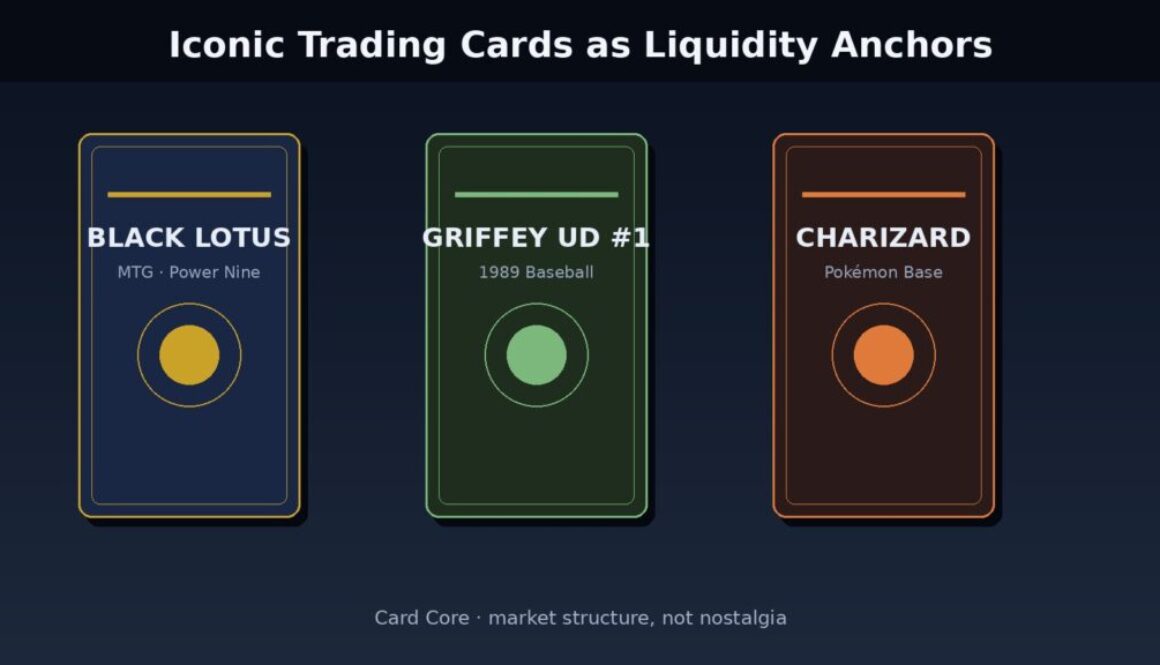
This first Iconic Cards piece looks at why a few landmarks keep that role: Black Lotus in Magic, the 1989 Upper Deck Ken Griffey Jr. in baseball, and Base Set Charizard in Pokémon. The goal is practical: what made them anchors, where the caveats sit, and what to look for instead of vibes. For how we apply the same completed-sale lens to new product weeks, see our TCG Drop Radar for September 28, 2026.
What “iconic” means in market terms
In hobby talk, iconic often means “everyone knows it.” In trading terms it means something narrower: deep enough recognition that buyers and sellers can clear deals without reinventing the story every time, plus enough observed sales that a grade-and-edition pair can be compared honestly. Recognition without depth is hype. Depth without recognition is a quiet niche. Anchors have both — with different ratios by hobby.
Card Core’s framing stays anti-hype. We care about print context, condition, and how often comparable copies actually change hands. Ask prices and Discord screenshots are noise. Completed sales and net outcomes after fees are the scoreboard. Browse related hubs under Collector Guides, Market News, Card Games, and Sports Cards.
Case study: Black Lotus (Magic)
Black Lotus sits at the top of Magic’s collector hierarchy for structural reasons, not just lore. It is one of the Power Nine — printed only in the earliest Alpha, Beta, and Unlimited runs — and it remains restricted or banned in most competitive formats. Christopher Rush’s original art is inseparable from the card’s identity. Early print scarcity is real: collector and grading coverage has long cited a very small Alpha population (on the order of about 1,100 Lotus copies for that first print run, per reporting such as CGC’s Black Lotus overview). Later Unlimited copies expand the pool but do not erase Alpha/Beta premiums.
Liquidity lesson: Black Lotus is a thin high-end anchor. Elite graded Alphas trade infrequently. Public auctions create visible comps; private sales create headlines that may or may not reflect what a typical buyer can clear next month. When a grail’s buyer pool shrinks to a handful of names, “the market” is really a sequence of negotiated outcomes. Treat outlier private figures as anecdotes until you can map them to condition, edition, and venue. Use Lotus as a reference for how Magic values early Power Nine scarcity — not as a price oracle for every vintage rare.
Honest caveat: Reprint culture, anniversary products, and Power Nine adjacent chase can shift attention without rewriting Alpha scarcity. The anchor role survives because the early printings remain the cultural and competitive origin story, not because every Lotus listing is equally liquid.
Case study: 1989 Upper Deck Ken Griffey Jr.
Griffey’s Upper Deck #1 is the modern baseball-card shorthand for “rookie that defined an era.” Upper Deck’s 1989 debut raised production quality (foil packs, holograms, no gum), and card #1 put a then-prospect on the first slot of a premium checklist. Beckett, ESPN, and Sports Illustrated have all treated the card as a lasting hobby landmark — “the last iconic baseball card” in SI’s anniversary framing — for reasons that go beyond any single sale week.
Liquidity lesson: Griffey is a deep anchor relative to Lotus. Grading populations for this card are enormous by vintage-TCG standards; PSA and other services have slabbed it in volumes large enough that mid and high grades have real secondary depth. That depth is the point. When many comparable slabs exist, completed sales can diverge from ask prices in the same week — a pattern SI and other market writers have documented when gem copies clear at very different levels. Liquidity here means you can usually find a buyer; it does not mean every list price is honest.
Honest caveat: Junk-wax-era print volume means raw and lower grades behave differently from gem slabs. Population reports matter. A “Griffey UD” without grade, centering, and surface notes is not one SKU — it is a ladder. Use the card as a reference for modern sports-card liquidity structure, then price the specific slab you hold.
Parallel: Base Set Charizard (Pokémon)
Base Set Charizard (especially 1st Edition and early shadowless/unlimited distinctions collectors track carefully) plays a similar reference role in Pokémon. It is the character and the print that mainstream coverage still uses when explaining why vintage Pokémon holds cultural weight. Market writers routinely describe it as a flagship for the Wizards-of-the-Coast era — the card through which a large share of vintage dollar volume routes — while noting that top grades thin out and mid grades trade more often.
Liquidity lesson: Charizard is a tiered anchor. Lower and mid grades can show steadier turnover; absolute top grades behave more like art-market pieces — longer time-to-sale, heavier fee impact at auction, and a smaller buyer pool. Reprints and modern Charizard chase can absorb hobby attention without replacing the Base Set flagship’s reference status. Edition and grade still do most of the explanatory work.
Honest caveat: We are not publishing dollar comps here. Charizard’s ladders move, and private or auction outliers are easy to misuse. Treat it as a structure lesson: cultural ubiquity plus graded scarcity at the top creates a permanent name on price guides — with liquidity that changes sharply by tier.
What collectors should actually look for
Strip the nostalgia and the checklist is short:
- Print context — Set, edition, and known production story (Alpha vs Unlimited; Upper Deck #1 vs other 1989 Griffeys; 1st Edition vs later Base Set). Without that, “iconic” is branding.
- Condition and population — Grade, subgrades if relevant, and how many comparable slabs exist. Deep pops support clearer comps; tiny pops support negotiation, not spreadsheet certainty.
- Market depth — How often true completed sales appear at your tier. Thin markets need patience and fee-aware net math. Deep markets need skepticism toward ask outliers.
- Venue and fees — Auction hammer, private deal, and marketplace sold price are not the same net outcome.
- Not vibes — Hype cycles, influencer screenshots, and “feels like a steal” language do not clear inventory.
If you are watching new sealed and singles flow while you study landmarks, keep the same rules on our Upcoming Drops calendar and weekly Drop Radar: cite the source, wait for completed sales, skip invented comps.
Closing
A few iconic trading cards become permanent reference points because recognition, scarcity structure, and enough observed trading let the hobby reuse them as yardsticks. Black Lotus shows thin, high-end TCG liquidity. Griffey Upper Deck shows deep modern sports-card liquidity with grade ladders. Base Set Charizard shows a tiered Pokémon flagship where culture and condition interact. None of that requires inventing print runs or sale prices — only reading structure carefully.
Card Core will keep Iconic Cards focused on liquidity and net outcomes. The landmarks stay useful when you treat them as market morphology, not mood boards.