
Card Grading Break-Even: A Worked Example
Card grading break-even is the graded sale price you need, after fees, shipping, insurance, and marketplace cut, to match what you could net by selling the same card raw today. PSA’s Value tier reopened October 29, 2026 at $39.99 with a 90–100 business-day estimate, while Standard and Priority got 20-day shorter turnaround quotes — so the fee stack, and the time your capital sits in a queue, both changed. This guide runs the formula from our 2026 grading primer end to end with those live November 2026 PSA numbers. Every dollar example that is not a dated official fee is labeled illustrative.
If you cannot name the exit venue and the net after fees before you ship, do not submit.
The formula (from the primer)
Our Grading in 2026 guide states it cleanly:
Net graded value = expected graded sale − grading fee − shipping/insurance − platform fees − taxes (if any).
Compare that net to what you could sell the card for raw now. This post does not repeat that primer’s “when grading makes sense” lists. It builds one fee table, then a break-even sale number, then a decision rule.
Live PSA fees and turnarounds (fetched Nov 4, 2026)
Per PSA‘s submission updates and its Oct 28, 2026 Value reopen article, new U.S. card submissions as of October 29, 2026 use:
- Value: $39.99 per card; $500 maximum insured value; estimated 90–100 business days. New Value orders process after units PSA already has.
- Standard: $59.99 per card; estimated 70–80 business days (cut 20 days vs the prior quote).
- Priority: $79.99 per card; estimated 50–60 business days (also cut 20 days).
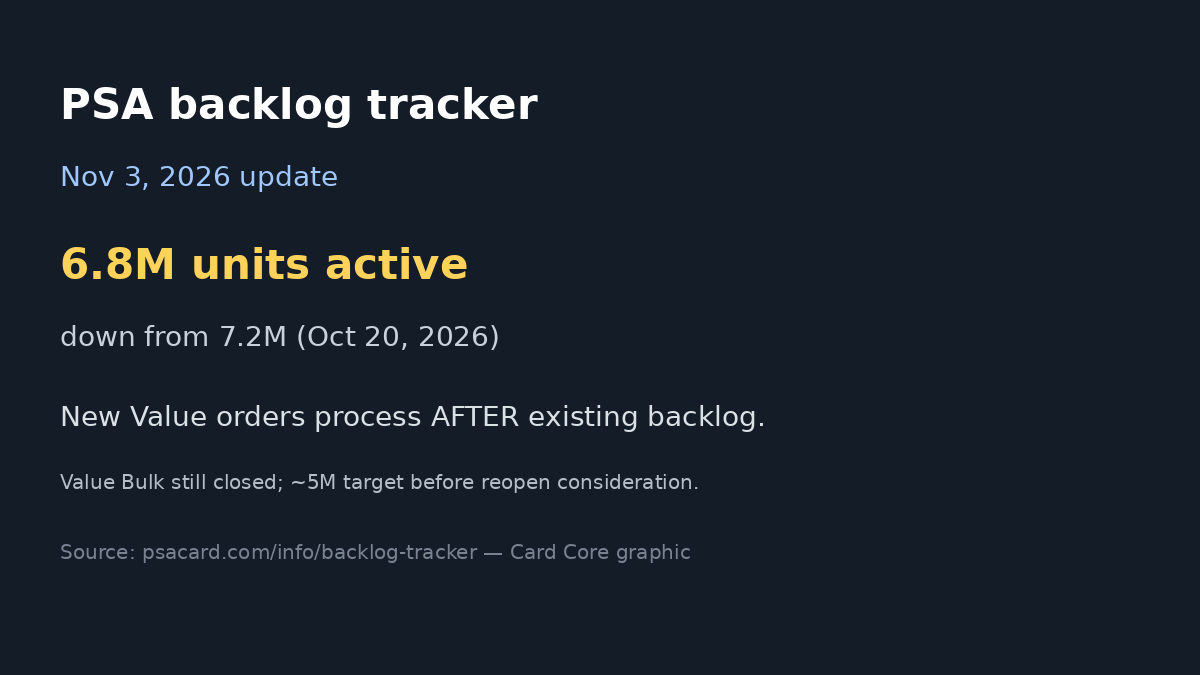
PSA’s backlog tracker update dated November 3, 2026 puts the active grading backlog at 6.8 million units, down from 7.2 million on October 20. PSA says Value Bulk remains closed and that holding momentum toward roughly 5 million units would position it to evaluate a Value Bulk reopen. Opening Value does not move existing orders ahead of the new Value queue — the opposite: existing orders stay first.
Worked example: one card, three PSA tiers
Illustrative assumptions only (written November 4, 2026). These are arithmetic placeholders, not comps for a named card:
- You could sell the card raw for $100 today (illustrative).
- Round-trip shipping and insurance to the grader and home costs $25 (illustrative; your carrier and declared value will differ).
- Exit venue takes 13.25% of the graded sale price (illustrative marketplace rate — confirm your venue before you submit).
- Taxes and tips/promoted listings are ignored here so the fee math stays readable.
Break-even graded sale price G solves:
G × (1 − 0.1325) = raw + grading fee + ship/ins
so G = (raw + fee + ship) ÷ 0.8675
Plug in the live PSA fees:
| Service | Fee (official) | Est. TAT (official) | Illustrative break-even G vs $100 raw |
|---|---|---|---|
| PSA Value | $39.99 | 90–100 business days | ≈ $190 |
| PSA Standard | $59.99 | 70–80 business days | ≈ $213 |
| PSA Priority | $79.99 | 50–60 business days | ≈ $236 |
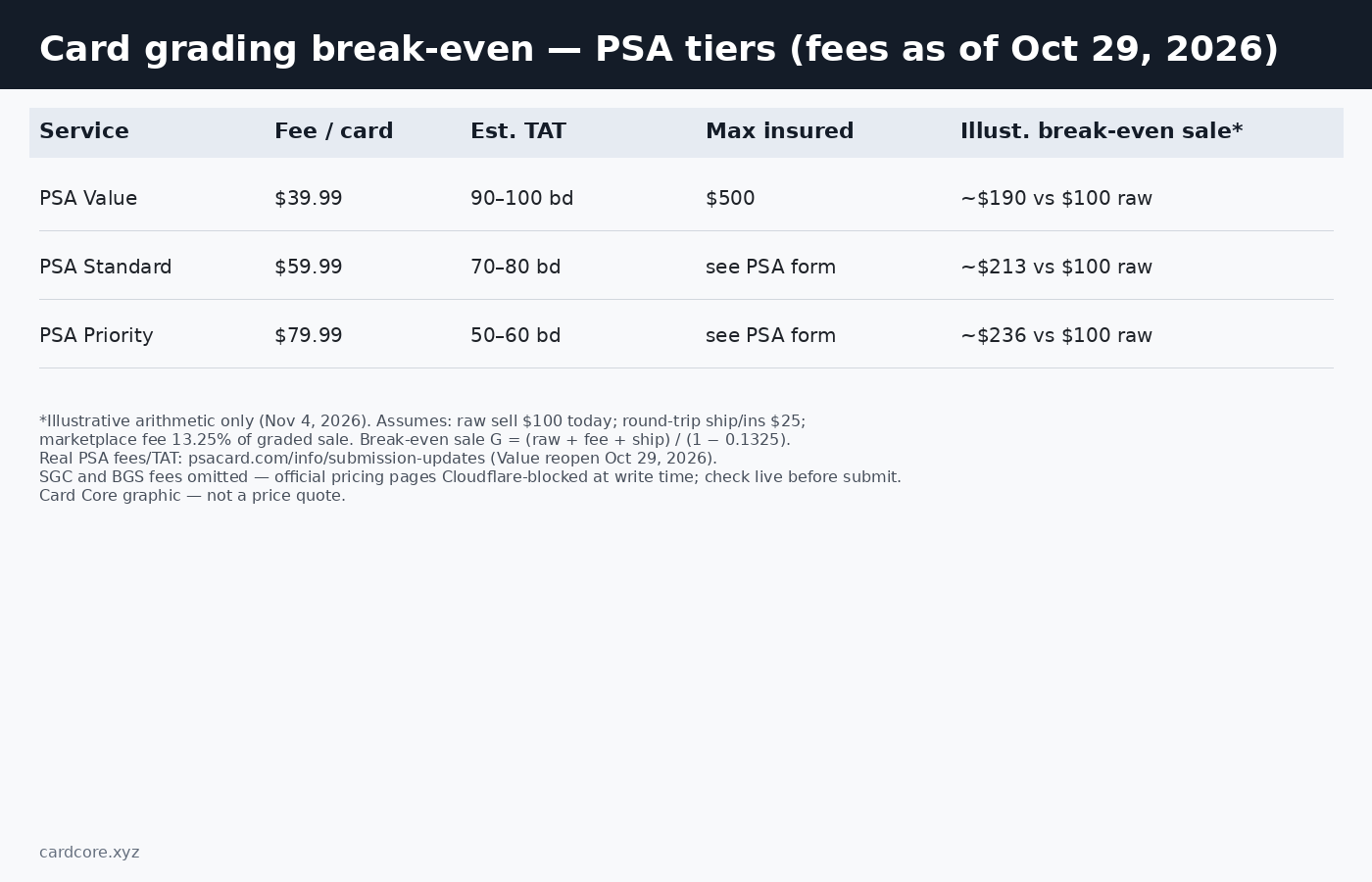
Read the Value row carefully. At $39.99, Value is the cheapest PSA lane in this reopen — but the illustrative break-even sale is still about $190 against a $100 raw. You are not “saving” relative to raw until the graded sale clears that bar and you actually get the grade you modeled. PSA’s own grading standards put a PSA 10 at roughly 55/45 front centering (with judgment calls on eye appeal). A 9 or 8 changes the exit price; the fee does not.
Time is part of the cost
Ninety to one hundred business days is roughly eighteen to twenty calendar weeks if the estimate holds. Priority’s 50–60 business days is still months. Capital locked in a queue cannot be sold raw if the market softens while you wait. That is the same liquidity problem we mapped when Standard launched in our PSA Standard tier and backlog math post — only now Value sits behind the existing 6.8M-unit backlog.
SGC and BGS: check live, do not copy old fees
Service menus at SGC and Beckett / BGS move often. At write time on November 4, 2026, both official pricing pages returned Cloudflare bot challenges from our fetch tools, so this post quotes no SGC or BGS dollar fees. Open each grader’s current pricing page yourself before you model a submission. Choose the grader for the buyers who will pay for that label — not habit — then rerun the same break-even formula with that day’s fee and turnaround.
The decision rule most guides skip
Before you print a label:
- Name the exit. eBay? A dealer buy? A private sale? Auction house? Each has a different fee and a different buyer pool.
- Write the all-in stack. Grading fee + ship/ins both ways + platform fee + any tax. Use today’s published numbers.
- Solve for break-even G. If you cannot show a realistic graded sale above G for the grade you actually expect, sell raw or hold.
- Price the wait. Value’s 90–100 business days (behind the existing backlog) is not free optionality. It is locked capital.
- Skip hope grades. “Maybe it gems” is not a line item. Our Pokémon PSA 10 vs raw report is a reminder that the slab premium is uneven across grades and games — model the grade you can defend under light, not the grade you want.
What this post is not
It is not a tip to “always use Value” or “always use Priority.” Value is cheaper per card and slower; Priority is more expensive and still measured in months. It is also not a price guide. We did not invent a named card’s raw or graded comps for this example. If you need a real sale table, pull dated sold listings for your card, then swap those numbers into the same formula.
For related reading in this cluster, see our Collector Guides hub, the PSA / SGC / BGS primer, Standard-tier backlog math, and the Pokémon PSA 10 vs raw split. Market-context posts also live under Market News.
Bottom line: card grading break-even is a net-after-fees number, not a vibe. PSA’s October 29, 2026 Value reopen gives collectors a $39.99 lane again — behind a still-large backlog. Run the table. Name the exit. If the math does not clear, keep the card raw.