Blue-Eyes White Dragon 1st Edition: Liquidity by Grade
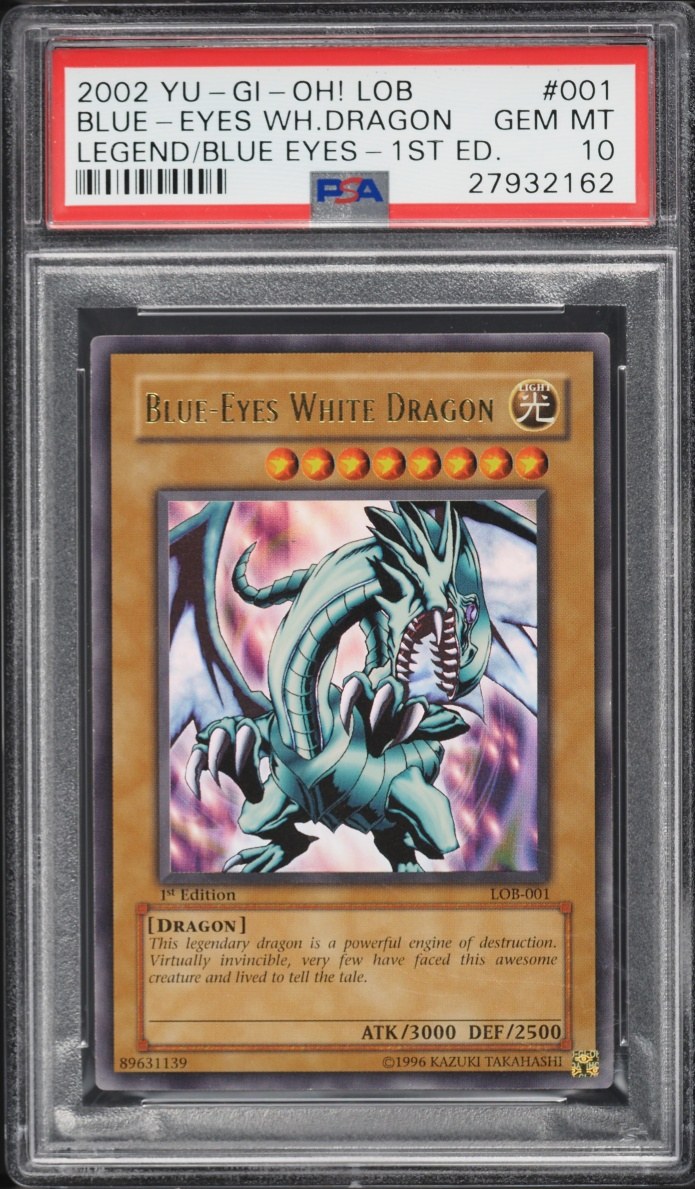
A Blue-Eyes White Dragon 1st Edition (LOB-001) in PSA 10 last sold for $78,000 on November 1, 2026, and it is one of the few landmark trading cards that actually trades often enough to have a price path. Card Ladder’s record shows five PSA 10 sales between May 22 and November 1, 2026, climbing from $43,200 to $78,000, about 80% in roughly five months. Even so, that run sits below an $85,100 eBay sale from October 2020 (CardVolume). The copy collectors really trade is the PSA 9, with 309 graded and recent sales between $7,800 and $10,000. The lesson: a liquid icon still moves in steps, and the step between grades is wider than most buyers expect.
This card joins our iconic-card liquidity series. For more frameworks on pricing graded cards, see Collector Guides.
What the 1st Edition LOB-001 is
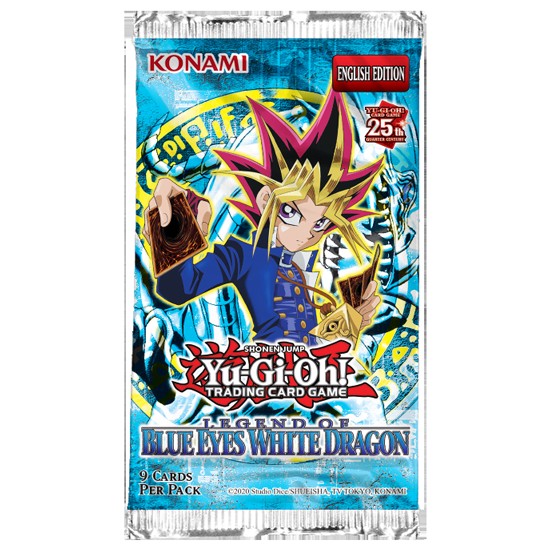
Legend of Blue Eyes White Dragon was the first booster set of the Yu-Gi-Oh! Trading Card Game. Konami’s own product page calls it “the very first Yu-Gi-Oh! TRADING CARD GAME booster set ever released” and lists 126 cards, including 10 Ultra Rares. Blue-Eyes White Dragon is card LOB-001, an Ultra Rare. The North American English set went on sale March 8, 2002, distributed by Upper Deck Entertainment, and 1st Edition and Unlimited copies hit shelves the same day (FLOAT).
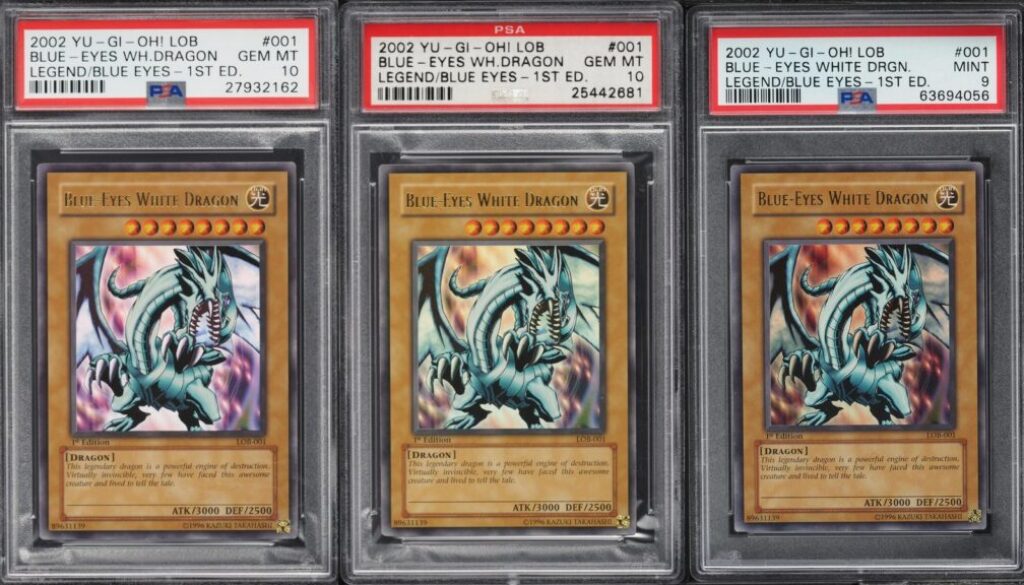
Three details decide which card you are holding. The words “1st Edition” print under the art on the left. The set code reads LOB-001, not LOB-E001 (the European print, released later with its own population and prices) and not LOB-EN001 (modern reprints). And PSA grades each regional version as a separate card, so a pop report or sale for one does not comp another.
The PSA 10 run: five sales, about 80% higher
PSA 10s are scarce but not unique. PriceCharting’s October 2026 read of the PSA census shows 106 Gem Mint copies out of 1,150 graded, about 9%. That is enough supply for sales to arrive every few weeks, which is why this card has a visible trend instead of one trophy print.
| Date (2026) | Grade | Venue | Price (incl. buyer’s premium) | Source |
|---|---|---|---|---|
| May 22 | PSA 10 | Fanatics Collect | $43,200 | Card Ladder |
| Sep 9 | PSA 10 | Goldin | $56,120 ($46,000 hammer, 34 bids) | Goldin |
| Sep 25 | PSA 10 | Fanatics Collect Premier | $63,000 | Card Ladder |
| Oct 11 | PSA 10, cert 25442681 | Fanatics Collect Weekly | $72,000 (33 bids) | Fanatics Collect |
| Nov 1 | PSA 10, cert 27932162 | Fanatics Collect Weekly | $78,000 (29 bids) | Fanatics Collect |
Each sale printed higher than the last, and the published bid counts (29 to 34) stayed close together. That looks like real depth. But five sales in about five months is still roughly one a month, and the 2020 eBay high of $85,100 is a reminder that this exact grade has been higher before. A streak tells you the direction of the last few buyers. It does not tell you where the next one stops.
Why the PSA 9 is the real market
The PSA 9 is the most common grade on the card. PriceCharting’s population read breaks the 1st Edition LOB-001 down like this:
| PSA grade | Population (Oct 2026) | Share of graded |
|---|---|---|
| 10 | 106 | 9% |
| 9 | 309 | 27% |
| 8 | 201 | 17% |
| 7 | 102 | 9% |
| 6 | 119 | 10% |
| 5 and below | 313 | 27% |
| Total | 1,150 | 100% |
Card Ladder’s sales for July 31 to October 31, 2026, as compiled by CollectorDream, show five PSA 9 sales between $7,800 and $10,000, the last at $9,100 on October 27. Against the $78,000 PSA 10, that is a gap of more than 8x for one grade step. FLOAT’s record of PSA auction results puts PSA 9s at $3,383 to $5,106 through 2024, so the 9 has roughly doubled too. It just did it with more copies changing hands.
That gap is the practical lesson. If you own a raw copy you believe is a 10, the expected value of grading depends almost entirely on whether it comes back a 10 or a 9, and nine in ten graded copies have not come back 10. Our Base Set Charizard lesson shows the same cliff between grades on the most famous Pokémon card.
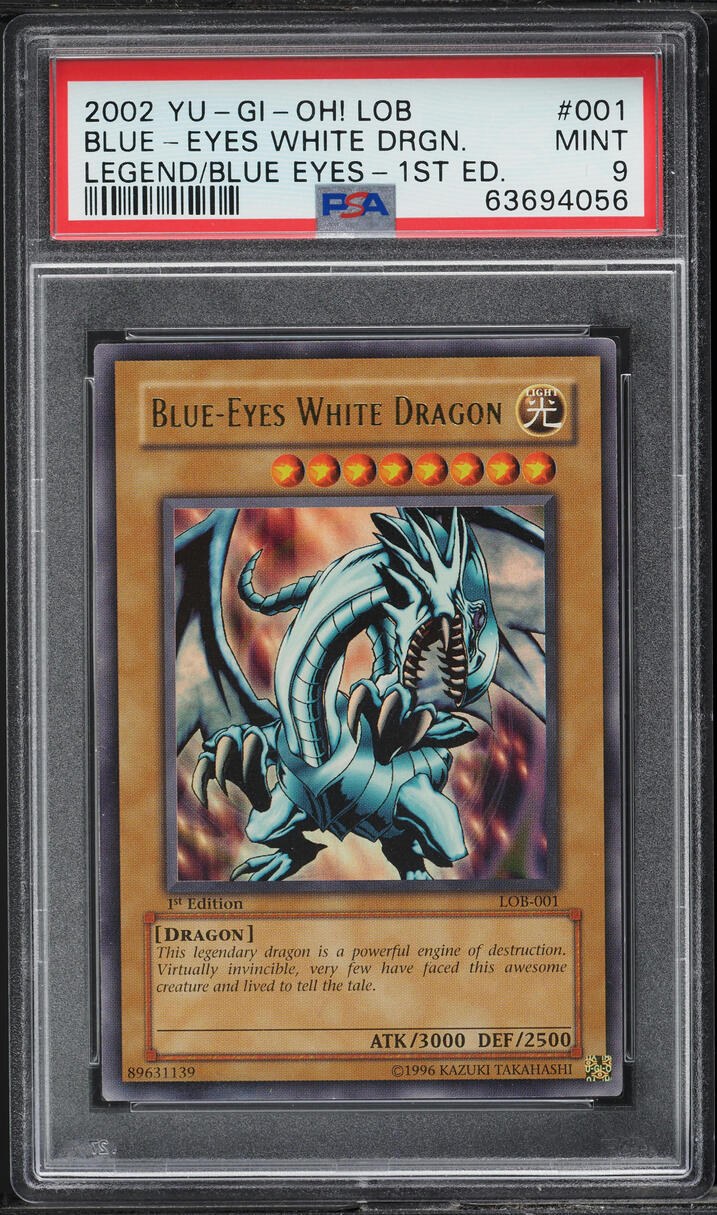
Same slab, two prices three weeks apart
Liquidity is not the same as stability. FLOAT’s price record shows PSA 9 cert 96720943 selling at auction for $4,808 on April 6, 2025 and again for $3,100 three weeks later, a $1,708 drop on the identical card. Another PSA 9, cert 80417767, sold for $4,348 in October 2024 and $4,538 in March 2025. Same grade, same card, and the spread between two buyers on two nights was wider than a year of trend.
Population is also still moving. PriceCharting’s history shows the total PSA count for this card rising from 1,087 in April 2026 to 1,150 in October, 63 more slabs in about six months. Rising prices pull more raw copies into grading, and some of those will come back 10. Watch the PSA 10 count next to the sales. If it climbs faster than buyers show up, the streak is the first thing to break.
Reprints don’t dilute it, but they do confuse buyers
Blue-Eyes has been reprinted for more than two decades, and those prints sit at very different prices. CardVolume lists Unlimited LOB-001 PSA 10s at $4,800 and $5,495 at Fanatics Collect in July 2026, a fraction of the 1st Edition. CollectorDream found raw Near Mint LOB-EN001 copies from the 25th Anniversary edition selling for $34.96 to $49.97 on TCGplayer between August and October 2026. None of them is the 2002 1st Edition, and a listing that blurs edition, set code or region is the most common way to overpay.
How to price a Blue-Eyes White Dragon 1st Edition
- Confirm the exact card first. “1st Edition” text, LOB-001 code, and the label’s set name. LOB-E001, Asian-English and LOB-EN001 copies have their own pops and prices.
- Price from the last three same-grade sales, not the high. For a PSA 10 right now that means $63,000, $72,000 and $78,000. For a PSA 9, the recent $7,800 to $10,000 band.
- Look up the cert’s sales history. Resold slabs show how far one card can swing between buyers. A slab that just sold is also a slab whose owner knows the number.
- Treat the 9-to-10 gap as risk, not upside. At more than 8x, a raw “10 candidate” priced like a 10 only works if it grades a 10. Run the numbers net of fees with our card grading break-even example.
- Watch population next to price. A growing PSA 10 count with flat bid counts is the early sign a run is cooling.
The bottom line
The Blue-Eyes White Dragon 1st Edition is the rare icon with enough supply to trade on a schedule. That makes it easier to price than a pop-1 trophy like the Pikachu Illustrator, but not safer. The PSA 10 just ran from $43,200 to $78,000 in five sales, the PSA 9 trades at roughly one-eighth of that, and a single PSA 9 slab once lost a third of its price in three weeks. Buy the grade you can resell, price from recent same-grade sales, and treat the streak as information, not a promise. For what’s new on the Yu-Gi-Oh! release calendar, see our Magnificent Maestros drop radar.