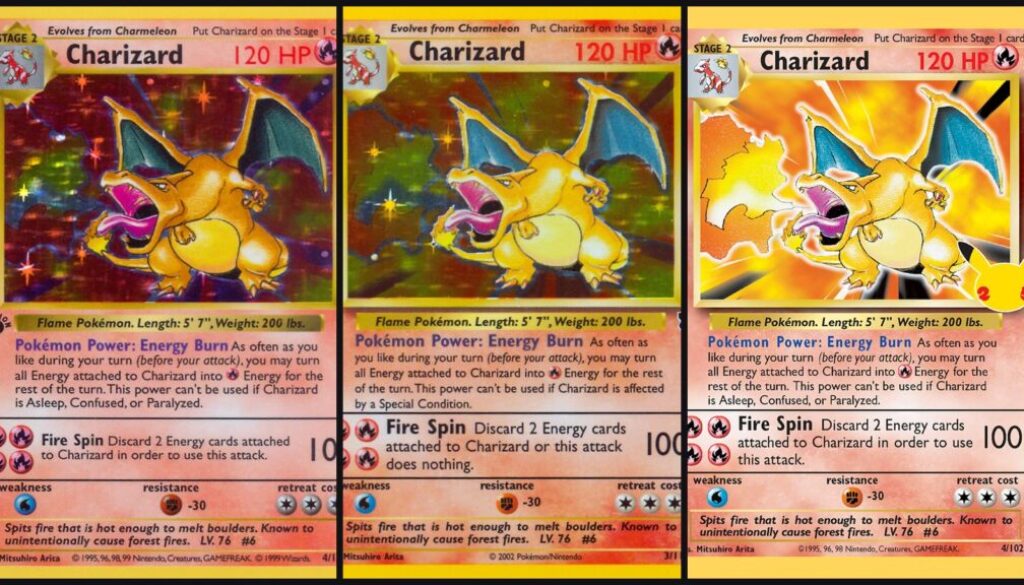
Base Set Charizard: Liquidity by Edition and Grade
Base Set Charizard is the most recognized card in the Pokémon Trading Card Game. It is also one of the easiest to misprice, because “Base Set Charizard” is not one market. It is a stack of separate markets: four English print runs, a population ladder that runs from PSA 1 to PSA 10, and more than two decades of official reprints with the same Mitsuhiro Arita artwork. If you know which of those markets you are in, you can price a copy honestly. If you don’t, the card’s fame mostly helps the person on the other side of the deal.
This Iconic Cards piece goes deeper on one of the three anchors from our iconic trading cards as liquidity anchors overview. The focus is structure, not hype: what each print is, where graded supply is thin, and why reprints change demand without adding a single vintage copy. For more frameworks like this, browse the Collector Guides hub and our Pokémon coverage.
Why Base Set Charizard became the reference card
Wizards of the Coast released the English Base Set on January 9, 1999, more than two years after the Japanese Expansion Pack came out in October 1996 (Bulbapedia: Base Set). Charizard was card 4 of 102: a holo rare with 120 HP, the Energy Burn Pokémon Power, and a 100-damage Fire Spin attack at a time when few attacks came close to that number. Combine the game’s most popular Fire-type, a holo slot, and a playground reputation, and you get a card nearly every collector can picture without looking it up.
Recognition is where liquidity starts, but it isn’t liquidity on its own. Fame means more buyers will look at a listing. It does not mean every listing deserves the same price, or that the next copy will sell as fast as the last headline sale. The rest of this guide is about the details that set the actual price.
Four English prints, four different markets
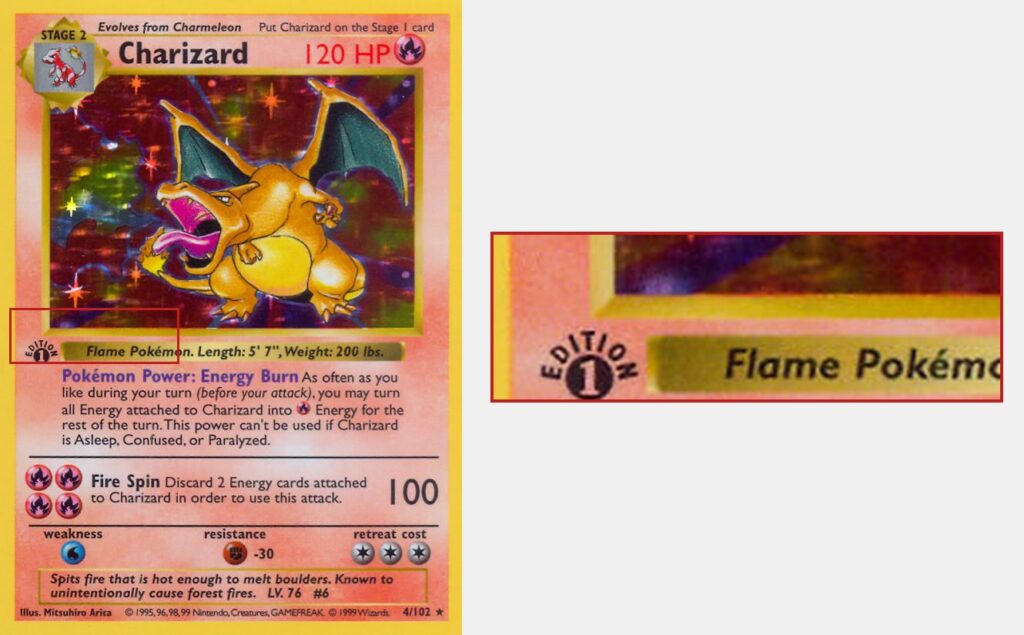
The English Base Set had four distinct print runs, and they share the art but not the market (Bulbapedia: Base Set; Bulbapedia: 1st Edition):
- 1st Edition: the first run. It has the black “Edition 1” stamp at the lower left of the art box, thinner HP and attack text, and no drop shadow around the illustration window.
- Shadowless: the second run. It matches the 1st Edition layout, with thin text and no shadow, but has no stamp. Its copyright line includes “99.”
- Unlimited: the third run. It adds a drop shadow along the art box and bolder HP and attack text, and the copyright line drops the “99.”
- Unlimited (1999–2000 copyright): a fourth run, the same as Unlimited apart from the updated copyright line.
The liquidity lesson: buyers price the print first and the name second. A listing titled “Base Set Charizard holo” with no clear photo of the stamp area, the art-box edge, and the copyright line is asking you to take on identification risk. Serious buyers discount that risk or walk away, so a seller with a vague listing gets fewer bids, even on a card everyone knows.
Grade-tier liquidity: the population ladder thins at the top
Population reports are where Base Set Charizard’s “rarity” gets specific. At the time of writing, PSA’s CardFacts page for the 1st Edition Charizard lists a population of 123 at GEM-MT 10, 729 at MINT 9, and 715 at NM-MT 8. The Shadowless Charizard page lists 58 at GEM-MT 10, 851 at MINT 9, and 1,507 at NM-MT 8. These counts change as more cards are submitted, so check the live pages before you rely on them.
Two lessons come out of those numbers:
- Scarcity depends on the tier, not just the print. Shadowless shows fewer PSA 10s than 1st Edition on PSA’s own pages, yet more 9s and 8s. Saying “1st Edition is rarer” is accurate about the stamp. It doesn’t tell you which slab has fewer buyers or sellers at a given grade.
- The top tier is thin, and thin markets clear unevenly. When only a few dozen or a few hundred copies exist at a grade, a single sale tells you little about the next one. Mid grades have deeper populations, which usually means more comparable sales and less guesswork. That depth is real liquidity.
Population counts measure what has been graded. They are not print-run totals. Raw copies still sitting in binders, crossovers between grading companies, and resubmissions of the same card all make the counts imperfect. If you’re deciding whether grading is worth it at all, our breakdown of card grading consolidation covers how grader choice and market structure affect what a slab is worth when you sell.
Reprints feed nostalgia, not vintage supply
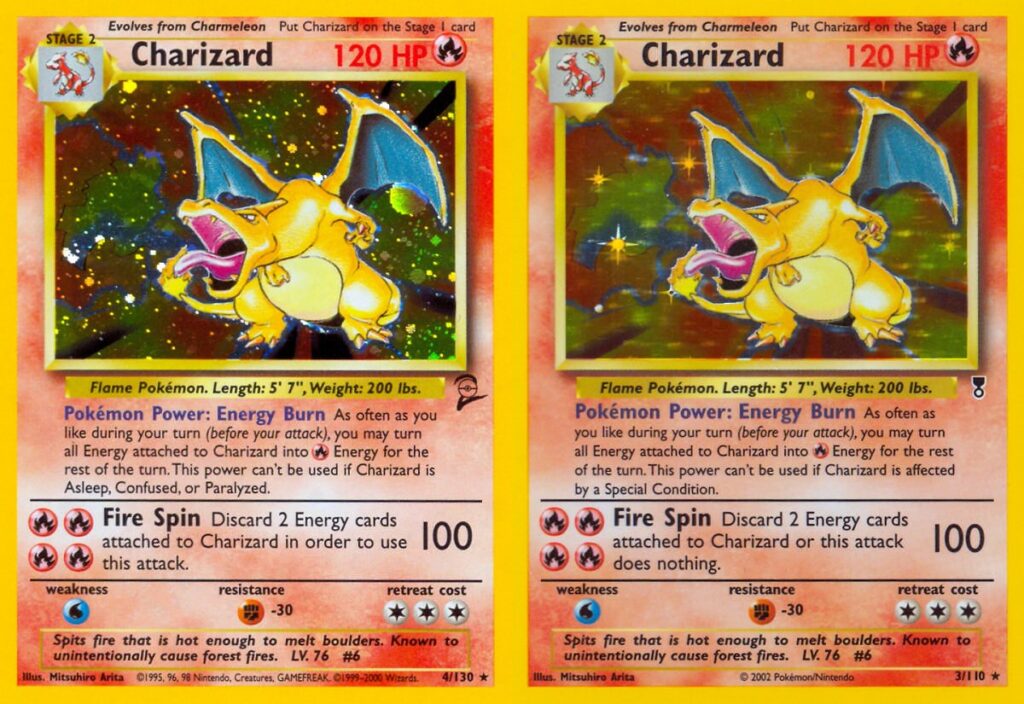
Charizard’s Base Set art has been reprinted several times. According to Bulbapedia’s Charizard (Base Set 4) entry, the original print returned in Base Set 2 (February 24, 2000) and again in Legendary Collection (May 24, 2002). Neither of those English sets had a 1st Edition run. Both carry their own set symbols, card numbers, and copyright lines, so a careful buyer can tell them apart from the 1999 Base Set prints.
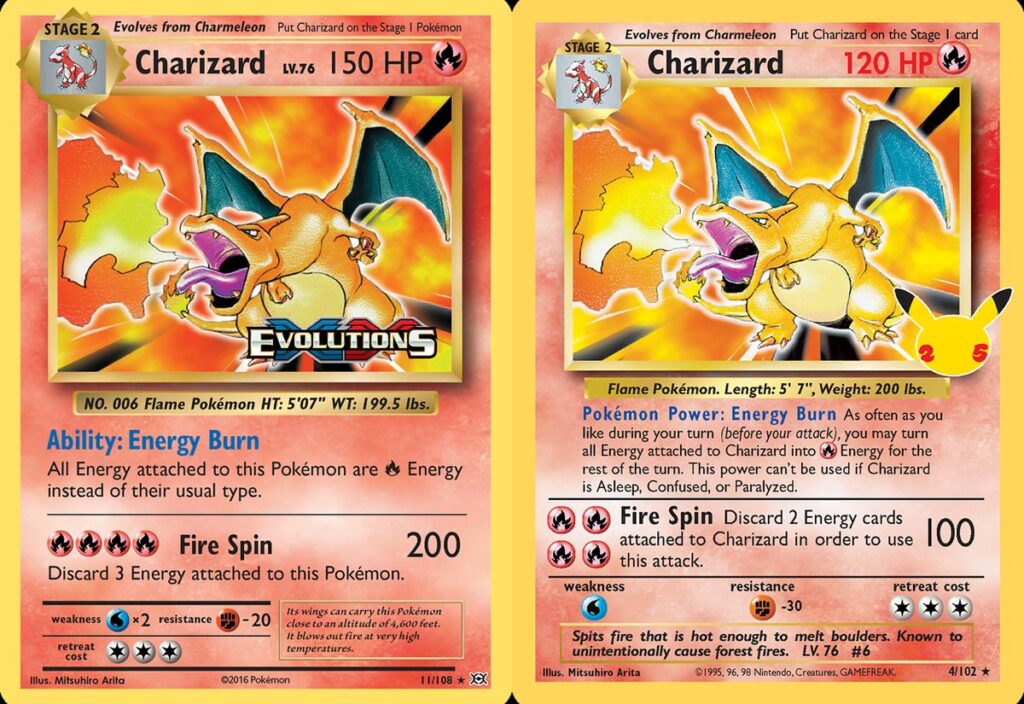
Modern reprints are labeled even more clearly. The Pokémon Company announced its 25th-anniversary Celebrations collection in June 2021, with a special subset of 25 “close remakes” of iconic cards that included Base Set Charizard. Products launched October 8, 2021. The Celebrations: Classic Collection Charizard in the official card database keeps the 4/102 number and Arita credit, adds the 25th anniversary logo, and per Bulbapedia drops the Wizards of the Coast copyright line. Earlier, the 2016 Evolutions Charizard brought back the Base Set look with updated card text. It’s a tribute, not a reprint.
The latest wave is underway now. The Pokémon Company’s 30th Celebration preview names Charizard from Base Set among the classic cards being reprinted, and notes that these reprints are not legal in the Standard format. The 30th Celebration expansion launched worldwide on September 16, 2026. Bulbapedia also lists a holo reprint in the Charizard & Ho-Oh ex deck of Pokémon Trading Card Game Classic.
The liquidity lesson: reprints add buyers who want to own the art, but they add no 1999 copies. Every anniversary reprint creates a new, separate market at a lower entry price, and it brings attention back to the original. Speculators sometimes read that attention as permanent demand for the vintage card. It’s safer to treat the reprint and the original as separate assets, and to expect hype around the original to rise and fade with each anniversary cycle. We used the same approach for sealed product in Pokémon sealed liquidity under reprints.
Raw vs graded: where liquidity actually lives
A raw Base Set Charizard and a slabbed one attract different buyers. Graded copies trade on a label that buyers already trust, so they’re easier to compare against other sales and to sell remotely. Raw copies trade on photos and trust. That suits local deals and buyers who plan to grade the card themselves, but it creates disputes about condition, centering, and whether the print was identified correctly. The more expensive the copy, the more buyers prefer the certainty of a slab.
If you hold raw copies while you decide, protect the card’s condition. A penny sleeve and a rigid holder are the minimum. Plain top loaders (affiliate link) cost little next to the value a single dinged corner can wipe out.
Base Set Charizard checklist before you buy or sell
- Identify the print. Check for the stamp, the art-box shadow, and the copyright line. Then check whether it’s from Base Set at all: Base Set 2, Legendary Collection, and the anniversary reprints each have their own markings.
- Price the grade, not the name. Compare completed sales of the same print at the same grade from the same grading company. Asking prices and sales from other tiers are not comparable.
- Read the population page yourself. Use PSA’s CardFacts pages (or the equivalent from the grader you use) and note how many copies exist at your grade and above.
- Expect thin tiers to clear unevenly. At the top grades, a single auction result is one data point, not a market price.
- Keep reprints and originals separate. Anniversary products bring buyers back to the art. They don’t expand the 1999 supply.
- Model your exit. Fees, shipping, insurance, and the venue all reduce what you actually take home. Know which platform fits a raw copy and which fits a slab before you buy.
Bottom line
Base Set Charizard earns its Iconic Cards spot because it shows how liquidity really works in the hobby. Fame brings buyers, but price depends on the print, the grade, and the market you’re actually in. PSA’s own pages show how thin the top grades are, and official reprints from 2000 through the 30th Celebration show how nostalgia demand can grow without adding vintage supply. Know which Charizard you’re holding, and price that card.
Sources: PSA CardFacts (1st Edition), PSA CardFacts (Shadowless), pokemon.com, press.pokemon.com, and Bulbapedia. Featured image source: Pokémon TCG API card scans (1st Edition Base Set, Legendary Collection, and Celebrations: Classic Collection Charizard). Card art by Mitsuhiro Arita; © Pokémon/Nintendo/Creatures/GAME FREAK.