Black Lotus: Why the Record Isn’t the Market
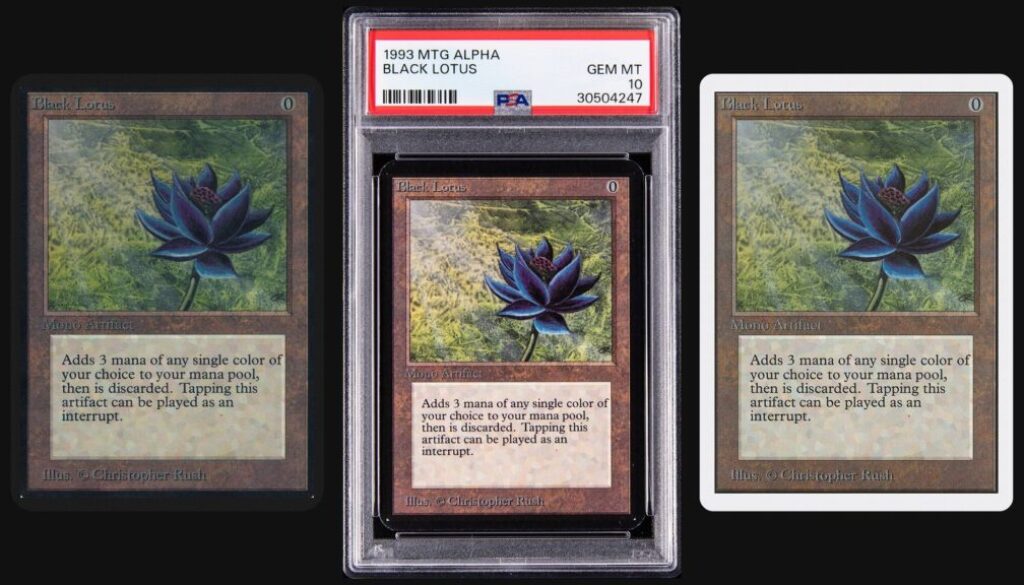
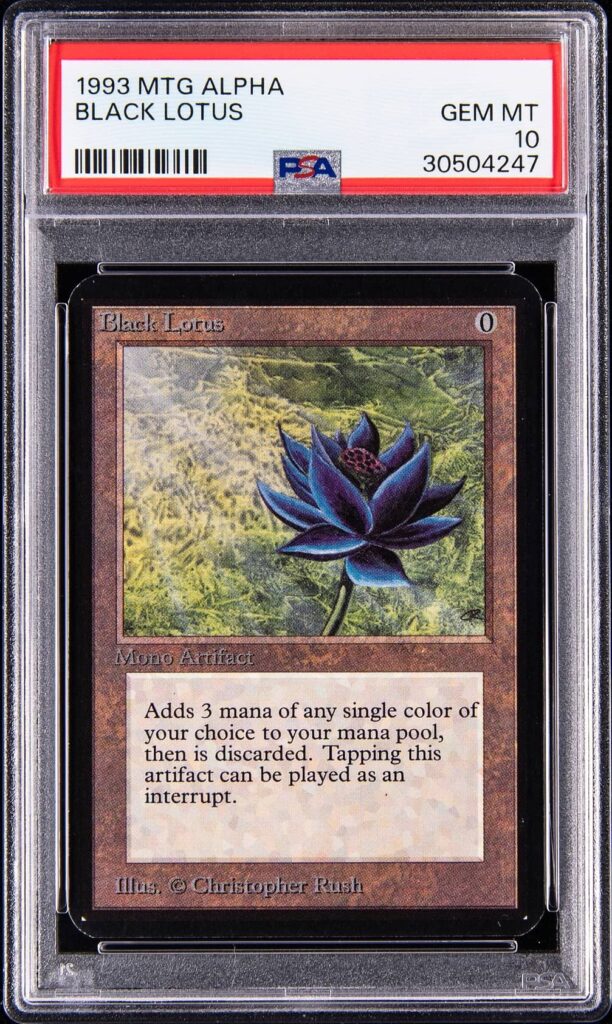
Black Lotus does not have one price. It has a ladder. The public auction record is $2.208 million, including buyer’s premium, for a PSA Gem Mint 10 Limited Edition Alpha copy that Goldin sold in its 2026 Summer Goldin 100 auction (ICv2, September 20, 2026). That card is one of only three Alpha Black Lotus copies at PSA 10. PSA’s CardFacts population table, checked October 20, 2026, lists 21 at PSA 9 and 41 at PSA 8. Edition (Alpha, Beta, or Unlimited) and grade decide which Black Lotus market you are actually in, and nearly every headline comes from the thinnest rung of that ladder.
Black Lotus joins the other landmarks in our liquidity series, including original MTG dual lands and the 1989 Upper Deck Griffey. If you want the print-run debate behind Lotus scarcity, our Reality Fracture scarcity piece walks through it. More frameworks like this live in Collector Guides and Market News.
Why Black Lotus is the reference card
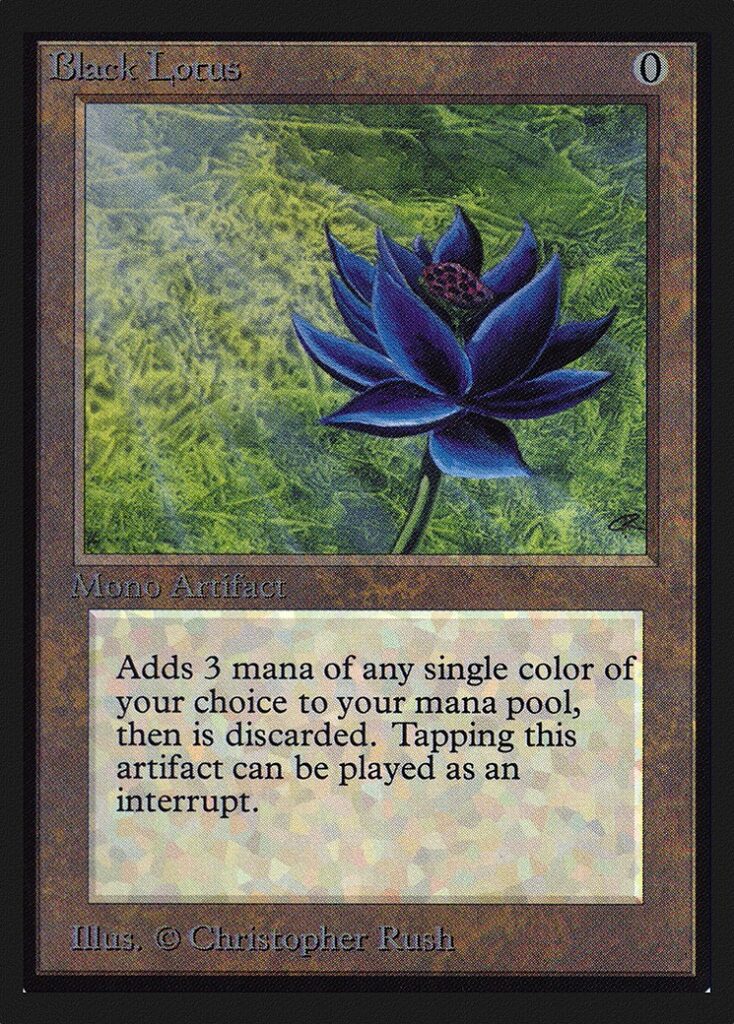
Black Lotus, illustrated by Christopher Rush, was printed for regular play in three 1993 core-set runs: Limited Edition Alpha (August 5), Limited Edition Beta (October 4), and Unlimited Edition (December 1), per Scryfall’s printing records. Wizards of the Coast lists it on the Reserved List in its Official Reprint Policy, which says reserved cards “will never be printed again in a functionally identical form.”
What gets talked about less is how little the card is played. Wizards’ Banned and Restricted list restricts Black Lotus in Vintage, so a deck can run only one copy, and bans it in Legacy and Commander. The original dual lands still get Legacy and Commander play, which gives them buyers who just want to use them. Black Lotus has very little of that. Its demand leans heavily on collectors, so its liquidity depends on collector money and on the condition of each copy.
Edition is the first liquidity split
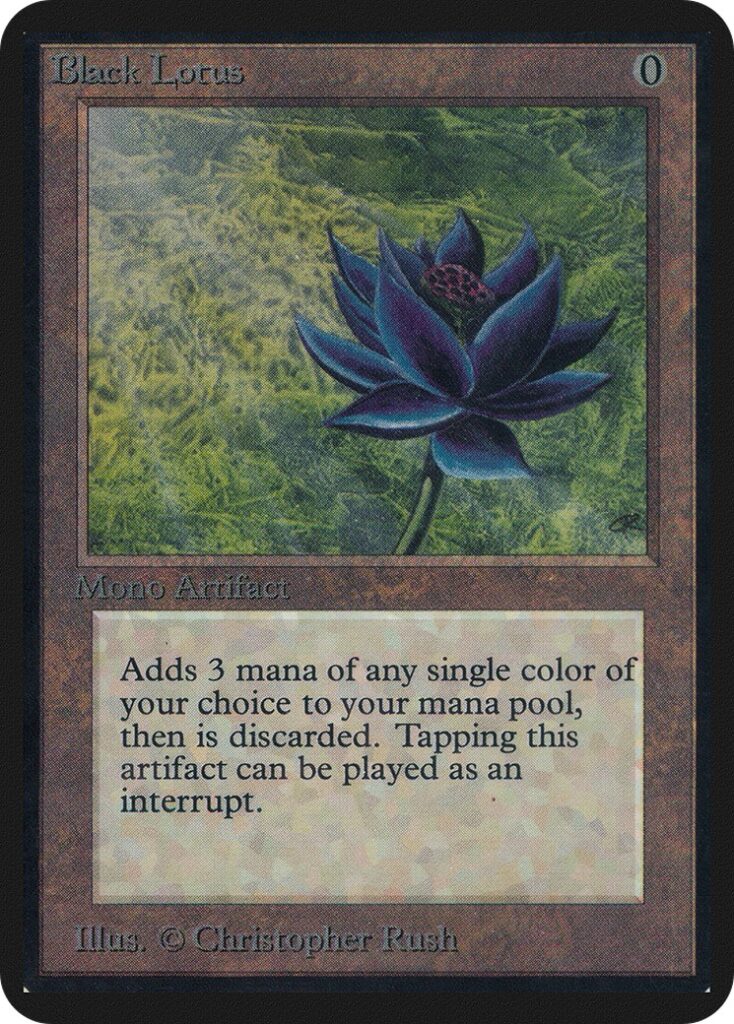
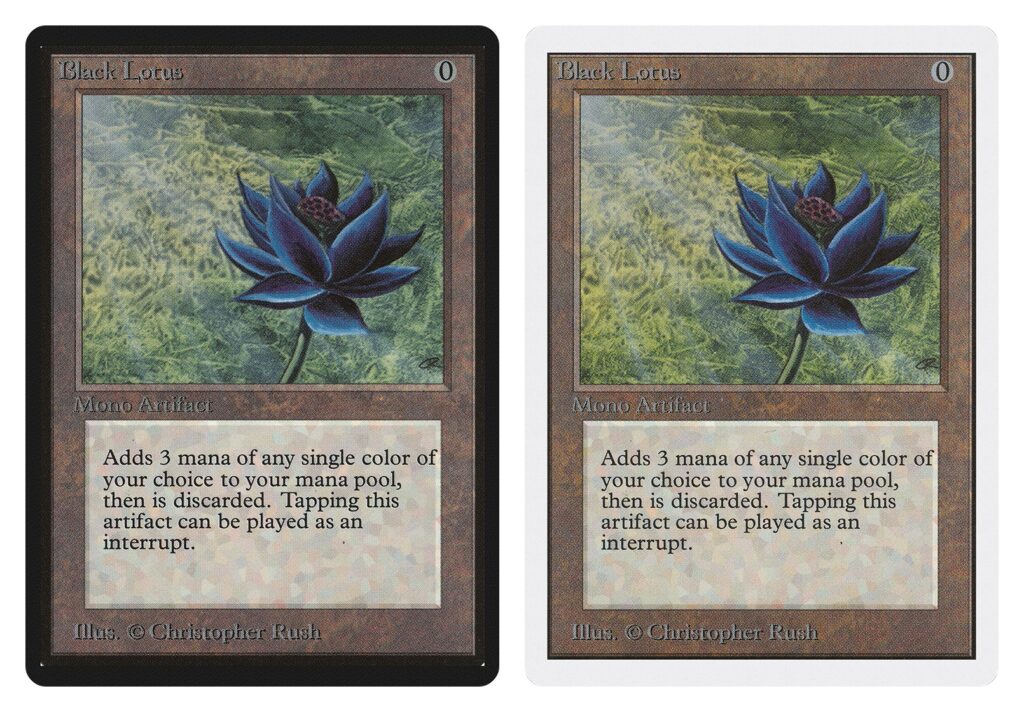
The three playable printings share the same art and text. You tell them apart by their physical features. According to Misprint’s Alpha vs Beta vs Unlimited guide, Alpha has noticeably rounded corners and a black border. Beta keeps the black border but has squarer corners. Unlimited switched to a white border. The same guide gives commonly cited whole-set print runs of roughly 2.6 million Alpha cards, 7.3 million Beta cards, and 40 million Unlimited cards. Those are totals for every card in each set, not counts of Black Lotus. Estimates for Lotus alone vary by source, so we leave them out here.
For a buyer, that splits the card into three different markets:
- Alpha: the trophy tier. It has the smallest supply, the most fragile corners, and the sales that make headlines.
- Beta: the black-border look without the Alpha premium. Misprint calls Beta “the usual target” for players who want an authentic 1993 card without paying the Alpha premium.
- Unlimited: the largest supply and the most realistic first Black Lotus for most collectors. The white border makes it easy to identify, and it has the deepest pool of copies to compare.
The grade cliff: what the population reports show
PSA’s CardFacts page for the Alpha Black Lotus shows how few copies reach the top. These are the counts we saw on October 20, 2026. Population reports change as cards are submitted, crossed over, or resubmitted, so check the live page before you rely on them.
| PSA grade (Alpha Black Lotus) | Population |
|---|---|
| GEM-MT 10 | 3 |
| MINT 9 | 21 |
| NM-MT 8 | 41 |
| NM 7 | 16 |
| EX-MT 6 | 7 |
CGC’s numbers are just as steep. When Goldin sold a CGC 9 Alpha Black Lotus for $138,402 in August 2025, CGC reported 51 Alpha Lotus copies in its population report, with only 9 graded higher than that one (CGC). Here is how sourced public results line up by tier:
| Copy | Venue and date | Reported price |
|---|---|---|
| Alpha, PSA 10 | Goldin, 2026 Summer Goldin 100 (reported Sept. 20, 2026) | $2.208 million incl. buyer’s premium (ICv2) |
| Alpha, PSA 10 (different copy) | PWCC on eBay, Jan. 2021 | $511,100 (ICv2) |
| Alpha, CGC 9 | Goldin, Aug. 2025 | $138,402 incl. buyer’s premium (CGC) |
| Beta artist proof, CGC 8.5, signed by Christopher Rush | Heritage, March 2023 | $615,000 (ICv2) |
| Alpha, CGC Pristine 10 (pop 1) | Private sale, 2024 | $3 million, announced by CGC (ICv2) |
The PSA 10 and the CGC 9 above sold a year apart and were graded by different companies, so you can’t read a clean ratio from them. Still, the 2026 PSA 10 brought more than fifteen times the 2025 CGC 9. At the top of the ladder, a one-grade difference isn’t a small adjustment. It puts the card in a different market with a different set of buyers.
Three reasons a headline price is not a market price
Bids are not clearing prices. In the January 2021 PWCC auction of an Alpha PSA 10, early bidding pushed the price past $700,000. Some of those bids were then disallowed because the bidders couldn’t be verified. The final winning bid was $511,100 (ICv2). A screenshot taken mid-auction would have overstated the price by a wide margin.
The same grade can still look different. ICv2 reported that observers noticed more white printer cut marks on the corners of the 2026 Goldin PSA 10 than on other PSA 10 copies, such as the one sold in 2021, and suggested this may have held bidding back a little. The same article notes that PSA Gem Mint cards tend to sell for more at auction than similar cards graded by other services. The label on the slab and the card inside both affect the price.
Private sales can’t be checked. The $3 million CGC Pristine 10 sale was private, and ICv2 pointed out the large gap it opened between private-sale and auction prices for Black Lotus. Outsiders can’t verify the terms. Treat it as a data point about one unique card, not a price for anyone else’s copy. Even public auction prices like the $2.208 million include the buyer’s premium, so the seller received less after fees. Check the auction house’s terms before you compare a headline with what a seller actually keeps.
Collectors’ Edition, 30th Anniversary, and the Reserved List fine print
Wizards’ reprint policy says its rules “apply only to tournament-legal Magic cards” and allows special-purpose versions “not meant for regular game play.” That is why Black Lotus exists in other forms. The December 1993 Collectors’ Edition reused Beta card faces with square-cut corners and gold-bordered backs. Wizards originally announced 10,000 sets for the U.S. and Canada and added about 5,000 International Edition sets, according to Peter Adkison’s newsgroup post as quoted by the MTG Wiki. Under Magic Tournament Rules section 3.3, cards with gold borders on the front or back are not Authorized Game Cards (Magic Judges rules resources).
In 2022, Wizards sold 30th Anniversary Edition for $999 per display. It was a non-tournament-legal product with its own card back, and its retro-frame rare slot could include Black Lotus. The Reserved List protects the supply of tournament-legal copies. It does not stop non-playable reprints of the card. A listing titled just “Black Lotus” could be any of these, so always confirm the edition, corners, border, and card back before comparing prices.
A practical Black Lotus framework
- Pick your market first. High-grade Alpha is a trophy market. Beta is the black-border collector’s market. Unlimited in mid grades is the first-Lotus market. Collectors’ Edition, International Edition, and 30th Anniversary are non-playable collectibles. Each has its own buyers and its own sales history.
- Compare like with like. Match the edition, grading company, and grade, and use completed public sales such as auction-house archives and PSA’s Auction Prices Realized. Asking prices and estimated values are not sales.
- Look up the cert. Check every slab’s certification number on the grader’s own site. Misprint notes that Alpha and Beta cards are among the most faked in the hobby, so buy raw copies only from sellers who let you inspect the corners and borders closely.
- Run the grading math before you submit. Grading pays off only if the likely grade’s real completed-sale price, minus the raw card’s value, is more than the grader’s fee for that declared value plus insured shipping both ways. For Alpha, the population ladder shows that most copies land well below Gem Mint, so plan around a mid-grade result.
- Price the net, not the headline. Buyer’s premiums, seller fees, insurance, and time on market all come out of the result. A record price shows the most one buyer was willing to pay for one copy. It does not tell you what you’ll net when you sell yours.
The bottom line
Black Lotus clearly shows how one famous name can hide several separate markets. The $2.208 million record is real, but it came from one of three PSA 10 Alphas. For most collectors, the realistic choice is a mid-grade Unlimited or Beta copy, and each of those has its own buyer pool and its own completed sales. Pick your edition and grade first, then compare like with like. The headline price tells you what one copy brought, not what yours is worth.