Pikachu Illustrator: The Record Isn’t the Market
The Pikachu Illustrator’s $16,492,000 record is not the price of a Pikachu Illustrator. That number belongs to one card: the only PSA 10, which Goldin sold on February 16, 2026 ($13.3 million hammer plus buyer’s premium, 97 bids). The copies that actually come up for sale are PSA 9s and lower, and in 2026 the PSA 9 alone printed $1,406,250 in March, $5,000,000 in September, and about $3.2 million in October. A buyer who prices from the headline misses two things. One PSA 10 cannot comp anything else, and the same grade has spread by more than 3.5x within about six months. Like our Base Set Charizard and Black Lotus lessons, the record is a trophy print, not a market.
This card joins our iconic-card liquidity series. For more frameworks, see Collector Guides and Market News.
What the Pikachu Illustrator is, and why so few exist
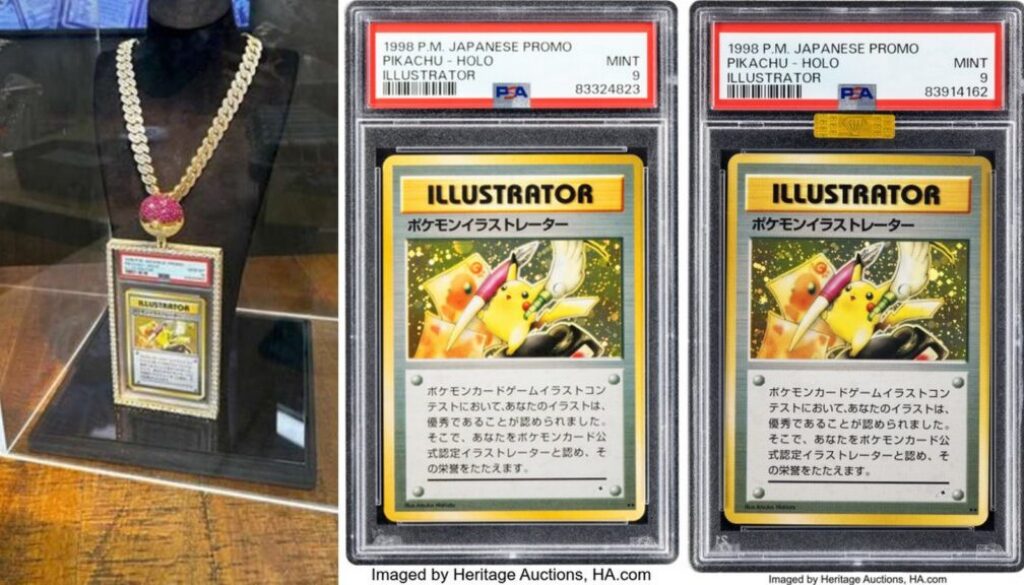
The Pikachu Illustrator was never sold in packs. It was a prize card for winners of illustration contests run through Japan’s CoroCoro Comic in 1997 and 1998. Heritage puts the distributed count at 39 copies across the first three contests (Collectibles News). The card reads “Illustrator” where a normal card reads “Trainer,” carries a pen symbol in place of a rarity mark, and features art by Atsuko Nishida. Nishida, a character designer on Pokémon Red and Green, in The Pokémon Company’s own creator profile, describes building Pikachu pixel by pixel and coming up with its name.
Graded population runs larger than the awarded count, and that matters for anyone reading a pop report. Folio’s November 9, 2026 read of the PSA census lists 15 PSA 9, 6 PSA 8.5, 13 PSA 8, 1 PSA 7.5, 7 PSA 7, 2 PSA 6, 2 PSA 5, 2 PSA 4 and 10 Authentic, plus the single PSA 10. That is 59 PSA entries against 39 awarded cards. Regrades, crossovers between graders, and copies that were never awarded all inflate the rows. Treat the PSA Population Report as an upper bound on supply here, not a count of cards.
The $16.49 million PSA 10 has no comp
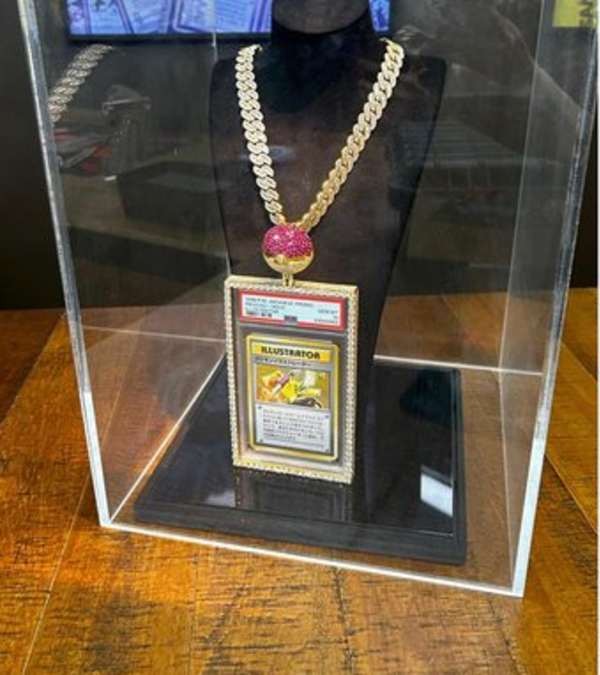
Goldin’s listing describes the card as the lone GEM MT 10 among the PSA census examples, and Guinness World Records certified the $16,492,000 result as the most expensive Pokémon card sold at auction. The same card had changed hands privately for $5,275,000 in 2021. Two things make that lot a poor yardstick for any other copy. It is a population of one, so no other card shares its grade. And the lot was not just a card: it included a custom diamond necklace appraised at $75,000 and hand delivery by the seller, per Goldin.
A pop-1 sale tells you what one buyer paid for one object on one night. It does not tell you what a PSA 9 is worth, how fast one sells, or what a seller nets.
Same PSA 9 label, 2026 prices 3.5x apart
The PSA 9 tier, with 15 copies on the census, is where the real Illustrator market lives. Here is what the public auction record shows for 2026, prices including buyer’s premium unless noted:
| Date (2026) | Grade / notes | Venue | Price | Source |
|---|---|---|---|---|
| Feb 16 | PSA 10 (pop 1), with necklace | Goldin | $16,492,000 | Goldin |
| March | PSA 9 | Heritage | $1,406,250 | Star City Games |
| June 26–27 | PSA 8.5, MBA Silver Diamond (lot 37028) | Heritage | $843,750 | Rare Book Hub |
| Sept 18–19 | PSA 9, MBA Gold Diamond | Heritage | $5,000,000 | Collectibles News |
| Sept 19 | CGC 9 | Goldin | $2,806,271 | Pallet.Club |
| Oct 22 | PSA 9 | Not named in reports | about $3.2 million | GempireCards; Folio |
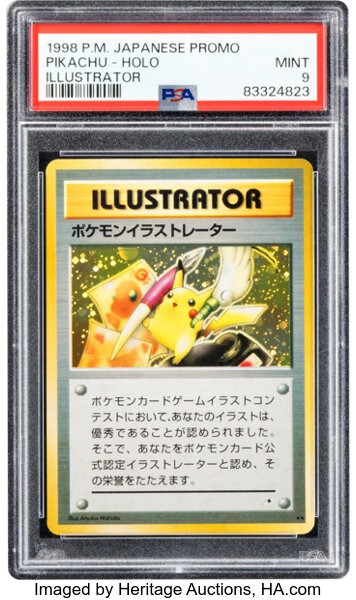
The September card was not a “better 9” on the PSA label. It carried a Mike Baker Authenticated Gold Diamond sticker, and Heritage said it was the only PSA 9 Illustrator with that designation. Heritage’s Jesus Garcia told Collectibles News the sticker effectively signals a card MBA views as worthy of roughly a 9.5. That is the same split we saw with the 1952 Topps Mickey Mantle, where an MBA Silver PSA 8 brought about double the plain PSA 8s. Stickered copies are real sales, but they are a separate lane from plain copies with the same grade.
The label gap: a PSA 9 and a CGC 9, one day apart
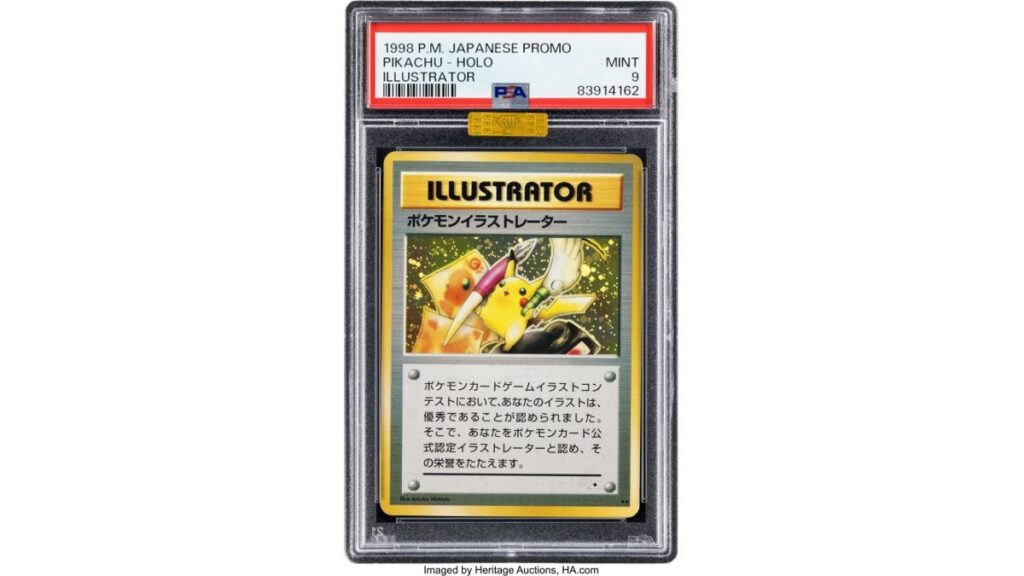
One day after the $5 million Heritage result, Goldin sold a CGC 9 Illustrator for $2,806,271, a $2,300,222 winning bid plus a 22% buyer’s premium (Pallet.Club). The Pack Report put the gap at 78% and argued that at seven figures the bidder pool is small and prices off PSA’s census. Pokeforecast made the opposite caution: with the MBA sticker on the PSA copy and so few sales, there is not enough liquidity to read a clean PSA-vs-CGC premium from two lots. Both points lead to the same practical rule. If you own a non-PSA Illustrator, do not price it off PSA results.
How liquid is a Pikachu Illustrator?
By trophy-card standards, 2026 was busy. Folio counts 12 copies sold at public auctions it could confirm this year, about $34.0 million in total, from $344,040 for a PSA 5 in May to the PSA 10 record. Spread that across every grade and every grader, though, and any one lane sees only a few public sales a year. Outside the Gold Diamond copy, the PSA 9 had two public auction results in 2026, March and October, roughly $1.8 million apart.
Older prints show how fast the reference points move. Folio’s ledger has PSA 9s at $54,970 in November 2016, $840,000 in June 2022, and $625,000 in August 2025 before 2026’s run. Folio also notes that PSA’s own price guide, read November 9, 2026, still showed $840,000 for a PSA 9, well below every 2026 PSA 9 sale. Guides lag on a card that trades this rarely.
A practical framework for a Pikachu Illustrator
- Ignore the PSA 10 for pricing. It is a population of one sold with a necklace. It is a ceiling, not a comp.
- Separate stickered and plain copies. The $5,000,000 MBA Gold Diamond PSA 9 and the $1,406,250 plain PSA 9 are different lanes. Average them and you mislead yourself either way.
- Compare within the same grader. A CGC 9 sold for $2,806,271 the day after a PSA 9 sold for $5,000,000. Use same-label, dated, lot-linked sales.
- Read the pop report as an upper bound. 59 PSA entries against 39 awarded cards means duplicates and crossovers. Supply is thinner than the rows suggest, and so is the buyer pool.
- Work net of fees and time. Reported prices include buyer’s premium: 24% on the Goldin PSA 10 and 22% on the CGC 9. A consignor’s proceeds start from the hammer, less any seller fee. With a few public sales per grade each year, plan your exit in auction cycles, not days. Our card grading break-even example walks through the same net-of-fees math at everyday prices.
The bottom line
The Pikachu Illustrator is the most expensive Pokémon card ever auctioned, but its record describes one pop-1 slab, not the card. The tradable market is the 15 PSA 9s and the grades below them, and in 2026 even that tier ran from $1,406,250 to $5,000,000 depending on stickers, label and timing. Price any copy from same-grade, same-grader, plain-versus-stickered sales, and expect to wait for the next comp.