Drop Week Liquidity: Sealed vs Singles Discipline
This week’s table is crowded: MTG Reality Fracture prerelease through October 1 (tabletop October 2), Riftbound: Radiance previews into October 9 (wide release October 23), and ongoing Pokémon sealed reprint / shortage dynamics. Capital that chases every sealed box will not also fund every PSA submission or every Showcase chase.
Here is a sealed-vs-singles discipline pass — liquidity-first, citation-first.
When sealed wins the liquidity argument
- Near-term play demand — Prerelease/Pre-Rift/draft nights create local exits for Play-style sealed.
- Intact product identity — Easier to list one SKU than twenty singles with condition fights.
- You will open anyway — Entertainment basis removes the need for secondary “moon” math.
When singles win
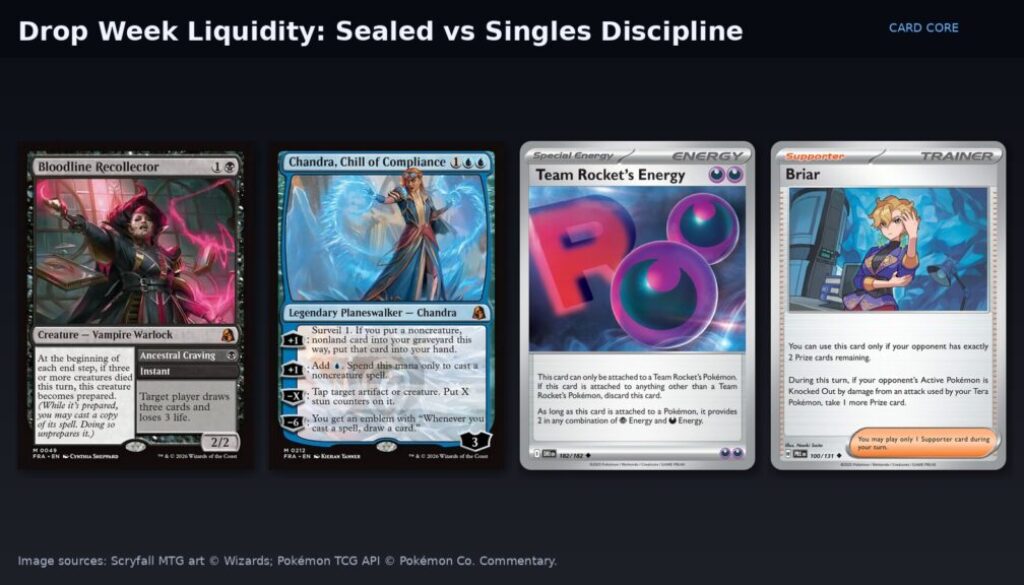
- Known chase after official quant — e.g., Wizards’ 500 serialized Bloodline Recollectors (see Reality Fracture checklist) or Riot’s <0.025% Ultimate Rare rate (see Radiance checklist) — still wait for completed sales before sizing.
- Format staples — Recurring tournament/Commander demand beats sealed box variance.
- Reprint-threatened sealed — When publishers state max-capacity printing (Pokémon sealed framework), singles with durable demand can be the cleaner inventory.
Drop-week rules of thumb
- Cap sealed exposure at what you can move through one primary exit in 30 days.
- Do not grade into a multi-million backlog unless your own comps clear friction (see PSA Standard math).
- Do not treat platform vault FMVs as sealed comps (Packed).
- Write the thesis and the exit on the same note — or do not buy.
Image credit: collage mixes Scryfall MTG art (© Wizards) and Pokémon TCG API images (© Pokémon Co.). Commentary use.
Bottom line
Drop weeks punish FOMO sealed stacks and reward collectors who already know whether they are buying play fuel, chase paper, or speculative cardboard. Pick one per purchase.