Fanatics Collect Unpaid Bids: A Comp Checklist
Fanatics Collect unpaid bids are the biggest pricing trap in the graded Pokémon TCG market right now. Since October 14, 2026, Fanatics Collect requires every bidder to keep a credit card on file, but its own payment policy only auto-charges that card on invoices of $10,000 or less. Above $10,000, a winner who never pays gets a restricted account, not a charge. So for six- and seven-figure slabs, a hammer price is still just a bid until it settles. Before you price a card off a headline sale, confirm it was paid.
This guide walks through what changed, what the first auctions under the new rule showed, and a short checklist for telling a real comp from a print nobody paid for. For more market-structure coverage, see the Card Core Market News archive.
What Fanatics Collect changed on October 14
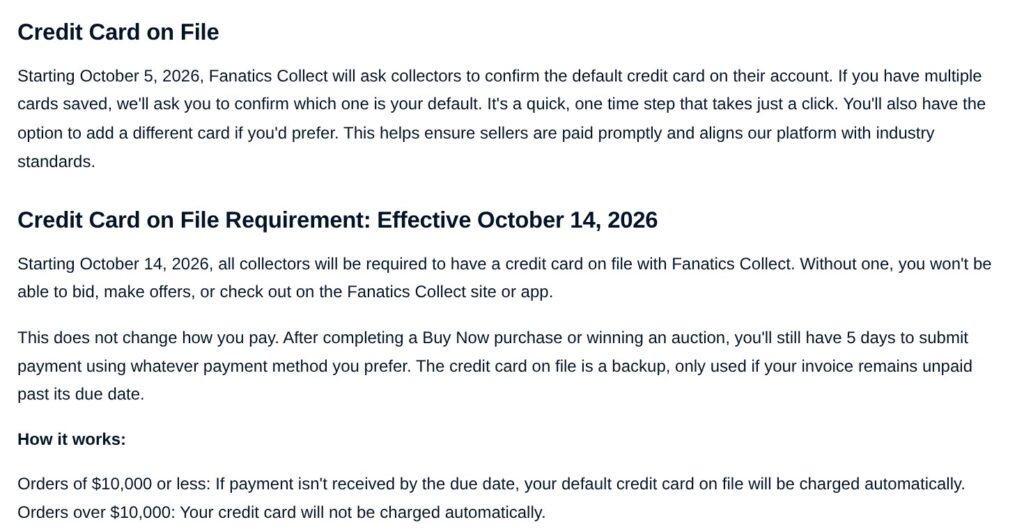
Fanatics Collect first asked collectors to confirm a default card starting October 5, then made it mandatory on October 14: without a card on file, you can’t bid, make offers, or check out on the site or app, according to its payment methods page. The card is described as a backup. Winners still get five days from the invoice to pay by any method, and the card is only touched if the invoice goes unpaid.
The important detail is the cap:
- Orders of $10,000 or less: the default card is charged automatically if payment is late.
- Orders over $10,000: the card is never auto-charged. If a Weekly Auction or Buy Now invoice over $10,000 isn’t paid within five days, the account is restricted.
- A declined card puts the invoice into default and restricts the account.
Fanatics Collect’s FAQ adds that when a buyer doesn’t pay, it does not list the price in its Sales History tool and relists the card, a step it says “ensures that comps reflect actual sales.” The same FAQ says bidders who place bids they don’t intend to honor are permanently blocked.
Why the rule arrived: weeks of unpaid six-figure closes
The rule followed a run of Pokémon closes that looked nothing like recent sales. TCGCharts’ October 16 Market Pulse reported that Fanatics Collect’s October 11 weekly auction closed with $30.6 million bid across 12,346 lots. By that Friday, buyers had paid for 7,665 lots, 62% of the lots but only $5.3 million, or 17% of the money. Of the 55 lots above $100,000, five had been paid. TCGCharts now holds any Fanatics Collect lot that clears at more than three times the card’s recent price out of its data until it is paid.
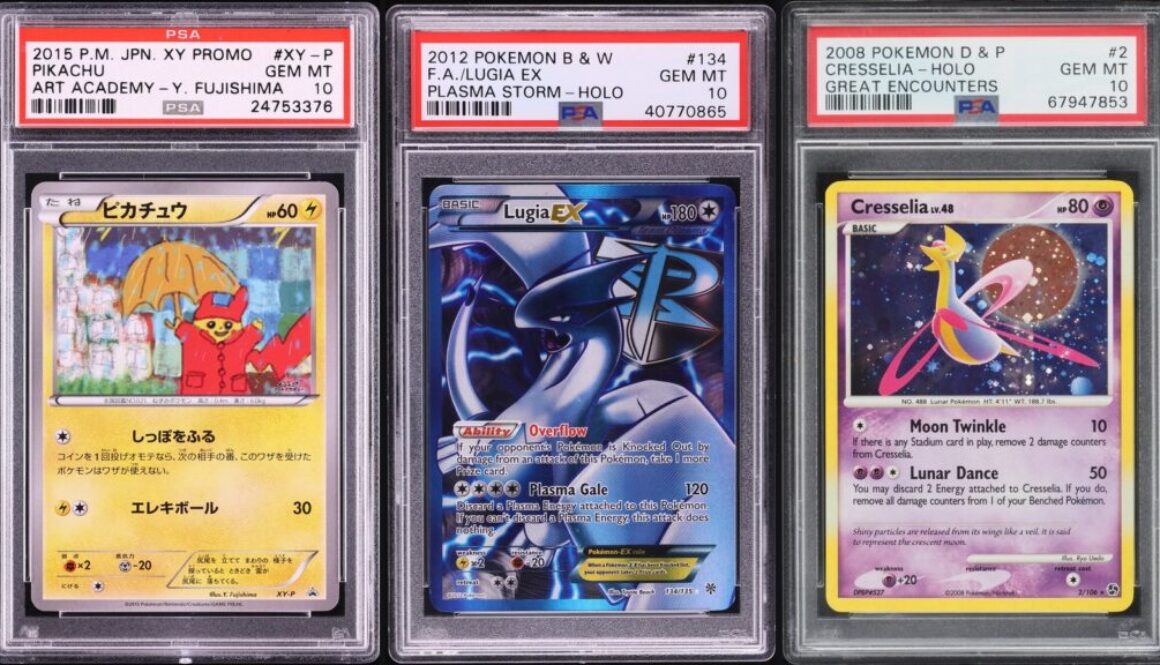
Chase Society, which reads the payment flag in Fanatics Collect’s public sales feed, has been tracking the same nights. Its running report said in an October 20 update that among October 4 lots above $100,000, 24 read paid, 9 unpaid and 17 had been deleted from the feed, with 53 deletions counted since October 8. The $960,000 Great Encounters Cresselia and the $840,000 Southern Islands Mew from that night were still listed as unpaid. The same report says other PSA 10 Cresselias sold on eBay between May and August for $2,550 to $4,800.
Two relisted lots give a rare look at what happens when a print fails. Chase Society reported that an Entei Gold Star deleted after a $40,800 close came back in the October 18 auction at $24,000, and a FireRed & LeafGreen Pikachu went from $48,000 to $19,800. The second number is the one that got paid.
The $8.4 million Pikachu: sold, paid, or cancelled?
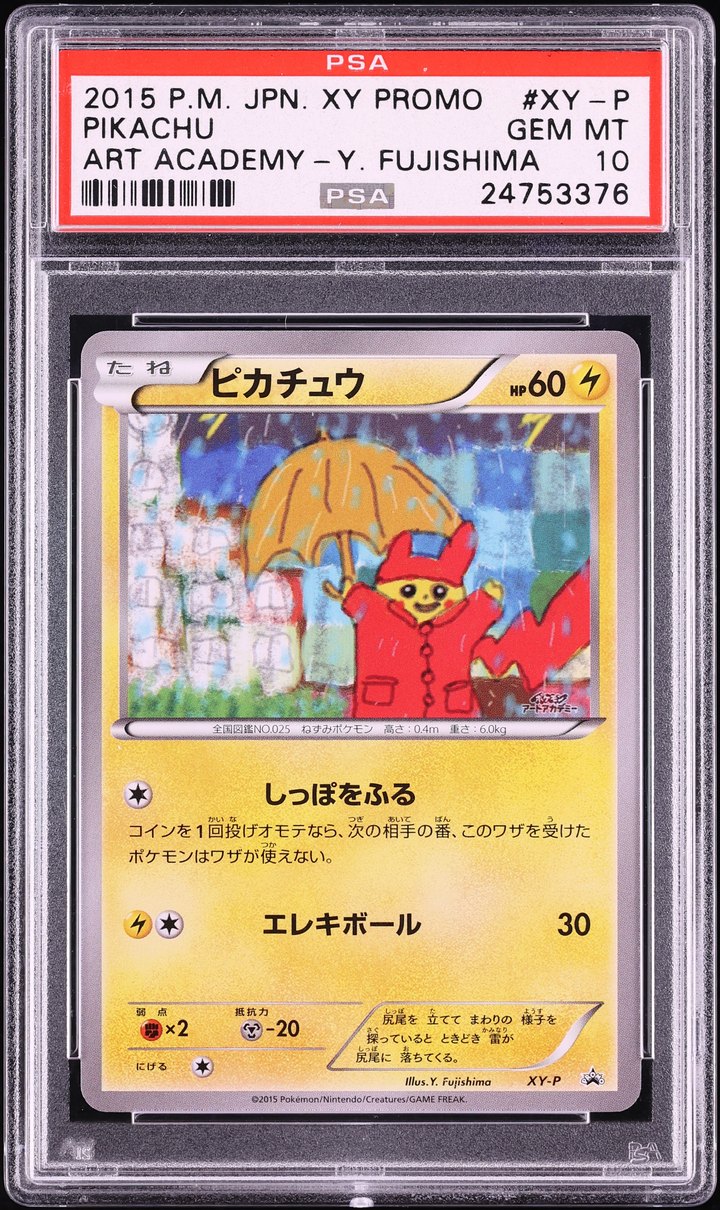
The 2015 Japanese Art Academy “Raincoat” Pikachu by Y. Fujishima, PSA 10 cert 24753376, closed at $8.4 million on 64 bids in the September 27 weekly auction. Kotaku called the price “inexplicable” at the time, noting a PSA 10 had sold for $156,250 at Heritage in June and that PSA lists 57 copies in Gem Mint 10.
Three weeks later, the record still disagrees with itself. When we opened the public lot page on October 21, it still showed “Sold” and $8,400,000, alongside “This item is not available at the moment,” while the page’s embedded data carried a cancelled status. Chase Society reports the sales feed removed the lot on October 14 and restored it flagged paid on October 15. RippingPatrol has withdrawn the result from its completed-sale ledger. Nobody outside Fanatics Collect has shown whether money changed hands, and Chase Society reported that Fanatics had not responded to its questions about the lot.
Why it matters even if you’ll never bid $8 million: according to Chase Society, the print reached price trackers, collection apps and PSA‘s certificate lookup as a sale while it read unpaid. A separate PSA 10 of the same card sold at Goldin on October 11 for $1,037,000, per TCGCharts. That one is a real number, but it was bid while the $8.4 million headline was circulating, and no correction to the Fanatics row can reach it.
Did the first auction under the rule look different?
Partly. Chase Society counted 39 lots above $100,000 in the October 18 weekly auction, the first under the card-on-file rule, against 50 and 55 in the two weeks before. That’s fewer extreme closes, but it isn’t proof the problem is gone, and the October 18 invoices were still inside their five-day payment window as of October 21.
The cap explains why caution still applies. A card on file closes the gap for a $500 slab. It does nothing automatic for a $660,000 one. Compare Goldin, whose FAQ says bidders start with a $10,000 limit and are pre-screened before bidding higher. Fanatics Collect’s new rule leans on account restrictions after the fact rather than a spending limit before the bid.
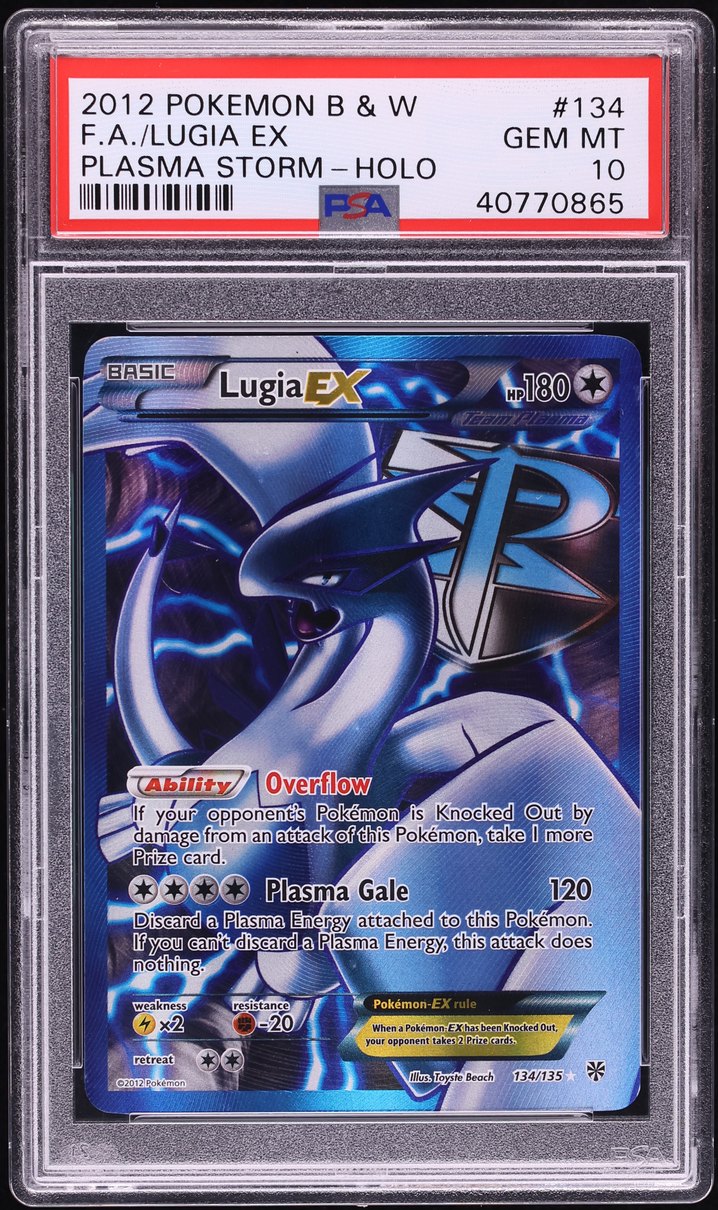
The Plasma Storm full art Lugia EX shows the risk. This PSA 10, one of 21 according to its lot page, closed at $660,000 in mid-October. Wargamer reported bids had passed $10 million at one point and that “it seems like there were many bogus bids,” while noting there is no evidence of deliberate manipulation. Whether or not that close settles, one print on a 21-copy population isn’t a market price.
How to check a comp before you pay off it
If you’re buying, selling, or insuring a graded card this fall, run any headline number through these checks first:
- Wait out the payment window. Fanatics Collect gives weekly-auction winners five days to pay and Premier winners ten, per its FAQ. A close younger than that is a bid, not a sale.
- Look for the paid version. Fanatics Collect says unpaid prices are removed from its Sales History tool. If a close disappears or the lot gets relisted, treat the original number as void.
- Compare to the last three paid sales. A Cresselia at $960,000 against $2,550–$4,800 eBay sales isn’t a new level. It’s a question.
- Check the population. When only a few dozen PSA 10s exist, one determined buyer can set a number the next copy never sees.
- Be wary of tools that carry every close. Price trackers and collection apps often take venue results at face value. If a value jumped on one print, find that print and check its status.
- Weight the venue’s checks. A pre-screened bid limit (Goldin) or an auto-charge (Fanatics Collect up to $10,000) means more than a hammer price with no financial check behind it.
The same discipline applies beyond Pokémon. Our Black Lotus liquidity breakdown makes the same point at the top of Magic: a record sale and the price you can actually get are different numbers. For the grading side of the equation, see how PSA 10 premiums held while raw prices softened in our Pokémon PSA 10 vs raw analysis, and how the grading business itself is changing in our grading consolidation report.
The takeaway
The credit card on file rule is a real fix for low-dollar non-payment and a step in the right direction. It doesn’t fix the part of the market making headlines, where a single unpaid close can lift the value of every copy of a card for weeks. Until a lot reads paid and stays that way, price your cards off settled sales, not hammer prices. More checklists like this live in the Card Core Collector Guides.
Sources: Fanatics Collect payment methods, Fanatics Collect FAQ, Fanatics Collect Sales History, Art Academy Pikachu lot, Lugia EX lot, Chase Society, TCGCharts, Kotaku, Wargamer, RippingPatrol, Goldin FAQ. Figures are as reported on the dates noted and may change as payment flags update.