1986 Fleer Michael Jordan: Liquidity by Grade
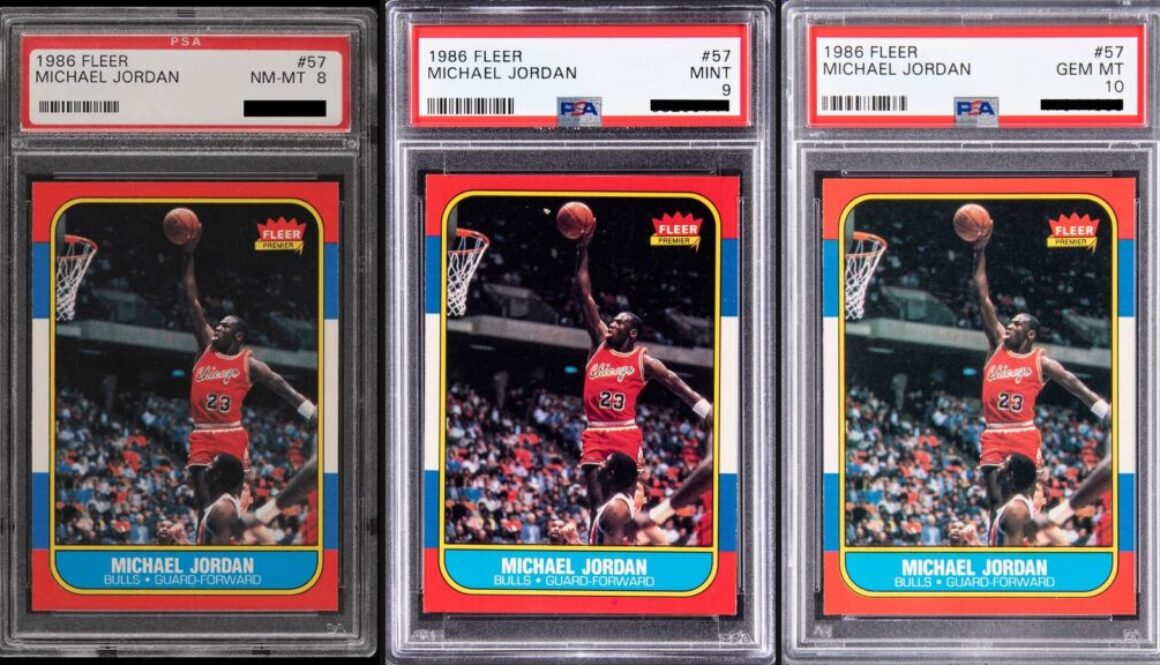
The 1986 Fleer Michael Jordan #57 is one of the easiest landmark cards to sell, but how easy depends on the grade. In the 90 days to October 27, 2026, Card Ladder logged 131 sales of the PSA 8, 57 of the PSA 9, and 7 of the PSA 10. Average prices were about $18,000, $48,500, and $396,000. Supply is a separate problem. PSA’s 2025 Fraud Report says 821 of the 3,285 copies of this card submitted to PSA in 2025 were counterfeit, or 25.0%. Liquidity is real, but only for a correctly identified card in a slab you can verify.
This card joins our liquidity series, which also covers the 1989 Upper Deck Griffey and Black Lotus. If you are deciding whether to grade a card yourself, our 2026 guide to PSA, SGC, and BGS covers the costs. You can find more frameworks like this in Collector Guides and Market News.
Why the 1986 Fleer Michael Jordan is basketball’s reference card
Fleer signed a deal with the NBA for 1986-87 to print 132 cards and 11 stickers. The set came out in September 1986. Each 40-cent pack held 12 cards, one sticker, and a stick of gum, according to Fanatics Collect’s guide to the card. Jordan averaged 37.1 points per game that season, the first of seven straight scoring titles listed in his NBA.com legends profile. The Fleer brand now belongs to Upper Deck, which bought it in 2005 for $6.1 million (ICv2).
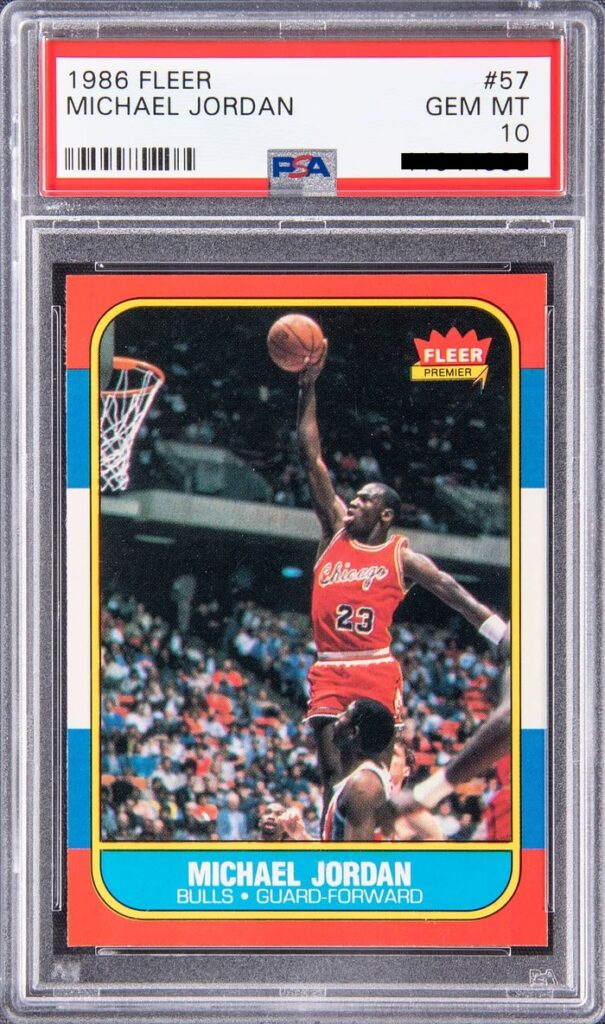
For a buyer, the important fact is how many copies exist in graded form. Fanatics Collect’s September 2026 lot description said PSA had assessed more than 31,200 copies of #57, and only about 1.1% had earned a PSA 10. Card Ladder’s PSA 10 page shows a population of 335. That is a deep, active market, but most of the supply sits below Gem Mint.
The grade ladder: where the sales actually happen
Card Ladder tracks completed sales for each grade. These are the numbers for the 90-day window from July 27 to October 27, 2026, checked on October 27:
| 1986 Fleer #57 Jordan | PSA population | Sales in 90 days | Average sale | Low to high |
|---|---|---|---|---|
| PSA 8 | 9,442 | 131 | $17,960 | $14,640 to $23,400 |
| PSA 9 | 3,078 | 57 | $48,500 | $40,260 to $55,600 |
| PSA 10 | 335 | 7 | $395,920 | $381,560 to $414,800 |
Three things stand out in that table.
- Each step up in grade costs more than the last. Going from PSA 8 to PSA 9 multiplied the average by about 2.7 times. Going from PSA 9 to PSA 10 multiplied it by about 8.2 times (our arithmetic from Card Ladder’s averages).
- How often a grade sells sets how fast you can exit. 131 PSA 8 sales in about 92 days is roughly one every 17 hours. Seven PSA 10 sales is about one every 13 days. A PSA 8 seller can check last week’s sales. A PSA 10 seller is often waiting for the next major auction.
- Mid grades show price changes faster. Card Ladder compares the first and latest sale in the window. By that measure, the PSA 8 fell 20.6% and the PSA 9 fell 14.9%, while the PSA 10 rose 3.3%. Mid grades trade so often that their prices respond right away. The PSA 10 price changes in a few large, separate jumps.
The same PSA 10, twice: what a headline price hides
Fanatics Collect sold a PSA 10 #57 with cert 45855746 for $384,000, including buyer’s premium, on July 24, 2026 (18 bids). It sold the same cert again for $384,000 on September 25, 2026 (21 bids). The slab is now listed on Fanatics Collect’s Buy Now page with a $408,000 “guide price.” That figure is an asking reference, not a sale.
Two identical results look like a stable market. For the July buyer who sold in September, though, the two prices are not the same number. They paid $384,000 including buyer’s premium. When they sold, the $384,000 total included the next buyer’s premium, and seller fees came out of what was left. They ended up with less than they paid. Some of a PSA 10’s sales may be one card being resold. The count of sales and the count of different cards are not always the same.
Goldin’s October result shows the same buyer’s-premium gap. A different PSA 10 (Goldin lot) realized $396,500 in the 2026 Monthly Sports Elite #9 auction, which closed the night of October 17. What The Slab notes that this matched Goldin’s previous high for the grade, set June 29, 2026. Pop Won lists Goldin’s buyer’s premium at 22%, which means a hammer price of about $325,000 before the premium. The seller’s net depends on their consignment terms, which are private.
One in four submitted to PSA was fake
PSA’s 2025 Fraud Report (PDF) lists the 1986 Fleer Michael Jordan #57 among its highest counterfeit rates: 3,285 submitted and 821 counterfeit, or 25.0%. The 1984 Star Jordan #101 was higher, at 96 of 360 (26.7%). These numbers only cover what reached PSA’s grading room. They do not tell you how many fakes are sold raw and never submitted.
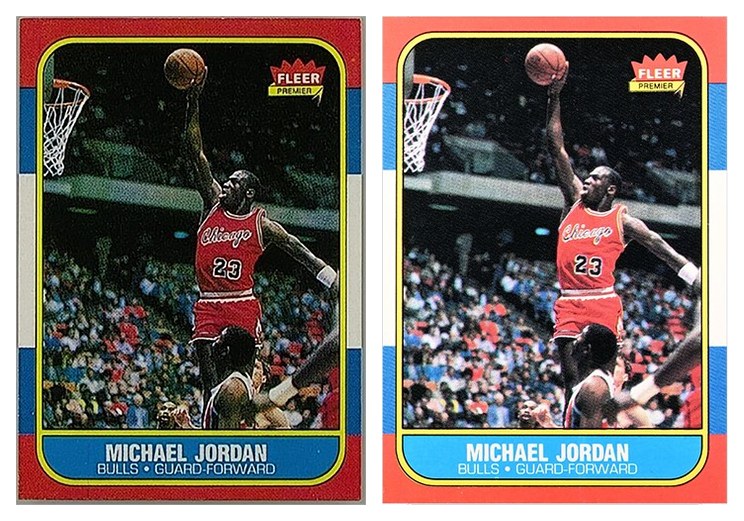
CGC’s January 2026 counterfeit alert lists the giveaways it found on a recent submission. The Fleer Premier logo was pixelated instead of crisp. The name plate was soft. On the back, the ® and © marks were blurry, and the NBPA basketball was missing the lines on the ball. The color and card stock were also off, and CGC says infrared light sources confirmed the differences. BBC Emporium’s counterfeit guide adds other checks, including the gold-toned arrow in the logo, the period in the “27.2” scoring average on the back, and the shade of the lower border.
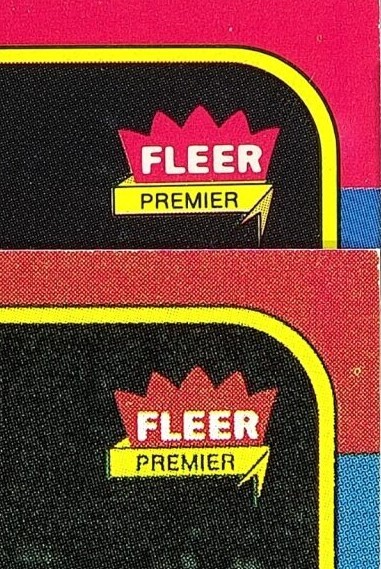
A slab only reduces the risk. BBC Emporium documents older PSA holders that were cracked open, given a different card, and resealed with a homemade label carrying a real cert number. In that case, a database lookup comes back clean. Its tells include frosting along the welded edges, “mushroomed” security nubs, and label fonts that don’t match the label generation. In its fraud report, PSA advises checking cert numbers in the PSA app and buying from reputable sellers or established marketplaces. It also says to compare against known authentic examples and to question deals far below market value. On eBay, PSA inspects eligible items over $250 through the Authenticity Guarantee before delivery.
The 1986 Fleer Jordan Sticker #8: cheaper, not the same
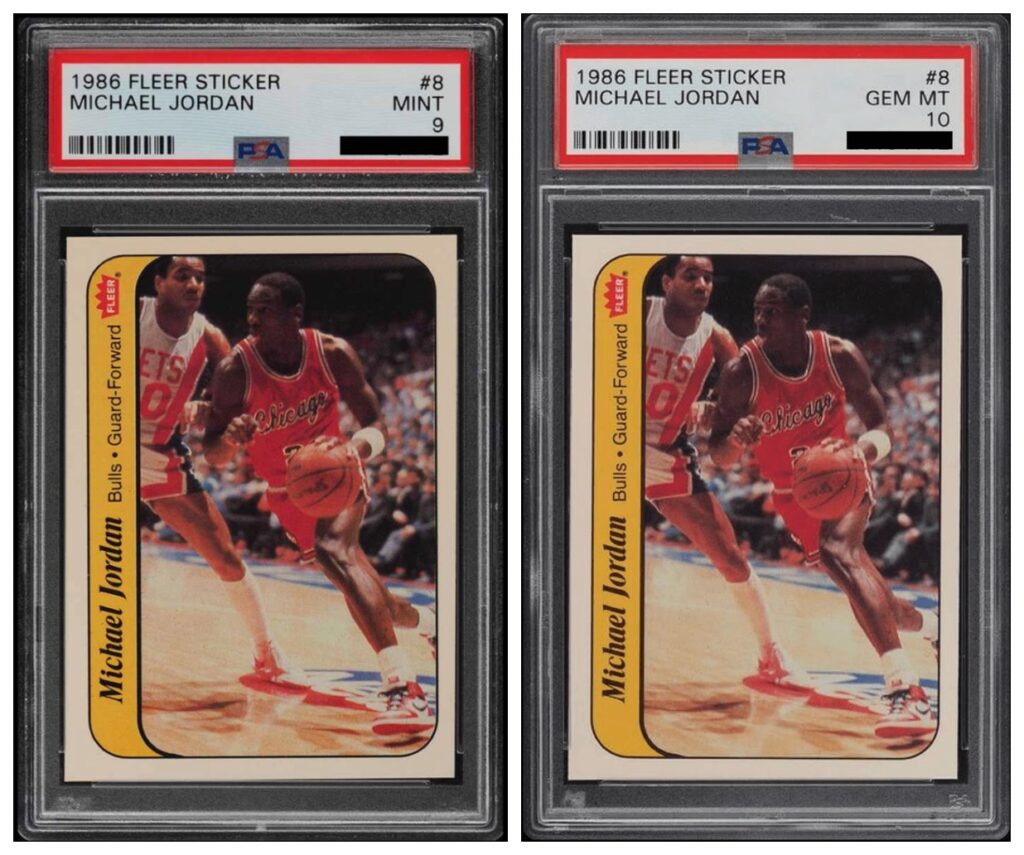
Every 1986-87 Fleer pack included a sticker, and Jordan is #8 in the 11-sticker set. It costs much less than the #57, but it is a separate market with fewer buyers:
| 1986 Fleer Sticker #8 Jordan | PSA population | Sales in 90 days | Average sale | Low to high |
|---|---|---|---|---|
| PSA 9 | 2,190 | 53 | $10,420 | $8,235 to $14,500 |
| PSA 10 | 128 | 4 | $103,090 | $88,450 to $114,000 |
A PSA 9 sticker averaged about a fifth of a PSA 9 #57 and sold almost as often (53 sales against 57). That makes it a reasonable way to own a 1986 Fleer Jordan for less. The PSA 10 sticker is different. With four sales averaging about $103,000, it carried a thin, volatile market, and its latest sale ($88,450 on October 23) was 22.4% below the first sale in the window ($114,000), per Card Ladder. Collectors generally prefer cardboard to stickers, Fanatics Collect notes, which is a big reason the #57 is the card the market treats as the rookie.
A practical framework for buying or selling a 1986 Fleer Jordan
- Pick your grade before you pick a copy. PSA 8 and PSA 9 are the liquid tiers, with dozens to more than a hundred public sales per quarter. PSA 10 is a trophy market with a handful. Sticker #8 is a separate market.
- Price from completed sales, not asking prices. Use same-grade, same-grader sales from the last 90 days. A guide price or a Buy Now listing is not a sale. Look for designation stickers or “high-end” notes in a listing, too. Card Ladder points out that some PSA 9 price spikes came from slabs carrying PWCC high-end designations.
- Verify the slab, then verify the card. Look up the cert, compare the label to the right PSA label generation, check the holder edges for frosting, and check the card against the known tells above. Be most careful with older holders.
- Buy where authentication is part of the process. That means established auction houses, dealers with a track record, or eBay listings covered by the Authenticity Guarantee. A raw Jordan priced well below graded sales is usually below market for a reason.
- Work out your net before you sell. Buyer’s premium on the way in, buyer’s premium and seller fees on the way out, plus insured shipping. As the July-to-September Fanatics example shows, selling at the price you paid can still leave you behind.
The bottom line
The 1986 Fleer Michael Jordan deserves its reputation for liquidity. More than 190 PSA 8, 9, and 10 copies sold publicly in one quarter, and few cards from any era can say that. Most of that liquidity is in PSA 8 and 9, though, and the PSA 10 tier is a handful of large sales that can include the same slab twice. Counterfeits are also common: PSA reports one in four submissions in 2025 was fake. Buy the grade you can resell, verify both the slab and the card, and judge any deal by what you’d net after fees, not by the headline price.